



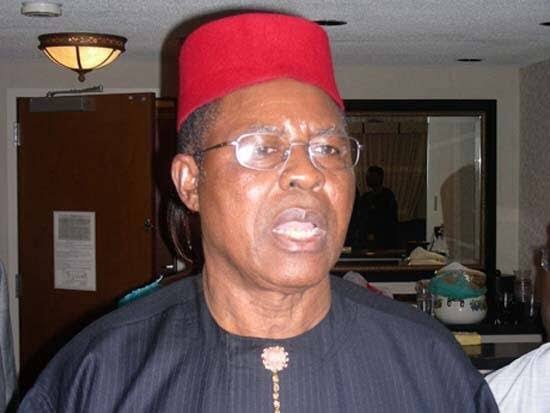
In August 1985, Commodore Okoh Ebitu Ukiwe was appointed Chief of General Staff, following a military coup that brought General Ibrahim Badamasi Babangida to power.
His ascent to such a pivotal position was remarkable, especially considering his past as a naval officer who had served on the Biafran side during the Nigerian Civil War. Ukiwe’s journey, from a promising naval cadet to a key figure in multiple military administrations, offers a unique window into the complex, often contradictory, systems that have shaped Nigeria’s post-independence history.
From colonial navy to Biafran command
Born on October 26, 1940, in Abiriba, in what is now Abia State, Okoh Ebitu Ukiwe came from a respected royal family. His father, Chief Ebitu Ukiwe, was a traditional ruler and head of the Old Bende Division Local Government Appeal Court. His mother, Chief (Mrs.) Aruodo Ukiwe, was a traditional ruler among the women of Agboji Abiriba.
Ukiwe’s early education spanned the Church of Scotland Mission School and Enuda College, culminating in studies in Physics and Mathematics for the Higher School Certificate. In 1960, the year Nigeria gained independence, he embarked on a military career, joining the Royal Nigerian Navy as an officer cadet.
After preliminary military training in Kaduna, he proceeded to the esteemed Britannia Royal Naval College in Dartmouth, England, from 1961 to 1964. He was commissioned as a Sub-Lieutenant in 1964 and received specialized training in navigation, gunnery, minesweeping, and anti-submarine warfare, serving aboard British naval vessels before his return to Nigeria.
But the young officer’s conventional career trajectory was soon disrupted by Nigeria’s deepening political crisis. The year 1966 brought two military coups and widespread ethnic violence, particularly targeting Eastern Nigerians in the North, fracturing the nation’s military and setting the stage for civil war.
As tensions escalated, Ukiwe, a federal naval officer, withdrew to the Eastern Region. When Lieutenant-Colonel Chukwuemeka Odumegwu Ojukwu declared the independent Republic of Biafra on May 30, 1967, Ukiwe made a fateful decision to serve on the Biafran side.
During the Nigerian Civil War, which began in July 1967, Ukiwe commanded Biafran gunboats, including PC 101, PC 202, and PC 203. He directed naval operations in the strategic creeks and coastal waters around Port Harcourt, playing a direct role in the conflict.
The war concluded in January 1970 with Biafra’s surrender, leaving many Biafran military personnel uncertain about their future. But Ukiwe’s story would take an unexpected turn.
Rebuilding a naval career post-civil war
In a powerful demonstration of post-war reconciliation, Ebitu Ukiwe was reabsorbed into the Nigerian Navy in January 1972. This was a significant development, as not all former Biafran military personnel shared the same fortune; many lost seniority or found their careers permanently stalled.
Ukiwe, however, meticulously rebuilt his professional standing. He served as a training officer at NNS Quorra, held executive responsibilities at the Apapa naval base NNS BEECROFT, and commanded various Nigerian naval vessels, including NNS Lokoja in 1973.
His leadership extended to commanding shore-based establishments like NNS ANANSA in Calabar and NNS BEECROFT in Lagos. By the mid-1970s, he was leading the Nigerian Navy Flotilla, commanding several warships.
His advancement continued with further training abroad, including the United States Naval War College in Newport, Rhode Island, and an appointment as the first Director of the newly established Naval Faculty at the Command and Staff College in Jaji. By 1984, he had risen to Flag Officer Commanding the Western Naval Command, one of the Navy’s most critical postings.
Ukiwe’s journey stands as a notable example of a former Biafran officer not just returning to service, but ascending to senior leadership within the unified Nigerian military establishment. This rise reflected a broader national effort toward reconciliation and reintegration, much like how a teacher’s journey could shape educational systems in a nascent nation.
From naval commander to governing states
Ukiwe’s career soon transcended purely naval duties, moving into military administration. He became a member of the Supreme Military Council (SMC) between 1975 and 1977, under the governments of General Murtala Muhammed and Lieutenant-General Olusegun Obasanjo.
In December 1977, he was appointed Military Governor of Niger State, placing a naval officer in charge of one of Nigeria’s newly created states during a crucial transition phase back to civilian rule. His tenure in Niger State lasted until July 1978.
He was then transferred to Lagos State, Nigeria’s federal capital and commercial heart, where he served as Military Governor until October 1979. In this role, he oversaw the handover of authority to Alhaji Lateef Jakande, the newly elected civilian governor.
His time in charge of these critical regions offered a perspective on the varying developmental challenges and opportunities across Nigeria’s diverse landscape, similar to the transformation of cities like Kano.
After the return to civilian government in 1979, Ukiwe resumed his naval career. But Nigeria’s Second Republic proved short-lived, lasting only four years before another military intervention.
Return to the centre of military power
On December 31, 1983, a military coup overthrew the civilian government of President Shehu Shagari, bringing Major-General Muhammadu Buhari to power. Ukiwe again found himself a member of the Supreme Military Council, holding a command in the Navy as the nation navigated another period of military rule.
However, Buhari’s government was itself overthrown on August 27, 1985, by Major-General Ibrahim Badamasi Babangida, who adopted the title of Military President. It was under this new administration that Ukiwe reached the pinnacle of his career in national office.
General Babangida appointed Ukiwe as Chief of General Staff in August 1985. This made him the first to hold the newly styled title and officially recognized him as the number two official in the government. His role was critical, often holding fort when the Head of State was abroad or indisposed, signifying immense trust and responsibility within the military hierarchy.
This period marked the highest point of Ukiwe’s public service, consolidating his status as a key architect of national policy. Yet, this high-profile tenure would also be relatively brief, shaped by a pivotal national debate.
The OIC controversy and a system’s limits
The most defining controversy of Ebitu Ukiwe’s time as Chief of General Staff revolved around Nigeria’s relationship with the Organisation of Islamic Conference (OIC), now known as the Organisation of Islamic Cooperation. Although Nigeria had informal contacts with the body prior to 1986, the Babangida administration’s decision to pursue full membership ignited an intense national debate.
Nigeria officially became a full member in 1986. Opponents, especially Christian organizations, viewed the decision as fundamentally altering Nigeria’s secular character, given its large Christian and Muslim populations. Supporters, on the other hand, argued for the economic and diplomatic benefits of membership, insisting it wouldn’t transform Nigeria into an Islamic state.
For Ukiwe, the controversy wasn’t just about the membership itself, but about the opaque process through which such a significant decision was made. He later stated publicly that he had not been informed of the decision for Nigeria to join the OIC as a full member.
This public disagreement, coming from the government’s number two official, starkly exposed internal divisions within the Babangida administration. The principled stand taken by Ukiwe ultimately damaged his relationship with the government, becoming strongly associated with the end of his tenure.
Tensions within the military hierarchy, including questions of authority and seniority, further weakened Ukiwe’s position. These dynamics, alongside the OIC controversy, led to his removal from the post in October 1986.
Rear Admiral Augustus Aikhomu succeeded him and remained Babangida’s principal deputy for the remainder of the military president’s time in office. Ukiwe subsequently retired from the Nigerian Navy in January 1987, closing a significant chapter of his military career.
After the uniform: civilian life and democracy advocacy
Retirement from the Navy did not signal the end of Ukiwe’s involvement in national affairs. He transitioned into private business, engaging in consultancy work with interests spanning property, maritime services, and the petroleum industry.
More significantly, he cultivated a political legacy through initiatives aimed at fostering cooperation among Nigerian leaders from diverse regions. He was actively involved with the Council for Unity and Understanding, a political association that brought together prominent figures from the East, West, and Middle Belt during a period of intense debate about Nigeria’s federal structure.
The political crisis ignited by the annulment of the June 12, 1993, presidential election further drew Ukiwe into the pro-democracy struggle. The election, primarily contested by Moshood Kashimawo Olawale Abiola and Bashir Tofa, was controversially halted and annulled by the military government, triggering years of political turmoil.
Available results confirmed Abiola as the winner, a fact acknowledged by Babangida in his 2025 autobiography, A Journey in Service. This annulment spurred the formation and expansion of organizations like the National Democratic Coalition (NADECO), which demanded recognition of the June 12 mandate and an end to military rule.
Ukiwe became closely associated with NADECO and the broader movement challenging continued military government. This marked another compelling dimension to his public life: a man who had held senior positions in successive military regimes now stood alongside those advocating for democratic governance.
His retirement marked a shift towards shaping the nation outside of military structures, a path also taken by other influential Nigerians whose legacies continued to impact the country.
A final presidential bid and lasting questions
Even after Nigeria’s return to civilian rule in 1999, Ukiwe harbored aspirations for direct electoral politics. In 2006, he sought the presidential nomination of the Peoples Democratic Party (PDP) for the 2007 general election.
He entered a crowded field for the ruling party’s ticket, which ultimately went to Umaru Musa Yar’Adua, who secured the presidency in April 2007. Though his bid was unsuccessful, it represented a final, significant transition in a career defined by its varied chapters.
Okoh Ebitu Ukiwe moved from being a naval officer and wartime combatant to a military governor, then to the nation’s number two official during a military regime. His path then led him to become a democracy campaigner, and finally, a presidential aspirant in a civilian political party.
His remarkable life encompasses key themes of Nigeria’s post-independence experience: the struggle for unity, the challenges of military intervention, the complexities of national reconciliation after civil war, the intricacies of military governance, religious and constitutional debates, the fight for democratic ideals, and the enduring quest for stable civilian rule.
His story compels us to consider how individual choices, even at the highest levels, can both shape and challenge the very systems they inhabit, leaving behind questions about loyalty, principle, and national identity that resonate even today.
