




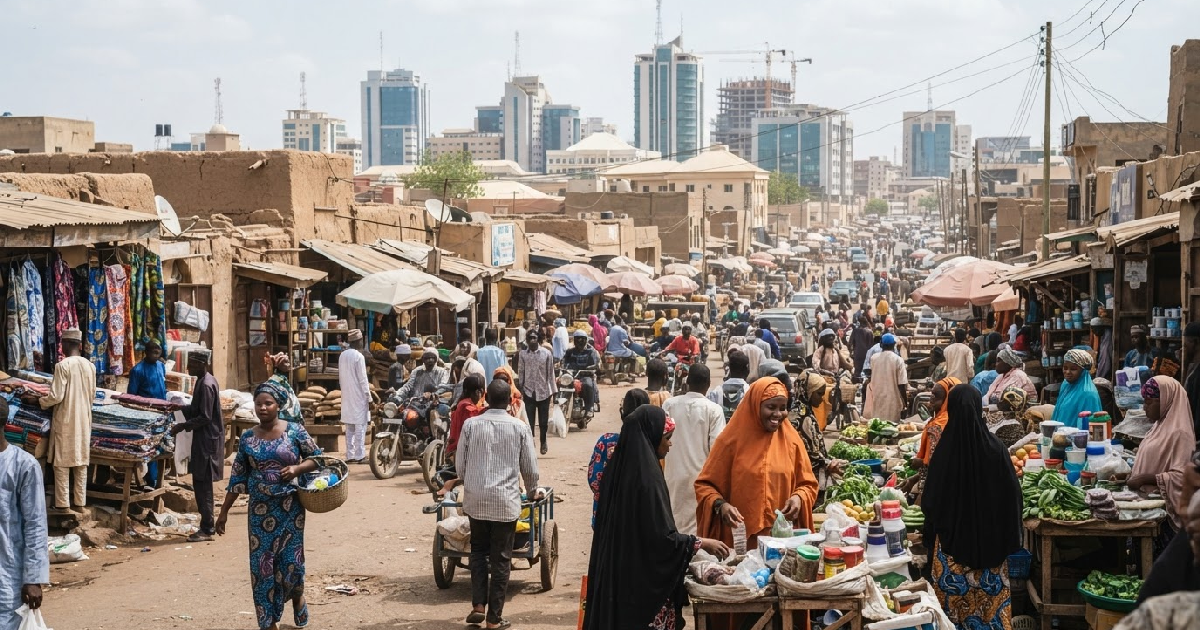
On Friday, August 8, 2026, a new demographic map of the world began to form, with the ancient city of Kano, Nigeria, unexpectedly etched among its largest urban centres. The World Population Review 2026 report revealed that Kano now hosts an estimated 17.5 million people, making it the 9th most populous city globally.
This surge in Kano’s numbers, a first-time entry into this elite global top 10, marks it as Nigeria’s most populous city, surpassing Lagos. It also stands as the only West African metropolis in this ranking, underscoring a profound moment for the region.
Kano’s historic ascent to a global megacity
For centuries, Kano has been a beacon of commerce, its markets drawing traders from across the Sahara and beyond. Now, it stands shoulder-to-shoulder with urban titans like Shanghai, Delhi, Kinshasa, and Beijing, a testament to its enduring magnetic pull.
The latest figures from the World Population Review 2026 report pinpoint Kano’s population at 17,510,247. This makes it Africa’s second-largest city, trailing only Kinshasa in the Democratic Republic of Congo, which boasts 21,852,144 residents and holds the title of the fastest-expanding megacity globally with an annual growth rate of 5.13 percent.
A five-fold surge in 35 years
Kano’s current population represents a staggering five-fold increase in just over three decades. Back in 1991, the city’s population stood at 3,005,222. By early 2026, the National Population Commission (NPC) estimated 16,253,549 residents, with the World Population Review now confirming the surge past 17.5 million.
The city’s annual growth rate currently hovers above 3.16 percent. If this pace continues, analysts project Kano’s population will surpass 20 million by 2030, solidifying its status as a global megacity. This trajectory has even pushed Kano past Lagos, long considered Nigeria’s largest urban centre, which now stands at an estimated 14.8 million people.
The forces driving Kano’s rapid growth
Kano’s demographic explosion isn’t an accident; it’s the culmination of several interconnected factors. High fertility rates in northern Nigeria play a significant role, contributing to a steady natural increase in births. This is compounded by improved health facilities, which have reduced infant and maternal mortality, allowing more children to survive and thrive.
But beyond natural increase, Kano has become a potent magnet for migration. In recent years, thousands of families fleeing persistent insecurity in the North-East and North-West, particularly from states like Borno, Yobe, Adamawa, Zamfara, Katsina, and Sokoto, have sought refuge within its relative stability.
The enduring pull of commerce and refuge
The city’s historical role as a commercial hub continues to draw people. Its sprawling markets—from the ancient Kurmi Market, established in the fifteenth century, to the vast Kantin Kwari textile market and Dawanau, one of Sub-Saharan Africa’s largest grain markets—offer livelihoods and opportunities. This economic gravitational pull, combined with the influx of displaced populations, has swelled Kano’s numbers dramatically.
Infrastructure development, including new roads and flyovers, has also intensified commercial activities, encouraging further immigration. Furthermore, the Kano State Government’s efforts in developing new layouts and converting residential areas to commercial use have broadened the urban footprint, absorbing surrounding communities and blurring the lines between city and rural life.
Educational and healthcare facilities, concentrated within Kano, also attract those seeking services unavailable in smaller towns. Access to better healthcare is a significant driver for internal migration across Nigeria.
Megacity challenges: A fragile success
Kano’s rapid expansion into the ranks of the world’s megacities presents a dual reality: immense opportunities twinned with daunting challenges. The city’s infrastructure, designed for a much smaller population, now struggles under the weight of 17.5 million people. Roads are often congested, public transport remains inadequate, and housing estates proliferate faster than effective regulation can manage.
The dream of urban opportunity for many new residents often collides with the daily reality of rising rents, overstretched services, and intense competition for resources. Hospitals and clinics are overwhelmed, and schools struggle to accommodate swelling enrolments, with classrooms often packed far beyond optimal capacity.
Even basic services like water supply and sanitation are under severe stress, raising public health concerns as informal settlements continue to expand.
Unemployment poses another critical threat. Dr. Abdussalam Muhammad Kani, an economist and lecturer at Sa’adatu Rimi College of Education Kano, points to an estimated four million unemployed people in Kano. This job deficit, particularly among the city’s large youth population, fuels frustration and can contribute to crime and social unrest.
Moreover, the integration of displaced persons from insecure regions adds complexity, creating additional pressure on scarce opportunities and increasing the risk of instability.
Environmental pressures are equally acute. The city’s sprawl into rural areas has led to deforestation, loss of farmland, and increased vulnerability to flooding. Waste management systems are struggling, leading to refuse accumulation in public spaces, while air pollution from vehicles and industries continues to worsen.
Experts weigh opportunities and looming burdens
Dr. Ibrahim Ado Kurawa, a Kano-based historian and independent researcher, suggests that while the population boom presents opportunities, inaction could lead to increased crime, social unrest, and further strained infrastructure. He argues that Nigeria’s economy tends to favor services over production, leaving manufacturing, agriculture, and energy sectors underdeveloped.
“Without electricity to power industries, Kano will struggle,” Dr. Kurawa warns, stressing that investment in these productive sectors is crucial to mitigate future risks. He advocates for the city to emulate other successful megacities by improving public infrastructure, waste management, transport systems, and education. Boosting industrial capacity often requires strategic financial instruments and government support.
Dr. Abdussalam Muhammad Kani echoes this sentiment, framing Kano’s rising population not as an inherent problem but as a challenge of productivity. He cites China’s success through massive investment in human capital as a model. Dr.
Kani recommends that the state government channel significant portions of its budget into education, health, agriculture, and security, alongside efforts to ensure a steady power supply to revive industries and create jobs.
Sociologist Dr. Moshood Isa from Kwara State University describes the development as a potential demographic dividend that could equally become a demographic burden if not managed effectively. He sees enormous economic opportunities in an expanded labor force and consumer market, which could attract domestic and foreign investors. But he also identifies the stark risks: unemployment, infrastructure deficits, environmental pressure, and insecurity.
Dr. Isa particularly highlights the security implications of a large, unemployed youth population, warning that a lack of economic opportunities makes them vulnerable to crime, political violence, and recruitment into criminal networks. The challenge, then, lies in transforming Kano’s population strength into productive human capital through targeted investment in jobs, education, and essential services.
Government’s multi-pronged approach to urban management
Recognising these pressures, the Kano State Government is working to address the city’s rapid growth. Mustapha Muhammad, Chief Press Secretary to the Governor, confirmed that population pressures were factored into the administration’s blueprint even before they took office. Health facilities have been a primary focus, with most primary health centres rehabilitated and about 10 general hospitals constructed across local government areas to meet increasing demand.
Muhammad also detailed increased budgetary allocations for education, leading to the construction of new schools and renovation of existing ones, along with the recruitment of more than 18,000 teachers. On housing, the governor has initiated the construction of over 400 houses, with 50 already underway, and is streamlining land allocation processes to help citizens access homes.
Beyond immediate projects, the Kano State Ministry of Land is developing a new Kano Masterplan 2025–2045. Murtala Shehu Umar, Director of Public Enlightenment at the ministry, explained that this plan aims to guide the city’s expansion, regulate property development, and address environmental challenges like flooding. Long-term infrastructure planning is vital for managing rapid urban growth, as seen in other Nigerian states.
Umar noted that previous attempts at long-term planning, like the 1963-1983 metropolitan development plan under the late Emir Abdullahi Bayero and a 2017 effort under former Governor Abdullahi Umar Ganduje, didn’t fully materialize. However, the current masterplan is reportedly far advanced and expected to be ready soon.
The concentrated pressure points in metropolitan Kano
The intensity of Kano’s population boom is most visible in its eight metropolitan Local Government Areas (LGAs). Data from the National Population Commission shows these councils — Dala, Fagge, Gwale, Kano Municipal, Kumbotso, Nassarawa, Tarauni, and Ungogo — together account for approximately 4.8 million people.
Nassarawa LGA, with an estimated 1,110,800 residents, and Dala LGA, with 779,900, exemplify the dense urban core where infrastructure and services face the greatest strain. These areas, home to crowded neighborhoods, highlight the urgent need for integrated planning and investment to ensure the city can sustain its growth.
Kano’s emergence as the world’s 9th most populous city is a defining moment, reflecting centuries of history as a commercial crossroads and the powerful contemporary forces of migration and natural increase. The question now for Nigeria is how this ancient city, now a modern megacity, will write its next chapter.
Will its growing millions become a powerful engine for national progress, or will the weight of unchecked expansion lead to new, profound challenges?
