




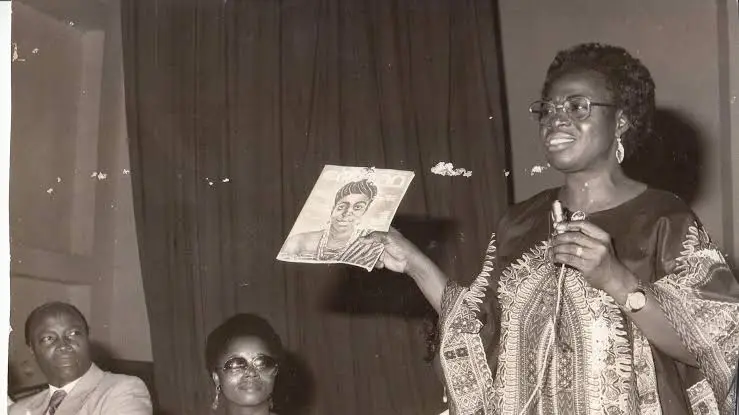
On April 3, 1968, Folayegbe Mosunmola Akintunde-Ighodalo stepped into a room at the Western Region Ministry of Home Affairs and Information in Ibadan, becoming Nigeria’s first female Permanent Secretary. This wasn’t just a personal triumph; it was a profound shift in how the young nation’s government operated.
Her appointment, during the tumultuous early years of the Nigerian Civil War, shattered a professional barrier that had long restricted women’s advancement. It demonstrated that even amidst national crisis, competence and dedication could redefine leadership in Nigeria’s public service.
Folayegbe Akintunde-Ighodalo’s Journey from Okeigbo to London
Folayegbe Akintunde-Ighodalo’s story began far from the corridors of power. Born Felicia Folayegbe Mosunmola Akintunde on December 17, 1923, in Okeigbo, a town in present-day Ondo State, she was the fourth child of Benjamin Olojomo Akintunde, a cocoa farmer, and Sarah Akintunde.
Even in colonial Nigeria, education proved her pathway to a wider world. In 1938, a scholarship opened the doors of Queen’s College, Lagos, one of the era’s most prestigious girls’ secondary schools. She excelled, passing the Cambridge Senior Certificate Examination in 1941.
Her initial career path led her into teaching. By 1943, she had completed her training at the United Missionary College, Ibadan, and soon after, she was teaching at Methodist Girls’ High School in Lagos. By 1946, her leadership qualities saw her appointed headmistress of CMS Girls Senior Primary School in Ile-Ife.
But these achievements were only the beginning. Akintunde-Ighodalo harbored a deeper ambition: a university education, specifically in Economics. This drive set her on a course that would take her across continents.
Activism and Intellect in a London Crucible
By the late 1940s, Folayegbe Akintunde-Ighodalo had made her way to Britain for further study. In 1949, with government support, she began studies associated with the Institute of Education, University of London, but her sights were set higher.
She soon moved beyond teacher training, enrolling at Regent Street Polytechnic to pursue an Economics degree, which the University of London ultimately conferred in June 1954. To fund her studies, she worked at the post office, illustrating the sheer determination behind her academic pursuits.
London offered more than just academic credentials; it was a hotbed of West African nationalist sentiment. Akintunde-Ighodalo plunged into this politically charged community, becoming an active member of the West African Students’ Union (WASU), an influential organisation founded in 1925.
Her leadership qualities shone through quickly. By 1953, she was elected WASU’s second female vice-president. That same year, she played a crucial role in founding the Nigerian Women’s League of Great Britain and Ireland, becoming its first president.
The League provided a vital platform for Nigerian women in Britain, fostering mutual support and contributing to crucial debates about women’s rights and Nigeria’s future. These activities brought her into contact with prominent Nigerian women activists like Margaret Ekpo and Comfort Tanimowo Ogunlesi during constitutional discussions in London that year.
Her engagement with British political conferences and the Labour movement further honed her understanding of political representation and social equality. These experiences profoundly shaped her vision for women’s roles in public life, forming a critical bridge between her education and her eventual career in Nigeria.
Forging a Path in the Nigerian Civil Service
Upon her return to Nigeria, Folayegbe Akintunde-Ighodalo immediately joined the Western Nigerian civil service. Her career coincided with the crucial process known as “Nigerianisation,” which sought to replace expatriate colonial officers with qualified Nigerians in senior administrative roles.
This transition wasn’t always smooth. While opportunities expanded for Nigerians, the senior civil service remained a hierarchical structure, heavily influenced by colonial-era norms. Women, in particular, faced ingrained institutional expectations that largely confined senior administration to men.
Despite these obstacles, Akintunde-Ighodalo steadily advanced, moving through various governmental responsibilities. Her diligence and capability saw her ascend through the ranks, eventually leading her to the Ministry of Home Affairs and Information.
Her professional journey unfolded against a backdrop of rapid and dramatic political change in Nigeria. The nation gained independence on October 1, 1960, became a republic in 1963, and then endured two military coups in 1966. By May 1967, Lieutenant-Colonel Yakubu Gowon’s Federal Military Government had restructured the country, replacing the four regions with 12 states, transforming the former Western Region into Western State.
Amidst this flux, Folayegbe Akintunde-Ighodalo’s quiet authority and demonstrated competence became even more valuable.
The 1968 Appointment: A Defining Moment
The appointment of Folayegbe Akintunde-Ighodalo as Permanent Secretary in the Ministry of Home Affairs and Information of Western State on April 3, 1968, was more than a headline. It was a definitive moment in Nigerian history.
This promotion came at a truly challenging period. The Nigerian Civil War, which had erupted in July 1967, raged on. The military governed the country, the administrative map had just been redrawn, and government institutions functioned under immense pressure.
Permanent Secretaries weren’t mere bureaucrats; they were the backbone of governance. They were senior career officials responsible for implementing policy, coordinating entire ministries, and ensuring institutional continuity through shifting political tides. Their role demanded not only administrative skill but also deep political acumen and stability.
Akintunde-Ighodalo’s elevation signalled that women were not only capable but essential at the highest professional levels of Nigerian public administration. Her presence in such a critical role helped to chip away at the long-held assumption that governance was exclusively a male domain. It didn’t instantly erase structural inequalities, but it undeniably set a powerful precedent for future generations of Nigerian women.
Her success provided a concrete example that women could rise to positions of substantial administrative responsibility, exercising significant influence over the nation’s affairs. This personal achievement resonated far beyond the Western State, offering inspiration during a period when the very fabric of the nation was being tested.
Beyond the Office: Family, Enterprise, and Advocacy
Life for Folayegbe Akintunde-Ighodalo wasn’t solely defined by her professional ascent. She had married Jeremiah Aghedo Ighodalo, an accountant she met during her London years. Together, they raised three children: Tolulope, Asuerinme (known as Asue), and Ituah Ighodalo. Asue Ighodalo later became a prominent corporate lawyer, while Ituah Ighodalo became widely known as a pastor and public figure.
Her demanding career coexisted with her family life, and her experiences as a married professional woman fueled her later advocacy. She actively challenged the prevailing societal notion that marriage should curtail a woman’s professional ambitions, a stance particularly significant in an era that often imposed such limitations.
She voluntarily retired from government service in 1976. But retirement didn’t mean an end to public life. Instead, she channeled her energies into new avenues, becoming more deeply involved with women’s organisations and writing extensively on issues concerning women, employment, and public participation.
Her entrepreneurial spirit led her to establish a successful poultry business, proving her versatility beyond the civil service. She also contributed her expertise to corporate and public institutions, notably serving as a director for Nigeria Airways. These varied roles showcased a career that spanned education, administration, advocacy, agriculture, and corporate governance.
In recognition of her outstanding contributions, she received the prestigious Order of Niger (OON) in 1977. Through all these endeavors, her commitment to women’s advancement remained a constant, consistently championing greater opportunities for women to participate fully in national life.
An Enduring Legacy in Nigeria’s Story
Folayegbe Akintunde-Ighodalo lived to see her remarkable life become the subject of historical scholarship. In 2001, historian LaRay Denzer published a 329-page biography, “Folayegbe M. Akintunde-Ighodalo: A Public Life,” cementing her place in Nigerian administrative history. The work was reviewed by Olatunji Ojo in Africa, the journal of the International African Institute, highlighting its academic importance.
Her story connects deeply with several major developments of 20th-century Nigeria: colonial education, Nigerian nationalism, the emergence of Nigerian cultural icons, women’s political organisation, the Nigerianisation of public institutions, independence, and the gradual expansion of professional opportunities for women.
Folayegbe Akintunde-Ighodalo passed away on February 14, 2005, at the University College Hospital, Ibadan, at the age of 81. Her historical significance extends beyond simply being “the first.” Her career vividly illustrates the transformation of institutions inherited from colonial rule and the persistent struggle by Nigerians, especially women, to gain access to positions of authority within them.
Her life prompts a critical question for contemporary Nigeria: how much does individual determination, like hers, truly shape systemic change? Her journey from a cocoa farmer’s daughter in Okeigbo to the highest echelons of public administration during a period of national upheaval suggests that while systems are powerful, they are not immutable.
Individuals, through quiet authority and unwavering commitment, can indeed redefine what is possible for a nation.
Her legacy serves as a reminder that the story of Nigeria’s formation is not merely one of grand political movements but also of the countless personal battles fought and won within its evolving institutions. Her life underscores that meaningful progress often begins with one person stepping forward, proving what many once believed to be impossible.
