




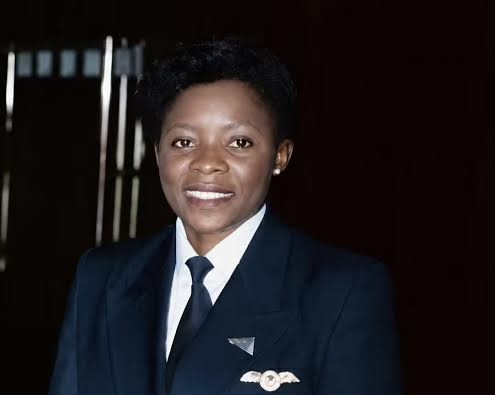
Hadiza Lantana Oboh was the sole woman in the cockpit for Nigeria Airways, breaking into a fiercely male-dominated industry.
Most Nigerians knew Oboh as the face of female achievement in aviation, a symbol of progress for women in specialized professions. Yet, the story of her rise and the chilling circumstances of her death paint a far more complex picture than her public image suggested.
Hadiza Lantana Oboh: Nigeria Airways’ lone female pilot
Oboh carved out her professional reputation during a critical period in Nigeria’s aviation history. By 1984, she had already qualified as a flight officer, navigating Boeing 737s for Nigeria Airways. This was an era when female pilots were virtually unheard of globally, let alone in Nigeria.
Her career progressed steadily through the late 1980s and into the 1990s, cementing her status as an established pilot. She wasn’t just flying planes; she was charting a course for countless women who dared to dream beyond traditional societal roles. She challenged stereotypes in a demanding field.
Her unique position within Nigeria Airways made her a figure of quiet inspiration. She embodied the possibility of excellence for Nigerian women when opportunities were scarce and gender barriers rigid. This singular achievement is often overlooked when discussing her tragic end.
Breaking Barriers in the Cockpit
Oboh’s journey into the cockpit was more than a personal ambition; it was a significant stride for women’s inclusion in demanding technical professions across 20th-century Nigeria. Her presence in the national airline’s operational structure demonstrated that competency knew no gender. The industry was historically the preserve of men.
Her impact resonated beyond Nigeria’s borders. The International Society of Women Airline Pilots maintains a memorial to her, acknowledging her place among women who shaped commercial aviation. This international recognition highlights the rarity and significance of her professional path.
Her achievement should be distinguished from that of Captain Chinyere Kalu. Kalu earned recognition as Nigeria’s first female commercial pilot after obtaining her license in 1981. Kalu’s achievement predates Oboh’s documented career at Nigeria Airways. They created distinct yet equally vital legacies for both women in Nigerian aviation history. Both contributed to the evolving narrative of women in the country’s commercial skies.
The Dark Turn in Ikoyi
Oboh’s ascending career met a brutal and unforeseen end on 8 February 1998. Her remains were discovered inside a septic tank at her Ikoyi residence in Lagos. This transformed her inspiring story into a chilling criminal investigation. The grim discovery immediately intensified concerns surrounding her sudden disappearance.
Prior to the finding, individuals connected to her household had reportedly continued occupying her property. They offered inconsistent explanations to anyone inquiring about her whereabouts. The elaborate deception pointed towards a crime orchestrated from within her immediate surroundings. This drew the focus of investigators directly to her home.
Allegations surfaced almost immediately regarding the disappearance of significant sums of money and personal possessions belonging to the pilot. This suggested a motive beyond mere violence, painting a picture of a calculated act. The circumstances surrounding her death captivated national attention, becoming a topic of widespread public discussion. It echoed other dramatic events in Nigeria.
A Justice Interrupted
The Lagos State Commissioner of Police at the time, Abubakar Tsav, reportedly oversaw the review of the investigation into Oboh’s death. The case was quickly referred to the State Criminal Investigation Department at Panti, Yaba. This initiated a rigorous inquiry into the grim discovery at her Ikoyi residence.
Investigators meticulously examined the premises, leading them to the septic tank where her body had been concealed. This crucial finding confirmed the suspicion that the crime had occurred within her own home. The focus then shifted to identifying and apprehending those believed responsible for her murder and the disappearance of her valuables.
Members of Oboh’s household were among those investigated, including Peter Eche, a security worker identified as Abdullahi, her driver Itoro Akpan, and another individual named Denise Osama. Allegations surrounding their involvement became central to the police inquiry. Peter Eche reportedly confessed to the killing.
The police pursuit of justice in this high-profile case highlighted the critical role of law enforcement in handling such sensitive matters. Challenges in Nigerian police careers often emerged from complex investigations.
Unanswered Questions, Enduring Legacy
Following the police investigation, four suspects reportedly faced legal proceedings in a Lagos court. They were charged with conspiracy, armed robbery, and murder. They were arraigned before a magistrate’s court on 1 June 1998. This step offered the public a glimmer of hope for accountability in the shocking case.
However, the pursuit of justice soon encountered significant hurdles. Two of the accused were released on bail following a High Court decision. This development proved to be a turning point, as authorities later struggled to secure their return for subsequent proceedings. The released suspects reportedly vanished, and questions arose regarding the legitimacy of the identities and addresses provided by their sureties.
This disappearance complicated the prosecution considerably, frustrating efforts to bring the alleged perpetrators to justice and leaving the case largely unresolved. More than two decades on, retrospective accounts continue to dwell on the failures of the judicial process. Lingering questions surround Oboh’s murder.
The incomplete documentation of the judicial history only deepens the mystery, ensuring the case remains a subject of public fascination and historical inquiry within broader Nigerian institutional contexts.
Despite the tragic and unresolved circumstances of her death, Hadiza Lantana Oboh’s legacy as a trailblazing pilot remains undiminished. She continues to be an important figure in the history of Nigerian commercial aviation. Her career was a testament to the expansion of opportunities for women in professions once considered exclusively male.
Her story stands as a powerful reminder of how individual ambition can reshape societal norms.
Her professional achievements and her quiet defiance of gendered expectations in the demanding world of aviation continue to inspire. While the abrupt end to her life often overshadows her contributions, it is her pioneering spirit and dedication to excellence that truly define her place in Nigerian history. She was a woman who dared to fly, literally and figuratively.
Her story, alongside other pioneering Nigerian female aviators like Captain Chinyere Kalu, illustrates the varied and often challenging paths women forged in the development of Nigerian commercial aviation. Oboh’s life may have concluded in 1998, but her significant contribution to the country’s aviation history is remembered as a beacon of what is possible when barriers are broken.
The enduring lesson from Ikoyi
Hadiza Lantana Oboh’s life offered a singular narrative of quiet determination in a profession few women entered. Her pioneering role as Nigeria Airways’ only female pilot shattered assumptions, proving competence transcends gender.
Yet, her brutal murder and the subsequent disappearance of suspects laid bare a deeper truth: even a national hero’s legacy could be profoundly overshadowed by the fragility of justice. The lasting uncertainty in her case highlights how swiftly a nation’s attention can pivot from celebration to the stark realities of an unresolved past.
