




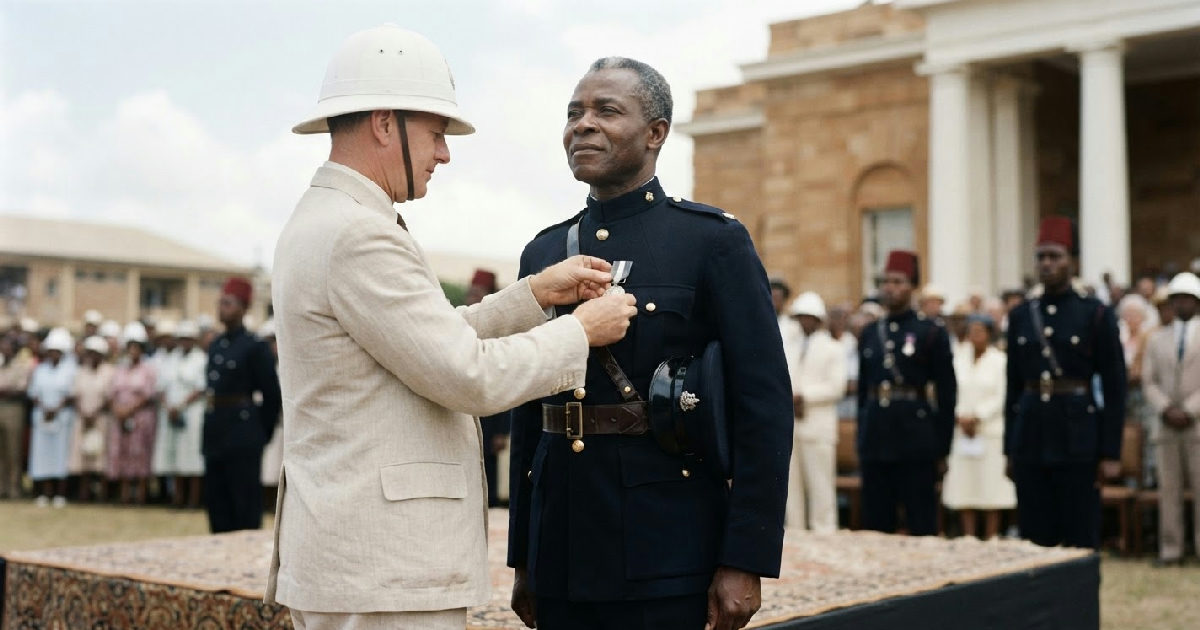
On June 1, 1953, Nigerian Assistant Superintendent Eugene Kenneth Keazor was awarded the Colonial Police Medal for Meritorious Service.
This award, listed in The London Gazette amidst Queen Elizabeth II’s coronation honours, wasn’t just a personal milestone. It marked Keazor as a pioneering figure, a Nigerian officer rising through ranks typically reserved for expatriates, long before the shouts of independence echoed across the nation.
Eugene Keazor’s Police Career and an Unlikely Colonial Honour
Eugene Akosa Keazor, born in Obosi, Eastern Nigeria, in 1907, was a man of firsts. He joined the West African Constabulary Force around 1927, at a time when opportunities for indigenous officers were severely limited. His appointment as Inspector in 1930 was an early indicator of his exceptional path.
The Colonial Police Medal itself was an official decoration, a nod from the British government for distinguished professional service within its vast colonial territories. For Keazor, it validated decades of dedicated service within a system not designed for his ascent.
His inclusion among recipients from across the British-administered world highlighted a subtle, yet significant, crack in the colonial structure. It was an acknowledgement that effective policing, even under imperial rule, relied on the competence of local personnel. Keazor represented a burgeoning class of Nigerian professionals stepping into roles that would soon become their own.
From Colonial Service to Independent Leadership
Keazor’s trajectory didn’t halt with colonial recognition. By 1959, he achieved the rank of Assistant Commissioner of Police. This made him the most senior African officer in the Nigeria Police Force while it was still under British command, a remarkable feat in itself.
As Nigeria marched towards its independence on October 1, 1960, Keazor’s career paralleled the nation’s own journey. He was not merely an observer but an active participant in shaping the institutions of a new sovereign state. His expertise was critical as the country prepared to take full charge of its security apparatus.
In 1960, the year of Nigeria’s independence, Keazor was called to an international stage. He commanded the first Nigerian police contingent deployed for the United Nations Peacekeeping Mission to Congo-Kinshasa. This assignment underscored the growing global role of Nigeria and the trust placed in its emerging leadership.
Forging a New Police Identity
After independence, Nigeria’s policing system underwent a critical transformation. The 1960 Constitution preserved the Nigeria Police Force as a national institution, but it also outlined new relationships between federal and regional authorities. The Inspector-General commanded the national force, while regional Commissioners of Police, like Keazor, managed contingents within their respective regions.
Around 1962, a photograph attributed to Ed Keazor captured Eugene Keazor outside his residence in Enugu, identifying him as the Commissioner of Police for the Eastern Region. This image connects the personal story of a seasoned officer to the broader narrative of Nigeria transforming its inherited colonial structures into a functioning independent federation.
Enugu was more than just a regional capital; it was a hub for police administration, coordinating criminal investigations, traffic policing, and personnel supervision across five provinces. Keazor oversaw a complex network of 62 police stations and posts. His role here was pivotal in demonstrating that Nigerians could lead and manage large, complex security operations.
The colonial blueprints had designed a system, but it was Nigerians like Keazor who would operate it.
The Unsung Pioneer and the Road Not Taken
Keazor retired in 1964, concluding a career that spanned over three decades of profound change. He had served during the colonial era, received British honours, and then led a crucial regional command in the nascent years of an independent Nigeria. His contributions were instrumental in establishing a professional, indigenously led police force.
However, while Keazor reached the pinnacle of African leadership within the colonial force, he was not destined to become Nigeria’s first indigenous Inspector-General of Police. That distinction went to Louis Edet, who took the helm from 1964 to 1966.
This detail, often overlooked, highlights the complex interplay of individual merit and historical timing in the forging of national institutions. Keazor paved the way, demonstrating capability, but the final step to the absolute top of the national force came just after his pioneering efforts reached their zenith.
His story reveals how individual careers, like his participation in the Inaugural World Scout Jamboree or representing the Colonial Police Force at King George VI’s funeral, wove into the larger fabric of Nigeria’s emergence on the world stage.
A Legacy of Transition and Quiet Leadership
Eugene Akosa Keazor’s life, from his birth in Obosi to his passing in 1975, embodies the spirit of a nation finding its feet. He was part of a generation that transitioned from being subjects of an empire to architects of an independent state. His professional journey underscores the often-unseen work of individuals who lay the groundwork for national sovereignty.
His career demonstrated that Nigerians were not just capable of maintaining law and order, but of leading sophisticated police operations at both national and international levels. It was a silent dismantling of the colonial myth that indigenous populations were unfit for self-governance, a testament delivered through decades of diligent service.
The learning here is clear: true leadership is often found not in the loudest declarations, but in the quiet, persistent work of individuals who navigate systemic barriers, proving capability through dedication. Their efforts, though sometimes overshadowed, are the bedrock upon which new nations are built.
