




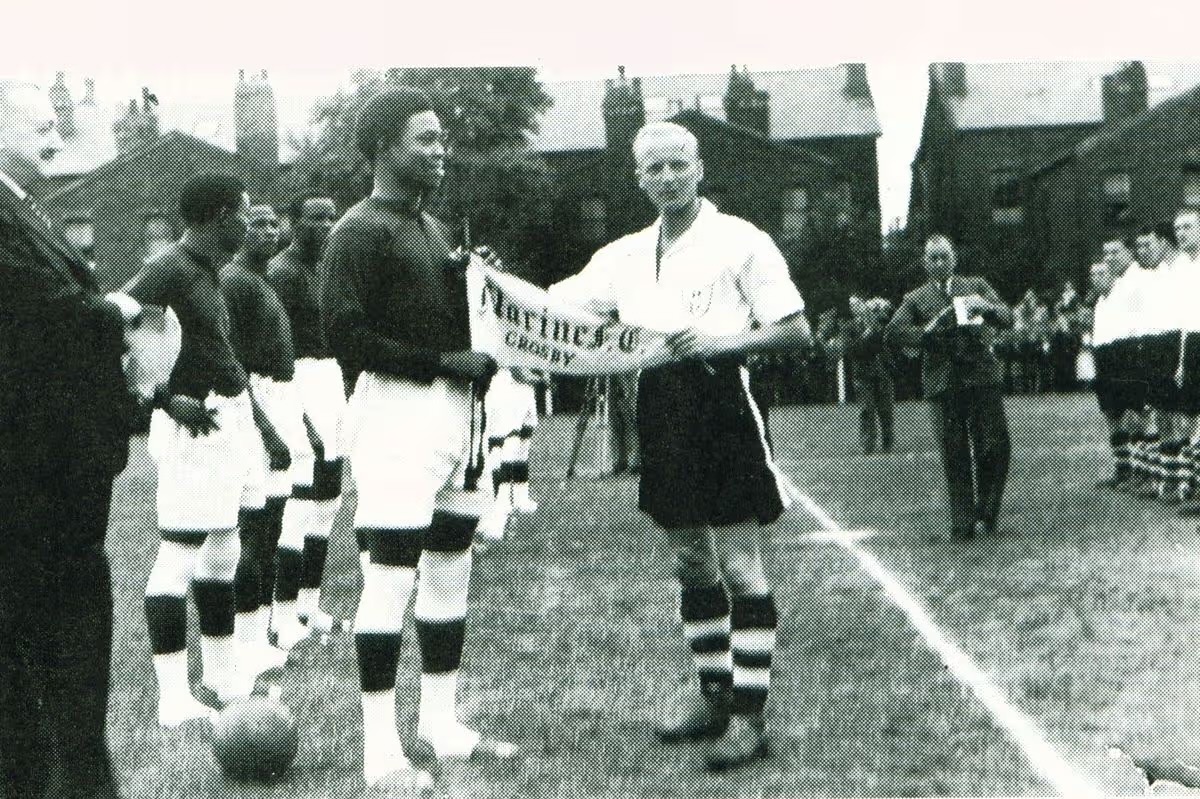
In the summer of 1949, eighteen Nigerian footballers, some of whom preferred to play barefoot, crossed the Atlantic to play a month of matches in Britain. Among their stops was a significant game against Marine Crosby. This was a pioneering voyage that would challenge perceptions of African sport.
Most British spectators, accustomed to structured, booted football, likely expected a curious spectacle. The sight of players with taped toes stepping onto English pitches without footwear seemed to confirm this initial bias. Yet, these men had come to compete, carrying the hopes of a nation still under colonial rule.
Marine Crosby Welcomes the Nigerian Team
The 1949 Nigerian national football team, dubbed the “UK Tourists” or “Red Devils,” was far from a collection of street players. Organized by the Nigerian Football Association, the squad drew from diverse professions, including civil servants, teachers, and railway workers.
Captain Etim Henshaw, a marine engineering apprentice, led a team that included future legend Teslim Balogun and talented forward Titus Okere. Their journey began on August 16, 1949, aboard the RMSS Apapa, arriving in Liverpool on August 29 after a two-week sea voyage.
What startled the British press most were the photographs: players with strapped, bare feet, sometimes with socks cut to expose their toes. This wasn’t a sign of poverty or a lack of equipment. Barefoot play was a deliberate tactical choice, preferred on harder surfaces where it offered better ball control.
Len Carney, captain of Marine Crosby Football Club, the Nigerians’ first opponent, famously remarked that the visitors’ “feet were harder than our boots.” This highlighted the stark cultural and sporting differences converging on the pitch. The colonial blueprints of the era meant these encounters were layered with deeper meaning.
First Match, First Statement
Just two days after landing, on August 31, 1949, Nigeria faced Marine Crosby FC at Rosset Park. Before 6,000 spectators, the Nigerian side clinched a decisive 5-2 victory. This win immediately dispelled any notion that they were merely there for entertainment.
The result sent a clear message: these amateurs from a distant colony could play, and they could win. Marine donated £200 from the gate receipts to the Nigerian Football Association, a gesture acknowledging the competitive quality they had encountered.
The tour, though presented as a goodwill initiative, carried immense significance for a colonial Nigeria seeking identity. Captain D.H. Holley, the team manager, emphasized the weight of their mission, framing it as a crucial test for Nigeria’s potential participation in the 1952 Olympic Games.
Beyond the Novelty: Testing Their Mettle
The tour comprised nine matches against established English amateur clubs and representative sides. The “Red Devils” ultimately recorded two wins, two draws, and five losses. While not a clean sweep, the record reflected their ability to compete under unfamiliar and often challenging conditions.
They faced Bishop Auckland FC on September 3, losing 5-2, and Leytonstone FC on September 8, with a 2-1 defeat. The schedule was relentless, with matches often separated by just a few days, pushing the amateur players to their physical limits.
One of the tour’s standout moments came on September 14, when Nigeria drew 2-2 against a Corinthian League XI. Teslim Balogun scored a late equalizer, demonstrating the team’s resilience. This result proved they could hold their own against strong amateur opposition.
The Day the Rain Challenged Bare Feet
The most substantial defeat occurred on September 21, against an Athenian League XI, where Nigeria lost 8-0. Heavy rain transformed the pitch into a muddy, slippery mess, exposing the limitations of barefoot play on soft ground.
Initially, some players started barefoot, as was their custom on hard surfaces. But the conditions were different. Though they eventually switched to boots, their unfamiliarity with proper football footwear in such adverse weather proved a significant handicap. This match underscored the practical challenges of adapting their unique style to European conditions.
The Duke of Edinburgh even sent a telegram of best wishes, highlighting the tour’s diplomatic implications. The team also benefited from observations at matches like Tottenham Hotspur vs. Sheffield Wednesday, and Chelsea vs. Sunderland, gaining insights into English football tactics.
A Bridge to Professional Dreams
The 1949 tour was more than just a series of games; it was a foundational moment for Nigerian football. It proved that Nigerian talent could not only travel abroad but also compete effectively. This access was arguably the most significant legacy, paving the way for a future generation of professional players.
Etim Henshaw, the captain, embodied this pioneering spirit. After the tour, he remained in Britain to pursue his marine engineering examinations. His commitment showcased that these were men with lives and ambitions beyond the pitch, who temporarily stepped onto the international stage.
The tour directly opened doors for individual players. Titus Okere returned to Britain and, in 1953, became the first Nigerian to sign a professional contract with an English club, joining Swindon Town.
Teslim Balogun followed suit, playing for Peterborough United, Skegness Town, and Queens Park Rangers, even appearing in the Football League during the 1956-57 season. Such pioneering acts set precedents for Nigerians in various fields.
The “UK Tourists” also influenced other African nations. Their success encouraged teams like the Gold Coast (Ghana) in 1951 and Uganda in 1956 to undertake similar tours. This created a broader pattern of sporting exchanges that integrated African football into the global consciousness.
Shaping Nigeria’s Football Future
Today, Nigerian footballers are household names across Europe’s top leagues and international stages, with the Super Eagles winning the Africa Cup of Nations three times. This ubiquity makes it easy to forget how recent this global integration truly is.
In 1949, the infrastructure of academies, agents, and scouts that now facilitate these moves was non-existent. The path was blazed by eighteen amateur players who boarded a ship, sailed thousands of miles, and faced formidable opponents with little more than raw talent and determination.
They brought their own yams and rice to supplement post-war rationing, demonstrating their commitment to their culture even while adapting to new circumstances.
This early engagement with international football provided a visible platform for Nigerians to demonstrate their abilities. While political arguments for self-governance were complex, a goal on an English pitch spoke a universal language. The scoreboard offered undeniable proof of capability. Moments of national pride often emerge from unexpected places.
The enduring image of the barefoot footballer is a powerful symbol. It’s not just about an absence of boots, but about the audacious spirit of a generation. It captures the moment Nigerian football stepped beyond local competition into the global arena, not as spectators, but as compelling competitors, laying the foundation for the immense success that would follow.
Their story reminds us that true progress often begins with unlikely pioneers. Before independence, before professional contracts were commonplace, these men carried Nigeria’s name abroad, challenging expectations and proving that potential knows no boundaries, even when played with bare feet.
