




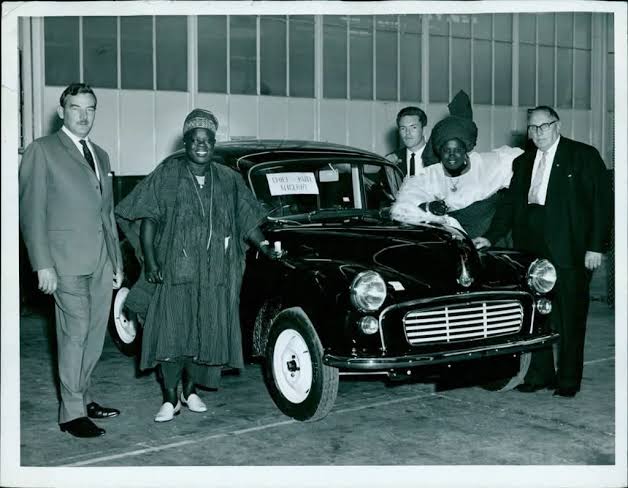
In 1966, Nigerian Chief T Kuti walked the factory floor of a major British automobile plant, not as a delegate, but as a customer. This visit by Nigerian Chief T Kuti highlighted the growing international reach of British manufacturing.
This remarkable journey, captured in a historical photographic account by ASIRI Magazine, pulls back the curtain on a forgotten chapter of Nigerian economic history. It shows a level of personal engagement in international trade that feels almost impossible today, highlighting the sheer ambition and resourcefulness of a generation of Nigerians who built commercial empires from scratch.
Nigerian Chief T. O. Kuti visits British Morris car factory in 1966
The image of Chief T. O. Kuti and his wife at the Morris factory isn’t just a snapshot; it’s a powerful symbol. It speaks to a time when Nigerian entrepreneurs were not merely consumers of imported goods, but active participants in the global supply chain.
This direct collection of a vehicle from its point of manufacture underscores the personal investment and commercial acumen that characterized figures like Kuti.
Kuti, hailing from Ijebu-Igbo, a key commercial town in what is now Ogun State, was a pioneer. His presence in Oxfordshire, personally overseeing the acquisition of a British-made car, signified more than just a purchase. It represented the bridging of continents by individual initiative, a direct link between the industrial heartland of Britain and the burgeoning economy of newly independent Nigeria.
From schoolteacher to transport magnate
Before Chief Timothy Odutayo Kuti became a titan of the transport industry, famously known as Abusi Odumare, his path began in an entirely different profession: schoolteaching. It was 1942, the height of the Second World War, a period of immense global upheaval and economic opportunity in Nigeria. He made a decision that would redefine his life and contribute significantly to Nigeria’s commercial infrastructure.
Kuti took the extraordinary step of selling a house he had built, converting his personal asset into the seed capital for a new venture. With the proceeds, he acquired his very first lorry. This single vehicle was the genesis of what would become a formidable transport business, hauling agricultural produce from Ondo to the bustling markets of Lagos, laying the groundwork for his future success.
Forging early commercial pathways
The colonial era in Nigeria saw agricultural production as the bedrock of the economy. Farmers and merchants relied heavily on efficient transportation to move goods from inland farms to major commercial hubs, railway stations, and coastal ports. Motor transport, still nascent, began filling crucial gaps in a network largely served by rail and waterways.
Entrepreneurs who invested in lorries were effectively creating new commercial arteries, connecting previously isolated communities to wider markets. Kuti entered this vital sector at a pivotal moment, recognising the growing demand for road transportation in southwestern Nigeria. His investment was not just in a vehicle; it was an investment in the future of Nigerian commerce. Many early road transport pioneers, like Kuti, saw the opportunity.
Building an empire: hire-purchase and vehicle imports
Chief Kuti’s ambition didn’t stop at operating a single lorry. He systematically expanded his fleet, growing from one vehicle to six, a significant logistical leap that demanded greater organisational skill and a keen eye for managing a burgeoning enterprise. This expansion was a testament to his ability to not only identify market needs but also to scale his operations efficiently.
But Kuti saw beyond merely transporting goods. He identified a critical unmet need within the industry: access to vehicles and capital for other aspiring transporters. This led him to pivot, moving from being solely an operator to becoming a supplier. He began selling vehicles through hire-purchase arrangements and, crucially, started importing vehicles directly from Europe for onward sale to indigenous Nigerian transporters.
The hire-purchase model was revolutionary for its time. It enabled individuals who lacked the upfront capital to buy a vehicle outright to still enter the transport business, making incremental payments over time. While it created financial obligations, it also democratised access to commercial equipment. Kuti’s business evolved into a linchpin, connecting smaller operators with the necessary tools to build their own livelihoods.
His involvement in vehicle importation positioned his business squarely within the international commercial networks that brought foreign-manufactured automobiles to Nigerian shores. This wasn’t just about selling cars; it was about facilitating an entire economic ecosystem. Kuti wasn’t just building his own fortune; he was building capacity across the Nigerian transport sector, a role amplified by the specific conditions created by colonial era policies.
The legal battle that defined his enterprise
Proof of Kuti’s established and sophisticated business model emerged vividly in a legal dispute that reached Nigeria’s Supreme Court in the 1970s. The case, T. O. Kuti and Another v. Oludademu Jibowu and Another, stemmed from an accident involving a Morris minibus, registration LM 7986, which Kuti had supplied to Joseph Adenuga under a hire-purchase agreement in July 1966.
When the minibus, driven by Adenuga’s employee Mufutau Ajagbe, was involved in an accident in Ibadan in May 1967, legal questions arose about liability. The Supreme Court ultimately ruled in Kuti’s favor in June 1972, concluding that Ajagbe was not Kuti’s employee or agent.
This judgment affirmed the independent nature of Kuti’s financing arrangements and his role as a vehicle supplier rather than solely an operator.
The case, heard long after the factory visit, provided a clear window into the scale and complexity of Kuti’s operations. It confirmed that, by the mid-1960s, trading under the name Abusi Odu Transport, he was deeply embedded in the business of supplying commercial passenger vehicles to other entrepreneurs. He was not just a driver or a fleet owner; he was a financier and an importer.
Global connections, local impact
The Morris Minor, the car Chief Kuti collected that day in Oxfordshire, holds its own significant place in automotive history. Introduced in 1948 and designed by Alec Issigonis, it became one of Britain’s most iconic post-war automobiles, known for its practical design and affordability.
By 1961, it became the first British car to sell over a million units, with more than 1.6 million produced by the end of its run in 1971.
Kuti’s personal acquisition of such a vehicle highlights the aspiration and access that a growing class of Nigerian entrepreneurs had in the 1960s. While his commercial enterprise primarily dealt with tougher, larger vehicles for freight and passenger transport, his personal choice reflected a connection to the global automotive trends and quality.
It also showcased his ability to navigate international markets for both business and personal needs.
This factory visit, around the time Nigeria was finding its feet as an independent nation, embodies the critical role imported vehicles played in developing the country’s road transport sector. Lorries and buses were essential for moving agricultural goods and people across vast distances. Without entrepreneurs like Kuti, who facilitated access to these vehicles, Nigeria’s internal commerce would have struggled to expand.
A legacy of indigenous enterprise
Chief T. O. Kuti was not alone in his entrepreneurial spirit. Many indigenous Nigerians had already ventured into motor transportation before his 1942 entry. Figures like W. A. Dawodu in Lagos, T. A. Odutola in Ijebu, and Salami Agbaje in Ibadan had all contributed to the nascent industry, along with pioneering women like Olajumoke Obasa.
What made Kuti stand out was his unique trajectory from schoolteacher to a comprehensive automotive magnate.
His contribution was in extending the scope of the industry beyond simple operation. By moving into vehicle acquisition, importation, and the innovative hire-purchase model, Kuti created a multiplier effect, enabling countless other Nigerians to enter the transport sector. He understood that growth wasn’t just about moving goods himself, but about equipping others to do so.
The journey from a single lorry in 1942 to personally collecting a Morris Minor from a British factory in 1966 is a narrative of relentless ambition.
It shows how a prominent Nigerian figure, through sheer will and shrewd business decisions, helped lay the groundwork for Nigeria’s modern commercial landscape, proving that true wealth is often built by empowering others.
His story reminds us that identity is often forged not just in what you own, but in the systems you build to help others thrive.
