




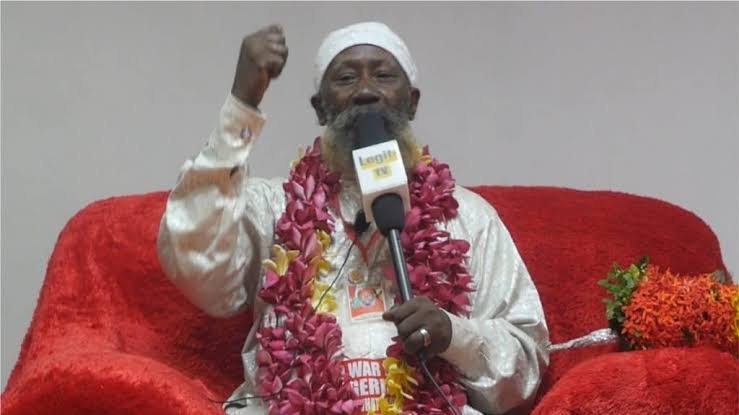
Before he was the “Black Jesus” of Ibadan, a self-proclaimed “Living Perfect Master” in flowing robes, he was an employee of Nigeria Airways. The man who became one of Nigeria’s most controversial spiritual figures began life as Mohamed Ajirobatan Ibrahim, born in Ghana in 1947 to a Yoruba Muslim family, but educated in a Methodist school.
For decades, the name Satguru Maharaj Ji has provoked strong reactions. To his followers, he is a divine saviour. To many others, he is an eccentric cult leader, surrounded by lurid rumours and legal battles. This extraordinary journey from airline worker to spiritual leader showcases a unique path among Nigeria’s historical figures.
Black Jesus Nigeria’s divine mission
Most Nigerians only know the public caricature of Guru Maharaj Ji. They know the sprawling 40-hectare commune on a solitary stretch of the Lagos-Ibadan expressway, a place his followers call the “Holy Land.” They’ve heard the whispers and the headlines—of arrests, court cases, and sensational accusations.
The idea of a man declaring himself God on earth is, for many, the beginning and end of the story.
But the real story begins much earlier, in a Nigeria grappling with its identity. Ibrahim’s early life was a blend of influences: born in Obuasi, Ghana, but with roots in Oyo State and a childhood spent in the bustling, syncretic city of Ibadan.
He grew up in a Muslim household, attended a Christian school, and came of age in a profoundly Yoruba cultural world. This fusion of identities would later become a hallmark of his spiritual movement.
His job with Nigeria Airways provided the catalyst for his transformation. It gave him a passport to the world outside West Africa, particularly London. It was there, amidst the spiritual curiosity of the late 1970s, that his life took a dramatic turn.
According to accounts from his movement, on January 1, 1980, he received a divine revelation. The mission, as he understood it, was to save humanity.
When he returned to Nigeria just seven months later, in July 1980, Mohamed Ibrahim was gone. In his place stood Satguru Maharaj Ji, the “Saviour of the New Age.” The airline employee had been shed like an old skin, replaced by a man who claimed to hold the universe’s secrets. He chose a path to influence that diverged sharply from conventional political or economic pursuits.
Building the One Love Family
Upon his return, Maharaj Ji didn’t just preach; he began to build. He established the headquarters of his new movement in Lagos, calling it the One Love Family. It was explicitly not a church or a mosque.
Instead, he presented it as a universal spiritual path that transcended the divisions of conventional religion, a message that resonated in a country often fractured by those very lines.
His teachings were a unique cocktail of ideas. He blended concepts from Hinduism and Christianity with Yoruba spiritual traditions, creating a syncretic faith that was uniquely Nigerian. His followers, known as “Premies,” were encouraged to see beyond ethnic and religious identities. The central message was one of love, peace, and the attainment of divine knowledge through him, the Living Perfect Master.
This message found fertile ground. The Nigeria of the 1980s was a country of immense social and economic turmoil. Years of military coups and economic instability had left many people searching for certainty and meaning. In this spiritual vacuum, charismatic figures offered a different kind of hope, diverging from standard approaches to national development.
A kingdom on the expressway
To institutionalize his vision, Maharaj Ji needed more than just a message; he needed land. In 1987, the One Love Family established the settlement, covering approximately 40 hectares, along the increasingly vital Lagos-Ibadan Expressway. This became the “Satguru Maharaj Ji Village,” a self-contained world with its own rules, rituals, and sacred geography.
Life in the commune was highly structured. Followers adopted a vegetarian diet, wore badges to show their loyalty, and removed their shoes before entering sacred areas. The community had its own gathering hall for spiritual activities, agricultural plots for self-sufficiency, and a calendar built around key dates in Maharaj Ji’s life.
His physical birthday on December 20th and the anniversary of his spiritual “revelation” on January 1st became holy days for the community.
By creating this physical kingdom, Maharaj Ji did what few other spiritual leaders manage. He turned a personal revelation into a durable institution. The village was not just a settlement; it was a powerful symbol of his claims, a concrete manifestation of his spiritual authority.
The establishment of this self-sufficient domain reflected his unique vision for his movement and carved out a new kind of economic power within Nigeria.
The cost of controversy
Fame and controversy grew in lockstep. The title “Black Jesus” became a media sensation, attracting both curious followers and intense scrutiny. As his profile rose, so did the number of accusations against him and his movement.
In 1989, the One Love Family faced its first major public crisis when former members alleged that as many as 200 bodies were secretly buried on the ashram’s grounds. Police swarmed the village, but a thorough search found nothing. The charges were dropped.
A decade later, in 1999, crisis struck again. After a Ghanaian man died at the commune, angry youths from a neighboring community burned down the ashram. Maharaj Ji and twelve of his disciples were arrested and charged with murder.
He spent several months in jail before being acquitted in 2000, with the presiding judge criticizing the prosecution’s flimsy case. Throughout his incarceration, he reportedly received an average of 25 visitors a day.
These episodes cemented his public image as a figure of perpetual conflict. To his critics, he was a dangerous and manipulative leader. To his followers, the accusations and arrests were merely proof of his persecution, the trials that any true saviour must face. Yet, through it all, the movement survived, outlasting dozens of smaller spiritual groups that had long since faded.
The man who could not be ignored
Despite his claims of divinity, Satguru Maharaj Ji was never above the laws of the land. One example came in 2011, when he was evicted from a property at 10 Awolowo Avenue, Bodija, Ibadan, following an Oyo State High Court order.
He challenged the eviction, demonstrating that even a spiritual leader was subject to the country’s legal institutions. He made political predictions, some of which were spectacularly wrong, such as his 2004 forecast that John Kerry would defeat George W. Bush.
He was, in many ways, a citizen of the very world he claimed to have come to save.
Yet, his endurance is the most remarkable part of his story. He successfully transformed himself from Mohammed Ibrahim, the airline worker, into a spiritual icon who commanded the loyalty of thousands. He built an institution that has lasted for over four decades, surviving legal challenges, public outrage, and the relentless churn of the Nigerian news cycle.
The story of Guru Maharaj Ji reveals something fundamental about the search for meaning in modern Nigeria. In a nation of deep faith and constant flux, a charismatic figure who can provide a compelling narrative, a sense of community, and a physical place to belong can wield immense power.
The man from Ibadan created his own world, and for a time, made a significant part of Nigeria pay attention.
The learning is not about whether his claims were true. It is about how, in a world full of uncertainty, the most powerful force can be a story. Mohamed Ibrahim’s greatest creation was not the One Love Family; it was the character of Satguru Maharaj Ji, a figure so vivid and so audacious that, once seen, he could never be forgotten.
