



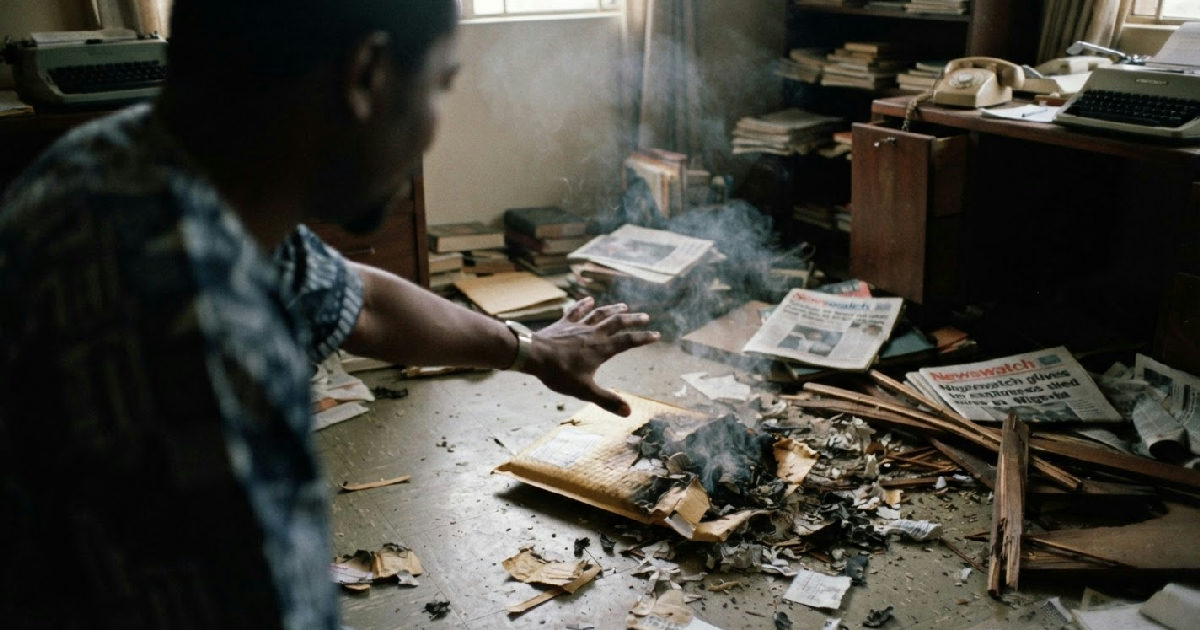
On the morning of Sunday, October 19, 1986, a parcel bomb delivered to the Lagos home of Dele Giwa, the editor-in-chief of Newswatch magazine, exploded as he opened it. This assassination of one of Nigeria’s most prominent journalists sent shockwaves through the nation, creating a mystery that has endured for nearly four decades. His last words, reportedly, were, “They got me.”
The central question was not just who sent the bomb, but why. Years of speculation, legal battles, and public inquiries have linked Giwa’s murder to one name: Gloria Okon. The story of her arrest, reported death, and alleged connections to powerful figures remains the most persistent theory behind one of the darkest moments in Nigerian journalism.
The Dele Giwa assassination raised many questions
The story begins more than a year before the bomb, on April 22, 1985. A woman identified as Gloria Okon was arrested at the Aminu Kano International Airport. She was allegedly in possession of heroin, foreign currency, and thousands of naira, attempting to travel out of the country.
This occurred during the military administration of General Muhammadu Buhari. Drug trafficking was a capital offense under the severe Decree No. 20 of 1984.
An arrest for such a serious crime would normally lead to a high-profile trial. But Gloria Okon’s case took an extraordinary turn just six days later. On April 28, 1985, authorities announced she had died in custody.
The official cause of death was listed as food poisoning. No family came forward to claim her body, and the case was officially closed. This left a trail of unanswered questions, fueling public unease and highlighting broader issues of power and accountability during the military era. Such events often deepen the public’s fascination with unresolved cases.
Whispers of a cover-up and powerful connections
The official explanation was met with immediate public skepticism. Rumours quickly spread that Okon was not just a low-level drug courier. Many believed she was a mule for powerful, well-connected individuals.
The most explosive theory claimed her death was faked. It was alleged she was secretly spirited out of the country. This would prevent her from exposing powerful employers during interrogation.
These rumours gained traction when linked to the military government’s highest echelons. Some versions alleged Okon had named Maryam Babangida, wife of then-Minister of Defence General Ibrahim Babangida, during interrogation. When General Babangida overthrew Buhari in August 1985, these suspicions intensified.
An inquiry into Okon’s death, begun under Buhari, vanished in the transition. This fueled the narrative of a deliberate cover-up. The mystery only grew larger without official answers.
How Dele Giwa became entangled in the web
Dele Giwa was a journalist at the peak of his powers. As co-founder and editor-in-chief of Newswatch, he pioneered a new brand of investigative journalism in Nigeria. It was stylish, aggressive, and unafraid to challenge authority.
The magazine delved into political controversies and personality profiles. This often put its journalists on a collision course with the military government. Their reporting frequently pushed boundaries.
In the days leading up to his death, Giwa was under intense pressure from state security services. On October 16, 1986, he was summoned and interrogated by officials. These included Lt. Col. A.K. Togun of the State Security Service (SSS) and Col. Halilu Akilu of the Directorate of Military Intelligence (DMI).
He was accused of plotting a socialist revolution in Nigeria. There were also accusations of reporting on the politically sensitive removal of Commodore Ebitu Ukiwe as Chief of General Staff. This incident underscored how Nigeria’s systems could be turned against individuals, a constant challenge for Nigerian governance.
Giwa denied all the allegations. Two days later, after a series of strange phone calls from intelligence officials, the parcel bomb arrived at his home at 25 Talabi Street, Ikeja. The enduring theory is that Giwa was killed because his investigation into the Gloria Okon story was getting too close to the truth.
Many believed he had uncovered evidence that Okon was alive in London. Such a discovery would have rocked the Babangida regime. His pursuit of truth potentially sealed his fate.
Contradictory accounts from within Newswatch
The link between Giwa’s death and the Gloria Okon case became an article of faith for many Nigerians. Yet, accounts from those closest to him have been surprisingly contradictory. The late Gani Fawehinmi, Giwa’s lawyer and human rights advocate, was convinced of the connection. He told the Oputa Panel that Giwa had travelled abroad to gather information on Okon.
However, Ray Ekpu, another Newswatch co-founder, offered a more measured account to the panel. He confirmed the magazine was indeed working on the story. But he suggested it was still in the early stages of investigation at the time of Giwa’s death.
This version was challenged decades later by Yakubu Mohammed, another co-founder. In his memoir, Beyond Expectations, Mohammed claimed the Okon story was a rumour. It was brought to an editorial meeting by a junior reporter, Bose Lasaki.
Mohammed asserted that the idea was quickly dismissed after Lasaki found no evidence to substantiate it. He forcefully rejected the idea that Giwa was killed over the Okon case. This differing perspective adds another layer to the complex narrative.
A legacy of unanswered questions
In the assassination’s immediate aftermath, Gani Fawehinmi launched a private investigation. He initiated a relentless legal campaign to bring suspected killers to justice. Fawehinmi publicly accused Colonels Akilu and Togun of murder, leading to a landmark legal battle.
This legal fight went all the way to the Supreme Court. However, despite his efforts and damning testimony from police investigators like Abubakar Tsav, no one was ever convicted. Tsav claimed his investigation was stonewalled, but the courts found insufficient evidence.
The fight for accountability in high-profile cases of alleged official misconduct has often been a long and frustrating journey in Nigeria. These legal battles highlight the persistent quest for justice in Nigeria, even when perpetrators remain elusive.
The Oputa Panel, established in 1999, revisited the case years later. It heard testimony that once again brought the Gloria Okon connection into the spotlight. General Babangida, Akilu, and Togun all refused to appear before the commission.
The panel ultimately recommended reopening the investigation into Giwa’s murder. However, this recommendation was never fully acted upon. The unresolved questions continued to hang over the nation.
The murder of Dele Giwa had a profound effect on Nigerian journalism. It demonstrated that even the most high-profile editor was not safe from powerful, hidden forces. The parcel bomb introduced a new level of fear into the profession, changing how many journalists approached their work.
Nearly 40 years later, the questions remain. Who built the bomb? Who delivered it? Was Dele Giwa silenced for what he knew about Gloria Okon, or was it for another story that died with him on that Sunday morning?
