




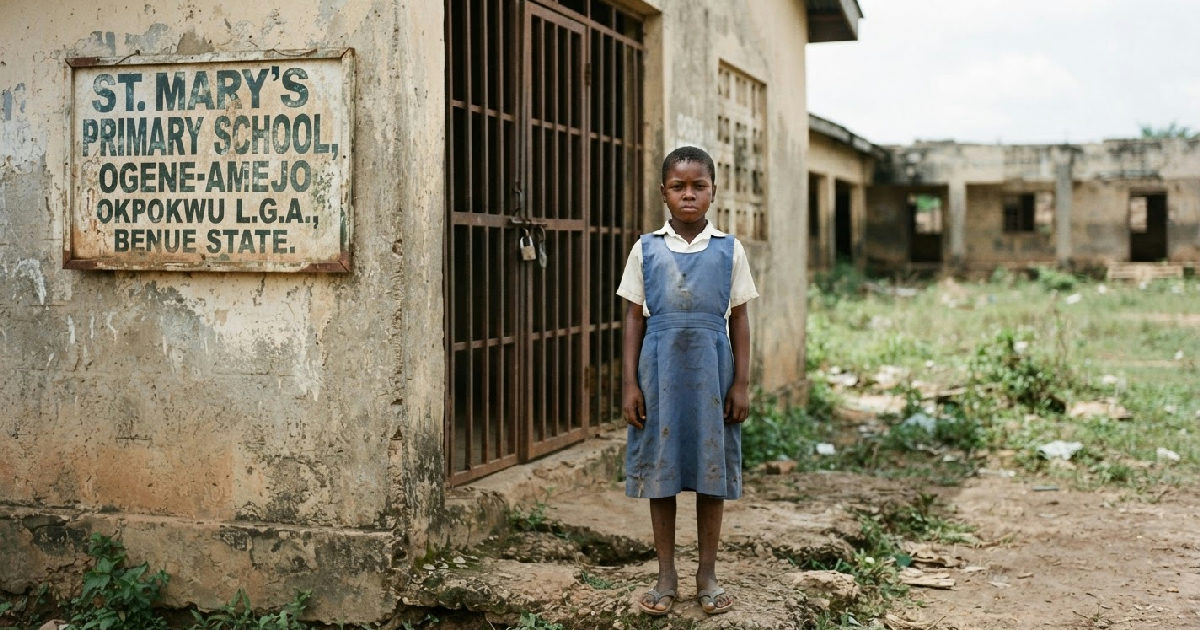
The primary school that cost Ochanya Ogbanje her life
The Benue State primary school that doomed Ochanya Elizabeth Ogbanje did not fail her with dilapidated classrooms or absent teachers; it failed her when the government simply stopped paying the staff in 2011.
The basic school in Ogene-Amejo, in the Okpokwu Local Government Area, had served the rural community for years, but the non-payment of teachers’ salaries forced its closure, setting off a chain reaction that would end in national tragedy.
This is the surprising, quiet beginning of a story that most Nigerians only remember for its devastating end: the 2018 death of a 13-year-old girl that focused a harsh light on child protection and the failings of the Nigerian justice system.
Her family’s search for a functioning classroom is the true pivot point, a detail that shifts the narrative from a story about a single horrific crime to a stark illustration of how systemic decay creates extreme personal vulnerability.
The collapse of a fundamental public service forced a family’s hand, creating the circumstances under which the unthinkable became possible, proving that bureaucracy can kill just as surely as a violent act.
A family decision born of desperation
Ochanya was the daughter of Michael Ogbanje and Rose Abah-Ogbanje, farmers who lived in Ogene-Amejo.
For parents in a community where education was the primary path out of rural poverty, the closure of the local primary school was not a minor inconvenience.
The geography of childhood changed overnight, forcing a brutal choice: leave the child without schooling or send the child away to another community that still had a functional institution.
Rose Abah-Ogbanje later recounted that she decided to send Ochanya to live with her sister, a maternal relative, so that the girl could receive a better education.
Ochanya was approximately seven or eight years old at the time of the move, which occurred around 2012.
The decision was rooted in the fierce belief that education was non-negotiable, a sacrifice that most people in rural Nigeria would understand completely.
She moved to Ugbokolo to stay with the Ogbuja family—specifically, Felicia Ochiga-Ogbuja, her husband Andrew Ogbuja, and their children.
This living arrangement was not simply about sending a child away; it was explicitly linked to accessing a school, allowing Ochanya to attend the Emmanuel Primary and Secondary School.
The child was in school, progressing through her education, and the sacrifice seemed to be yielding the desired opportunity for her future.
But the move, born of necessity and the failure of the local system, placed Ochanya far from the protection of her immediate parents.
It created a distance that made her dependent on a household that would ultimately become the site of her suffering and death, transforming a good intention into tragedy.
The crisis of rural education failure had subtly engineered the conditions for a monstrous personal crime.
The collapse of the protective ecosystem
Ochanya’s story is often recounted starting with the abuse she suffered within the Ogbuja household, but the full picture reveals a system designed to fail vulnerable families.
The prosecution’s case later alleged that the abuse, involving Andrew Ogbuja and his son Victor Ogbuja, began shortly after she arrived and continued for years.
By the time her condition became public knowledge, Ochanya was suffering from severe medical complications, including Vesicovaginal fistula (VVF), attributed to the abuse.
She was admitted to the Federal Medical Centre in Makurdi, where she died on October 17, 2018, at the age of 13, having spent two months in the hospital.
The tragedy shocked the nation and fueled massive campaigns demanding accountability and reforms for child protection in Nigeria.
But while the abuse was the direct cause of her death, the initial decision that placed her in the path of harm—the search for a school—was driven entirely by the state’s abdication of its duty in Ogene-Amejo.
The closure of the village school did not cause the crime, but it fundamentally changed the circumstances of Ochanya’s childhood, swapping the safety of a family home for dependency on relatives.
This is the overlooked connection: a government that fails to pay its teachers inadvertently makes a child more vulnerable by forcing her parents to seek precarious, improvised solutions.
Renovated buildings but absent teachers
The shocking reality is that Ochanya’s death briefly fixed the very problem that caused her relocation, but only cosmetically.
In November 2018, weeks after the tragedy, then-Benue State Governor Samuel Ortom announced plans to renovate the Ogene-Amejo school and name it in her memory.
The symbolism was clear: the state was attempting to redeem itself by publicly addressing the physical failure that had contributed to her death.
The school building was indeed renovated and upgraded during Ortom’s administration, complete with new facilities to expand basic education in the community.
But journalists investigating the school years later, in 2024, found that the deeper problem had not disappeared—it had merely changed form.
While the classroom walls were new, the school still faced a severe shortage of teachers, and its junior secondary section reportedly failed to commence operations because staff were unavailable.
The lesson was impossible to miss: a government can repair bricks and mortar quickly, but rebuilding a functioning educational ecosystem, complete with paid, motivated teachers and community trust, is far harder.
When public confidence declines, parents start looking elsewhere, creating a self-perpetuating cycle of decline where low enrollment makes the school less viable, and less viability further reduces parental trust.
Even with her name on the building, the school had not fundamentally recovered from the crisis of legitimacy that began when the teachers went unpaid years earlier.
This inability to solve the core problem underscores the deeper systemic rot that plagues rural public services in Nigeria.
Justice delayed and denied
The legal consequences that followed Ochanya’s death highlighted the same institutional fragility witnessed in the education system.
Criminal proceedings commenced against the accused parties, attracting intense national scrutiny and advocacy under the hashtag #JusticeForOchanya.
In April 2022, the Benue State High Court acquitted Andrew Ogbuja of charges related to rape and causing Ochanya’s death.
The court found that the prosecution had failed to prove the four counts beyond reasonable doubt, citing conflicting autopsy evidence and flaws in the investigation.
Journalist Kiki Mordi publicly condemned the acquittal, arguing it exposed a wider failure within Nigeria’s justice system to protect and prosecute on behalf of victims of abuse.
However, Felicia Ochiga-Ogbuja, the lecturer’s wife and Ochanya’s maternal relative, received a different outcome in a separate case.
She was convicted by the Federal High Court in Makurdi for negligence in failing to protect Ochanya from sexual abuse and sentenced to five months in prison.
That conviction was later upheld by the Court of Appeal in November 2022, confirming the legal finding that negligence was a factor in the tragedy.
These divergent outcomes—an acquittal for the primary accused, a negligence conviction for the guardian, and a son, Victor Ogbuja, remaining at large—underscored the messy, unsatisfying conclusion to a national cry for justice.
The whole affair, from the unpaid teachers to the flawed trial, felt like a study in institutional failure at every single level.
The painful paradox of parental hope
Rose Abah-Ogbanje’s statement years after her daughter’s death captures the devastating irony at the core of the story: she sent Ochanya away specifically because she wanted her daughter to receive a better education.
The decision was made for a future filled with opportunity, a future that never arrived.
Ochanya Ogbanje’s history is a painful record of how a child’s life can be shaped, warped, and eventually destroyed by decisions made far beyond her control.
It began with a teacher not paid, leading to a school that stopped functioning, resulting in parents searching desperately for alternatives, and culminating in a child moved to another community and made dependent on non-immediate family.
The most enduring insight from the Ogene-Amejo school is not that education failed one girl; it is that when core public institutions—schools, payment structures, judicial processes—collapse in rural communities, families are forced to improvise their children’s safety and futures.
And sometimes, the consequences of those improvisations reach far beyond the classroom, transforming the ordinary struggle for education into the greatest possible catastrophe.
