




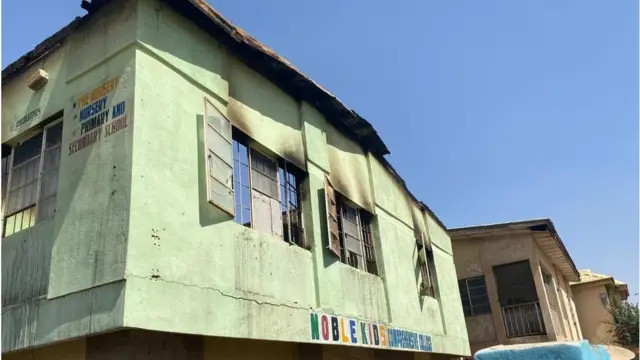
In the early hours of Monday, January 24, 2022, a mob set parts of Noble Kids Comprehensive College in Kano ablaze. This act of arson occurred days after the proprietor, Abdulmalik Tanko, confessed to the brutal murder of five-year-old pupil Hanifa Abubakar.
Even with the school already shut down by the state government and suspects in custody, public anger found a physical outlet in the destruction of the institution.
Fury burns noble kids, betrayal’s symbol
The fire was more than just property damage; it marked the moment collective outrage over Hanifa Abubakar’s death transcended administrative action and police investigations. It was a visceral manifestation of a community’s pain, targeting a building that had become synonymous with an unthinkable betrayal.
Noble Kids Comprehensive College, located in Kwanar Dakata, Nassarawa Local Government Area, was once simply a place of learning. But following Hanifa Abubakar’s disappearance in December 2021 and the subsequent revelations, it transformed into a potent symbol of a shocking crime.
Hanifa was a pupil there, and Abdulmalik Tanko, the man who kidnapped and murdered her, was the school’s proprietor. When investigators confirmed Hanifa’s remains were buried within premises connected to him, the line between the perpetrator, the institution, and the heinous act blurred irrevocably in the public mind.
The building itself acquired the full weight of the tragedy. It became the physical representation of shattered trust and profound sorrow. For a grieving community, this made the school vulnerable to the raw emotion surrounding Hanifa’s death, turning classrooms into a target for their anguish.
The First Spark of Outrage
The January 24 fire wasn’t the community’s first attempt to strike back at the perceived heart of the tragedy. Several days earlier, youths had reportedly tried to burn the building but were thwarted by security personnel deployed to maintain order around the premises.
This earlier attempt is crucial. It shows the arson wasn’t a spontaneous, isolated act. Tensions had been steadily building around Noble Kids Comprehensive College as details of Hanifa’s murder emerged. Security forces had evidently recognised the school’s potential as a focal point for public fury.
But the protective measures ultimately failed. The escalating public anger eventually overwhelmed official attempts to contain it, leading to the early morning attack on January 24.
A Community’s Retaliation in the Night
Residents interviewed by the Nigerian Tribune described youths descending on the school around 1 a.m. Most people in the neighbourhood were asleep when the blaze began, which quickly engulfed the upper floor of the one-storey building.
By morning, the damage was extensive, with shattered windows and blackened walls marking the physical scars of the community’s fury. The Kano State Fire Service and local residents worked to prevent further destruction, and police spokesman Abdullahi Kiyawa later confirmed the incident, noting no casualties from the fire itself. No arrests were immediately made in connection with the arson.
The timing was particularly striking. The government had already ordered the school closed on January 21, three days prior to the fire. It was no longer operational, and there were no children inside. The fire, therefore, served no practical purpose related to the investigation or the school’s closure. It was purely an expression of a community’s profound anger.
The deliberate targeting of the structure, even after official actions had been taken, highlights the deep emotional resonance the case held. It demonstrated how a place could absorb the trauma of an event, becoming a canvas for collective grief and rage.
The Weight of Association and the Rented Property
Why this particular building became the focus lies in its powerful association with the crime. Hanifa Abubakar’s tragic case forged an unbearable link between Noble Kids Comprehensive College and the death of one of its pupils. Public knowledge that Abdulmalik Tanko, the accused, was the proprietor, further solidified this connection.
Reports indicated Tanko had leveraged his position and relationship with Hanifa during her abduction. The discovery of her body on school premises made the physical environment even more disturbing. For the public, the school ceased to be mere walls and classrooms; it became the nexus where the horrifying story of Hanifa’s disappearance converged.
This symbolic identification explains why the school became the target, but it also masked a critical detail: the property itself was reportedly not owned by Abdulmalik Tanko. Residents, like Malam Ibrahim Muhammad, told the Nigerian Tribune that the building was rented, raising questions about the fairness of the destruction.
This distinction often evaporates when public anger reaches its boiling point, transforming a business, its name, and its associated property into a substitute target for collective wrath.
Beyond Administrative Action: The Scale of Outrage
The burning of Noble Kids Comprehensive College gained significance because it occurred after the Kano State Government had already taken decisive action. On January 21, authorities ordered the school’s immediate closure following the revelations surrounding Hanifa’s death. The state had effectively removed the institution from operation.
Yet, three days later, the building was attacked. The government’s response was administrative—shutting down an institution. The youths’ response was physical—destroying part of a building. Both actions stemmed from the same public outrage, but they represented fundamentally different ways of reacting to the crisis.
By January 24, the outrage had spread far beyond Kwanar Dakata, gripping the entire nation. The case generated intense national attention, with hashtags circulating widely across social media. The Kano government faced immense pressure to ensure justice, which led to further measures.
On the same day as the fire, the state announced the extraordinary step of withdrawing operational certificates for all private schools in Kano State, demanding revalidation. This demonstrated how Hanifa’s case had broadened into a systemic questioning of private school supervision.
The fire, however, wasn’t a policy decision; it was a visceral community reaction. It starkly illustrated that the anger was bigger than the school itself, a potent force that could not be contained by official directives alone.
The Physicality of Grief and Its Limits
Buildings connected to major tragedies often acquire an emotional charge, offering a tangible focal point for otherwise incomprehensible events. Hanifa Abubakar was a child, and her death was horrifying. The public’s anger was immense, yet anger itself has no physical form. A school, however, does.
Its gates can be approached, its walls seen, its rooms entered. For those consumed by fury, Noble Kids Comprehensive College presented a concrete object onto which the overwhelming emotion could be projected. The fire thus transformed the building into a visible symbol of the community’s profound grief and outrage.
But the destruction could not change the grim reality. By the time the fire erupted, the investigation was already advanced. Police had arrested Abdulmalik Tanko, Hashim Isyaku, and Fatimah Jibril. Authorities had recovered Hanifa’s remains. The Kano government had closed the school.
On the same day as the arson, the three suspects were arraigned before a Kano magistrates’ court on charges including criminal conspiracy, kidnapping, and culpable homicide. The fire could not bring Hanifa back. It could not establish guilt, nor determine a sentence. It could only destroy a physical place associated with the tragedy.
The Unsettling Question of Ownership
The fact that the building was reportedly rented by Abdulmalik Tanko, rather than owned by him, introduces a layer of complexity often overlooked in moments of intense public anger. While the school became a symbol of the crime, the actual owner of the property was likely an innocent party. This detail was not lost on some residents.
Those who spoke to the Nigerian Tribune condemned the arson, acknowledging the widespread grief but questioning the targeting of a rented property. This internal division within the community highlighted that public outrage is rarely monolithic.
Many sought justice for Hanifa Abubakar but differed on the appropriate form that collective action should take, especially when it inflicted harm on those only tangentially connected to the primary offense.
This particular aspect reveals how intense emotional responses, while understandable, can sometimes bypass nuanced considerations of ownership and responsibility. The symbolic weight of the school as a site of betrayal overshadowed the practical implications for an innocent property owner.
Betrayal of Trust and Its Wider Implications
The burning of Noble Kids Comprehensive College laid bare a deeper societal problem that Hanifa Abubakar’s murder had already exposed: the fragility of trust in institutions, especially when children are involved. Schools, more than many other organisations, depend entirely on trust.
Parents entrust their children to educators; teachers are given authority; proprietors control the learning environment. Communities operate on the fundamental assumption that these relationships protect children. When that expectation is violently shattered, the damage extends far beyond a single victim or institution.
Parents begin questioning the safety of schools, communities become suspicious of educational facilities, and government regulators face immense pressure to act. Institutions closely associated with an accused perpetrator can quickly become symbols of this profound betrayal.
Noble Kids Comprehensive College became inseparable in the public imagination from the tragedy surrounding Hanifa, a stark reminder of how quickly public confidence can erode and how devastating the consequences can be.
Insight: The Destructive Power of Symbolic Rage
The fire at Noble Kids Comprehensive College on January 24, 2022, offers a stark lesson in the dynamics of collective emotional response. Public anger, especially when fueled by a profound sense of betrayal and injustice, possesses a formidable power to transcend rational targets.
It can transform physical spaces into potent symbols, drawing onto them emotions far more expansive and destructive than the facts alone might warrant.
The school was no longer just a building; it became a tangible representation of a community’s violated trust and unbearable grief. This incident reveals that in moments of extreme emotional trauma, the desire for an immediate, visible act of retribution can override considerations of practical consequence or even specific culpability.
It underscores how societal rage, when unchanneled, can inflict collateral damage, mirroring in a different form the very destruction it seeks to condemn.
This dynamic of symbolic destruction in the face of profound injustice remains a recurring theme in Nigeria, demonstrating how collective fury can seek an outlet, even when that outlet is imperfect or misdirected.
