




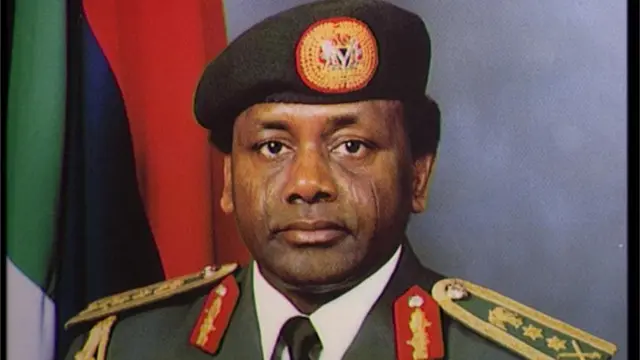
In 1995, as his government drew global condemnation for political repression, General Sani Abacha did something unexpected. He signed the decree establishing Nigeria’s National Human Rights Commission. It was a stunning contradiction from a leader whose rule was defined by the suppression of those very rights, even as Sani Abacha built infrastructure.
This single act captures the paradox of the Abacha years. For many, his name evokes only darkness: a brutal military dictatorship, the execution of activist Ken Saro-Wiwa, and the theft of billions. But another, more complicated story is written across Nigeria’s landscape in asphalt, concrete, and administrative boundaries.
Who Sani Abacha built his government with
When Abacha seized power on November 17, 1993, he inherited a nation on the brink. The annulment of the June 12 election had plunged Nigeria into political chaos. The economy was in a tailspin, with inflation soaring at 54% and foreign reserves depleted to just $494 million.
Public infrastructure was crumbling. The political uncertainty that followed the collapse of Ernest Shonekan’s Interim National Government crippled investment. Abacha stepped into a vacuum, leading a country desperate for direction. His regime was born from crisis, and its actions were shaped by the deep fractures in the nation’s economy and politics.
The administration’s approach mixed iron-fisted political control with ambitious, and surprisingly visible, development projects. It sought to restore a sense of order, not through democratic consensus, but through a top-down developmental agenda funded by oil revenue.
What they did
The most significant pillar of Abacha’s developmental push was the Petroleum Trust Fund (PTF), established in 1994. Chaired by a future president, Muhammadu Buhari, the PTF channeled oil revenue directly into infrastructure projects. Its mandate was simple: make Nigeria’s oil wealth tangible for ordinary people.
For the first time in years, Nigerians saw dilapidated roads being rehabilitated across the country. The PTF intervened in education, supplying schools with materials. It equipped hospitals, funded water supply projects, and became the most visible sign of government activity in a generation. Its impact was felt in major cities like Lagos and Port Harcourt and in smaller communities.
On October 1, 1996, Abacha fundamentally redrew Nigeria’s map. He announced the creation of six new states: Bayelsa, Ebonyi, Ekiti, Gombe, Nasarawa, and Zamfara. This act responded to decades-long agitations for more local autonomy and brought the number of states to 36.
These weren’t just lines on a map; they were new centres of administration, civil service, and political power, addressing some of the regional rivalries embedded in Nigeria’s structure. The colonial blueprints that shaped Nigeria’s initial regions had long been a source of tension.
Alongside new states came an expansion of local government areas to 774. The goal was to bring governance closer to the people. His wife, Maryam Abacha, also spearheaded the creation of the National Hospital for Women and Children, which has since become the National Hospital in Abuja, the country’s leading public hospital.
In one of the era’s greatest ironies, the regime also established the Vision 2010 committee in 1996. This body brought together professionals to chart a course for Nigeria’s economic and political future, envisioning a prosperous, democratic society—a stark contrast to the reality of military rule.
What it cost or earned
The economic results of Abacha’s policies were, on paper, remarkable. By 1997, foreign reserves had swelled from $494 million to an impressive $9.6 billion. External debt was reduced from $36 billion to $27 billion. Inflation, which had crippled the economy, was tamed to just 8.5% by 1998.
This fiscal discipline, noted by economists like Adebayo Olukoshi, stabilized the nation’s finances. The government was running budget surpluses. For ordinary people, the gains were more concrete: rehabilitated highways, newly constructed urban roads in cities from Kano to Enugu, and better-equipped local clinics. The interventions by the PTF represented a rare moment where oil wealth translated into visible public good.
But the cost was immense and undeniable. These achievements were delivered by a regime that tolerated no dissent. The execution of the Ogoni Nine on November 10, 1995, made Nigeria a pariah state. Political opponents were jailed, and civil liberties were non-existent. The transformation of Nigeria’s public service and finances occurred under a cloud of fear.
The greatest contradiction lies in the money. While the government practiced fiscal discipline and built reserves, investigations after Abacha’s death in 1998 revealed that billions of dollars had been systematically looted from the treasury. The state was being built and plundered simultaneously.
The insight
The legacy of Sani Abacha forces a difficult conversation. It demonstrates that authoritarian power can be a brutally effective tool for development. A government that does not need to answer to voters or a legislature can execute ambitious, long-term projects with speed and decisiveness. It can impose fiscal discipline without popular consent.
Abacha’s government built roads, states, and institutions that remain part of Nigeria today. The 36-state structure is his. The National Human Rights Commission is his. Yet this physical legacy was built on a foundation of political repression and staggering corruption. His rule showed that development and democracy are not always aligned. One can exist without the other.
The enduring question Abacha’s legacy leaves for Nigeria is profound. It reminds us that the capacity for large-scale national projects has always existed. The resources and planning that built roads and hospitals under a dictatorship did not disappear with the return to democracy.
This history serves not as a defence of tyranny, but as a challenge to democratic governments that have followed. It asks: what if that same ambition and focus could be paired with accountability, transparency, and freedom?
That is the question Nigerians still grapple with today, echoing the choices made by leaders in other critical moments, like the General who stood against revenge in a time of national crisis. Nigeria’s potential has never been in doubt, only the character of the leadership chosen to unlock it.
