




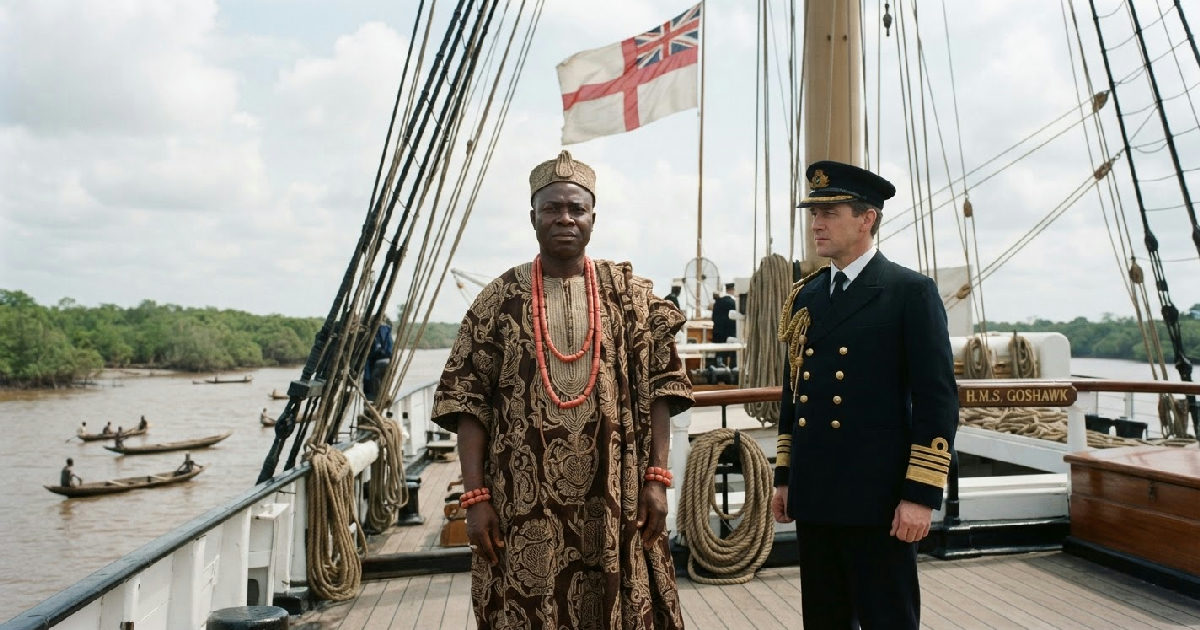
Palm oil kingdom then: the trader king
In 1887, a British consul invited King Jaja of Opobo, the most powerful merchant in the Niger Delta, aboard a warship for negotiations. The consul, Harry Johnston, promised the king his safety. It was a lie. Once aboard, Jaja was arrested, put on trial, and exiled to the West Indies. He would die before ever seeing his home again.
The charge was ‘obstructing trade’. But Jaja’s real crime was being too successful. He had built a commercial state so powerful that it threatened Britain’s own ambitions. His story is not just about the fall of one man, but about the moment when the pretence of partnership between African merchants and European traders collapsed into the reality of colonial conquest.
Who he was
Jaja was not born a king. Born in 1821 in Igboland, he was sold into slavery in the Delta city-state of Bonny as a boy. But in the unique society of the Delta’s trading houses, talent and ambition could rewrite a person’s destiny. The region was already a sophisticated commercial hub, crisscrossed by canoe routes that brought palm oil from inland producers to the coast.
This was an African world of trade, built by African entrepreneurs. European merchants arriving on the coast did not create this system; they plugged into it. They depended entirely on local rulers and merchant middlemen to supply the palm oil demanded by Britain’s industrial revolution for soaps, candles, and machinery lubricants.
Within this system, Jaja thrived, rising through the ranks of his trading house until he became its head.
What he did
Jaja’s genius was in understanding the shifting mechanics of power. By the 1860s, rivalries within Bonny were boiling over. In 1869, he made a daring move. He led his followers out of Bonny and founded a new state, Opobo, at a strategic point on the Imo River.
From here, he controlled the river’s mouth, and by extension, the primary routes to the palm oil producing interior.
Opobo became a major commercial power almost overnight. Jaja cut out the other Bonny middlemen and began shipping palm oil directly to British firms. He was a shrewd negotiator and a brilliant strategist, securing a near-monopoly. He even bought a steamship to transport his goods.
The man who had arrived in the Delta in chains now ran a kingdom built on palm oil, becoming one of the wealthiest men in West Africa.
But his success created friction. British merchants, whose own competition was increasing, grew frustrated. They wanted to bypass Jaja’s authority and trade directly with the inland markets for cheaper supplies. They began to frame their ambition in the language of ‘free trade’ — a concept that, for them, meant freedom for Europeans to trade wherever they wished, regardless of local sovereignty.
Jaja saw this for what it was: a challenge to his rule. He argued that the trade routes ran through his territory, and he had the right to regulate them.
When British officials presented him with a ‘treaty of protection’ in the 1880s, he famously had his own clerk strike out a clause that would have permitted unrestricted access for British traders. He was not against commerce; he was determined to control the terms of commerce within his own kingdom.
What it cost and what he earned
For a while, Jaja’s strategy paid off handsomely. He earned immense wealth, political power, and the grudging respect of the Europeans he outmanoeuvred. He demonstrated that an African leader could master the rules of international trade and build a modern state on its foundations. Opobo was his creation, a testament to his ambition and skill.
But the cost of his defiance was absolute. The industrialising powers of Europe were no longer content to be mere trading partners. Figures like George Goldie were consolidating British commercial interests, forming the United African Company which would soon receive a royal charter to become the Royal Niger Company.
These new entities blended commerce with political power, signing treaties and establishing a monopoly that strengthened Britain’s hand during the 1884 Berlin Conference. The colonial blueprints for Nigeria were being drawn.
Jaja’s independent kingdom was an obstacle to this new imperial vision. His arrest in 1887 was a calculated act of state. Britain was sending a message to every other ruler in the newly-declared Oil Rivers Protectorate: your sovereignty is conditional. After his removal, resistance crumbled.
The very commercial networks that African merchants had built were systematically dismantled or subordinated to British control. The path was cleared for total annexation.
The capture of a single, powerful man marked the end of an era. It was the moment trade became territory. A commercial dispute over palm oil provided the justification for a political takeover. Britain was no longer negotiating; it was ruling.
Jaja’s exile showed that the new order had no room for powerful African kings who insisted on their own authority, a dynamic that would eventually lead to a descent into chaos in a future nation.
The insight
King Jaja of Opobo’s life reveals a timeless truth about power. Economic strength does not guarantee sovereignty when it challenges a larger imperial force. Jaja mastered the world of commerce he was born into, but he could not stop that world from changing around him.
He believed he was in a contest over the price of palm oil, when in fact he was in a fight over who had the right to set the rules.
His story teaches that when a commercial relationship becomes too valuable, the more powerful party will seek to control it entirely. The language of ‘free trade’ can become a weapon to dismantle the authority of a competitor. Jaja’s legacy is a reminder that controlling a resource is not the same as controlling its destiny.
True power lies not just in participating in the global economy, but in having the strength to dictate the terms of that participation. It’s a question of political will and institutional strength, a lesson Nigeria has wrestled with ever since.
