




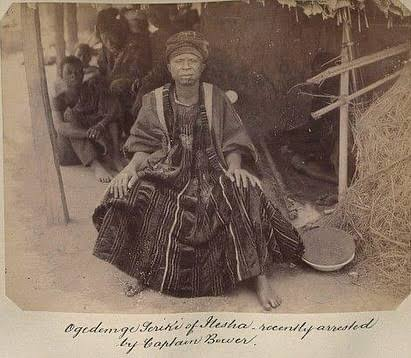
In June 1894, British administrative records captured a moment of profound colonial assertion in Ilesa.
Yet, the very colonial records that captured Ogedengbe’s arrest also present intriguing, sometimes unverified, claims. A particular point of historical contention emerges from the mention of a supposed subordinate, “Guregu,” described as Ogedengbe’s “principal Lieutenant” and “a great scoundrel” in a surviving colonial caption.
The darkness hidden in Colonial Yoruba Military Records
This fleeting reference, however, finds no corroboration in broader historical research, highlighting the complex and often problematic system through which colonial authorities documented—or misdocumented—Yoruba history.
The concept of “Guregu,” as an individual linked to Ogedengbe through a single, disparaging colonial caption, reveals a fundamental challenge in reconstructing Nigeria’s past. While the user-provided historical account points to this figure, extensive current research into Yoruba military history does not yield verifiable facts or a distinct historical figure by that specific name.
This discrepancy isn’t merely academic; it speaks to the systemic limitations and biases inherent in colonial-era documentation. Such records often prioritized the perspectives and objectives of the colonizers, sometimes reducing complex indigenous realities to brief, judgment-laden annotations. The existence of “Guregu” becomes less about the man himself and more about the Yoruba naming traditions and the system that created his fleeting, unverified historical imprint.
Ogedengbe’s Undeniable Historical Prominence
In stark contrast to the shadowy figure of Guregu, Ogedengbe’s place in Yoruba history is firmly established. Born Òrìṣàráyíbí Ògúndàmọ́lá in 1822 in Atorin, a small village near Ilesa, his life began with a prophecy. Oral tradition recounts a babalawo foretelling his destiny to liberate the Ijesa people on “Isegun Day” that year.
From a young age, Ogedengbe distinguished himself. He earned his childhood nickname for a unique wrestling technique, later evolving into Agbógungbórò, meaning “one who craves war as festivals,” after his formidable military career. He was a tall, handsome man with “the eyes of an owl,” a leader whose presence commanded respect and loyalty.
The Shaping Hand of British Administration
Ogedengbe’s rise coincided with a period of intense upheaval in nineteenth-century Yorubaland. The decline of the old Oyo imperial system had plunged the region into decades of conflict. New centers of military power emerged, and commanders like Ogedengbe gained influence that transcended local boundaries.
He became the Seriki, or commander-in-chief, during the 16-year Kiriji War, a brutal conflict from July 30, 1877, to March 14, 1893. This prolonged struggle pitted the Western Yoruba, primarily Ibadan, against the Eastern Yoruba, an alliance known as Ekiti-Parapo. Ogedengbe’s leadership of the Ekiti-Parapo confederacy was pivotal in helping to liberate northeastern Yoruba districts from Ibadan’s domination.
The Kiriji War and Indigenous Military Structures
Ogedengbe’s early military experience included being captured while defending Ilara-Mokin in 1864 and again during the Igbajo War of 1867. These experiences, including training from the Ibadan warrior Bada Aki-Iko, honed his tactical genius. He learned military intelligence, decoy strategies, and night attacks, skills he would later impart to his own soldiers.
His reputation was such that in 1878, war leaders specifically requested him to command the Ekiti-Parapo army. Prince Fabunmi voluntarily stepped down, a clear sign of Ogedengbe’s stature. His army, though often outnumbered by Ibadan’s, was renowned as a ferocious fighting force, held together by discipline, diligence, and Ogedengbe’s personal charisma.
This indigenous system of warfare, built on personal loyalty and battlefield prowess, would soon clash with a different kind of power.
Photography, Captions, and Historical Construction
The arrest of Ogedengbe by Captain Bower in 1894 was a watershed moment, illustrating the rapid imposition of a new political system. Bower, representing the expanding Lagos government and backed by armed constabulary forces, symbolized a shift from indigenous military power to colonial administrative authority. Ogedengbe, the warrior who had commanded thousands, now faced detention at the hands of a foreign official.
A photograph of Ogedengbe taken after his arrest survives in the Colonial Office photographic collection. The image is captioned: “Ogedemge Seriki of Hesha, recently arrested by Captain Bower.” This artifact offers a glimpse into the colonial practice of documenting prominent African figures.
But it also highlights the systemic inconsistencies: “Ogedemge” for Ogedengbe and “Hesha” for Ijesha or Ilesa, reflecting European officials’ phonetic interpretations of African names.
The Power of a Label: “A Great Scoundrel”
The notion of “Guregu” being described as “a great scoundrel” in a colonial caption, as presented in the user-provided source, underscores how subjective judgments could become entrenched in official records.
Even if the individual “Guregu” is not verifiable through wider scholarship, the *type* of description — a severe insult in nineteenth-century English — reveals a prevalent colonial mindset. Such labels were often applied to indigenous figures perceived as disobedient or disruptive to the nascent colonial order.
This system of labeling extended beyond individuals, often shaping perceptions of entire communities and their leadership. It highlights how colonial narratives, embedded in seemingly objective documentation like photographs and captions, could actively diminish the status and legitimacy of those they sought to control.
It’s a subtle but powerful way history can be manipulated through the very act of recording it. For those tracing the indigo legacy, the stories are very different.
The Silence and the Stories Left Untold
The absence of verifiable historical detail for a figure like “Guregu” in broader academic research serves as a stark reminder of the systemic gaps in our historical understanding of colonial Nigeria.
While commanders like Ogedengbe eventually earned their place in documented history through their sustained political influence and confrontations with British authority, many subordinates faded into obscurity. Their lives were rarely considered significant enough for detailed colonial record-keeping.
This silence isn’t just a lack of information; it’s a consequence of a historical system that privileged certain narratives and figures over others. The vast majority of individuals who shaped events, particularly those who were not in direct opposition or alliance with colonial powers, often remain unrecorded. This leaves future generations with an incomplete, sometimes distorted, picture of their past.
Reclaiming Narratives: Beyond the Colonial Gaze
The journey to understand Nigeria’s past involves critically examining the systems that produced its historical records. It means recognizing that colonial documentation, while a valuable source, is often incomplete, biased, and filtered through the lens of imperial ambition. The case of “Guregu” serves as a microcosm of this larger challenge: a fleeting mention, a harsh judgment, and then silence.
Reclaiming these narratives requires looking beyond official records, embracing oral traditions, indigenous histories, and the painstaking work of contemporary scholars. It’s an effort to piece together the full human story behind the broad strokes of colonial history, ensuring that the lives and contributions of all who shaped Nigeria are acknowledged. This deep dive into Yoruba identity often relies on uncovering hidden histories.
Ultimately, the story of Ogedengbe and the enigma of figures like “Guregu” illuminate the transformative period of nineteenth-century Yorubaland. It was an era where powerful indigenous armies gave way to formal colonial government, and where the very act of historical documentation became a tool—and sometimes a distortion—in the hands of the new authorities.
The task for us now is to sift through these layers, to distinguish verified history from colonial captions, and to reconstruct a fuller, more authentic understanding of who we were and how we came to be.
