




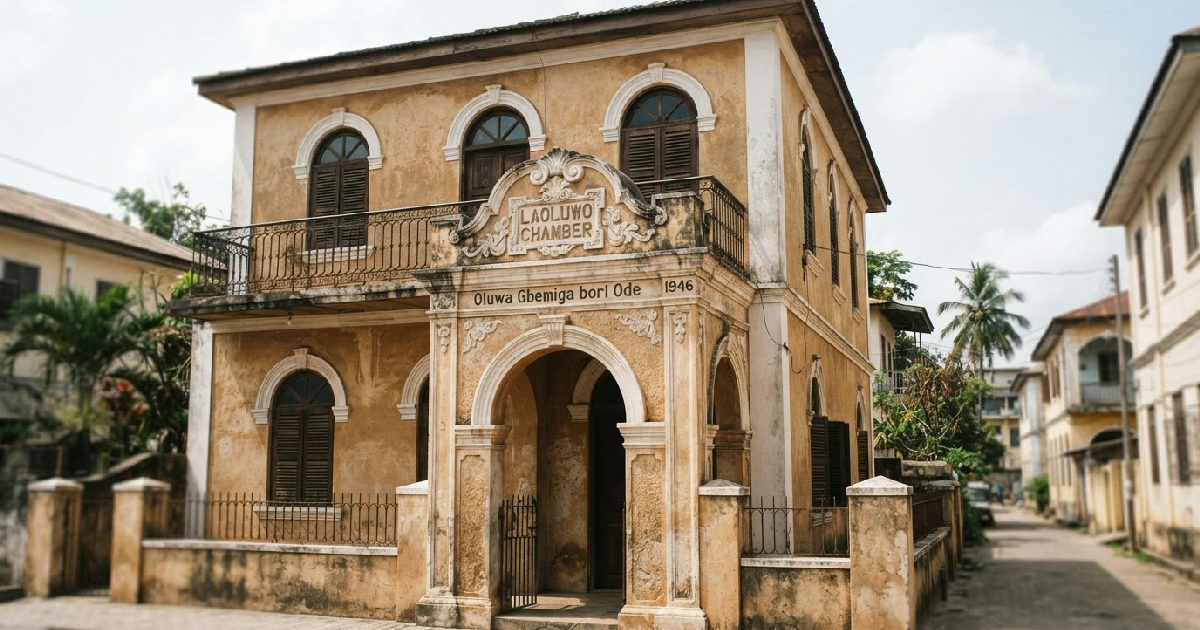
In a black-and-white photograph from mid-century Lagos, a building stands with an impossible story. It has the elegant arches and ornate plasterwork of Brazilian architecture. Yet, it bears a Yoruba inscription, “Oluwa Gbemiga bori Ode,” and proudly displays the year 1946 over an archway marked “Laoluwo Chamber.” This structure is a testament to the enduring legacy of Nigerias Brazilian returnees.
This single building, captured by a British photographer, is not an anomaly. It is a key to a chapter of Nigerian history that feels like fiction.
The homecoming of Nigerias Brazilian returnees that reshaped a city
It tells the story of people who were taken as slaves, forged a new identity across the Atlantic, and then returned to their ancestral homeland not as they left, but as something entirely new, changing the face of Lagos forever.
The common history of Lagos is often told through two lenses: its indigenous origins and its transformation as a British colonial capital. But this misses a crucial, vibrant thread. Starting in the 1820s, waves of formerly enslaved Africans, primarily of Yoruba descent, began returning to West Africa from Brazil. They were known as the Agudas.
By the 1880s, they accounted for nearly a tenth of Lagos’s population.
Their return was not a simple journey home. They brought with them new skills, a new religion in Catholicism, Portuguese names like de Silva and Moreira, and a unique cultural identity forged in the crucible of Brazil.
They settled on Lagos Island in an area that became known as Popo Aguda, the Brazilian Quarter, a neighbourhood formally demarcated in 1852. This was not just a settlement; it was the beginning of a profound cultural and architectural revolution.
This community’s story is woven into the fabric of Nigerian life during the colonial period, yet it stands apart as a narrative of self-driven transformation. The Agudas were not just re-assimilating.
They were actively building a new Lagos in their own image, bringing with them a vision of urban life that the city had never seen before, creating a unique layer in the city’s complex identity.
A new architecture for Lagos
The most visible legacy of the Agudas is the architecture they created. Many returnees had been forced to work in Brazil’s booming construction industry, where they became master masons, carpenters, and bricklayers. Freed and returned to Lagos, they put these skills to work, introducing a style that was both breathtakingly new and deeply influential.
They brought the sobrado, the iconic two-storey Brazilian townhouse, to the shores of Lagos. These houses were unlike the traditional compounds. They featured ornate plaster facades, elegant archways, and decorative ironwork. They were built to face the street, creating a new kind of urban landscape. These were not just houses; they were statements of prosperity, resilience, and a worldly identity.
The style became an instant sensation. Soon, it was not just the Aguda community building these magnificent homes. Wealthy Yoruba merchants and other prominent Lagosians began commissioning Afro-Brazilian artisans to build houses for them. The architectural DNA of Popo Aguda spread across the island, becoming a signature feature of Lagos’s urban renewal in the late 19th and early 20th centuries.
The hands that built the faith
The Agudas’ influence extended deep into the city’s spiritual life. While many returnees were Catholic, the community was not a monolith.
Figures like Saliu Salvador Ramos das Neves, a Yoruba Muslim enslaved in the Oyo region, returned from Brazil in 1857 to become a key figure in Popo Aguda, even founding one of its oldest mosques. This highlights the diverse experiences held within the returnee community.
Yet, it was in Catholicism that their building skills found their most monumental expression. When the Catholic mission in Lagos decided to build the Holy Cross Cathedral, they turned to Brazilian master craftsmen.
Lazaro Borges da Silva, Francisco Nobre, and Marcellino Ferreira are recorded as the master masons for the original church, which was completed in 1881. Their contribution was so fundamental that even when the original structure was replaced in 1934, Brazilian artisans were again involved in its construction.
The meaning of the house marked 1946
This brings us back to the photograph of “Laoluwo Chamber.” The building marked 1946 is significant precisely because it is so late. By that year, the original wave of returnees was long gone. The architectural style they had pioneered over a century earlier was no longer just the “Brazilian” style; it had become a Lagos style, a part of the city’s own visual language.
The house, documented by British educator Edward Harland Duckworth, shows how thoroughly this aesthetic had been absorbed. It reflects the continuation of building traditions that had powered the broader transformation of Lagos for decades.
Its existence in the mid-20th century is proof that the Aguda did not just build houses; they built a tradition that outlived them, shaping how Lagosians saw and built their city for generations.
The story of Popo Aguda is more than one of architectural influence. The returnees established businesses, participated in Atlantic commerce, and worked as skilled artisans and labourers, contributing to Lagos’s economic growth. Their descendants continued to develop identities shaped by both African ancestry and Atlantic connections.
This rich heritage is still celebrated today, most visibly in the Lagos Fanti Carnival, a vibrant procession of costumes and dance that echoes the cultural fusion the Agudas brought to the city.
A legacy of resilience
The Aguda story is complex. These were people who endured the horror of the transatlantic slave trade. They returned to an ancestral home that was now under British colonial rule. Some even participated in the very commercial inequalities of the Atlantic world that had displaced them. Theirs is not a simple story of heroes and villains, but a human story of adaptation and survival.
They came from different backgrounds and had vastly different experiences. The trigger for one major wave of returns was the 1835 Malê uprising in Bahia, Brazil, a revolt of mostly Muslim Africans. Its brutal suppression led many freed Africans to seek refuge back in West Africa. Others returned for commercial reasons, family ties, or simply the pull of home.
What they all shared was a hybrid identity. They were Yoruba, but they were also Brazilian. They were African, but they carried an Atlantic story with them. They did not choose one over the other. Instead, they fused them into something new, creating a community and a culture that was uniquely theirs, and uniquely Lagosian.
They stand as a powerful example of how professional roles could emerge and shape society.
The real story of Popo Aguda is not just in the beautiful, aging buildings that still line the streets of Lagos Island. It’s in the quiet resilience of a people who were taken, transformed, and returned—not to vanish back into the world they were taken from, but to rebuild it with skills and a vision acquired in a foreign land.
Identity is not just what you are born with. It is also what you build from the pieces you have left. The Agudas built a new identity for themselves, and in doing so, they gave Lagos a new face.
