




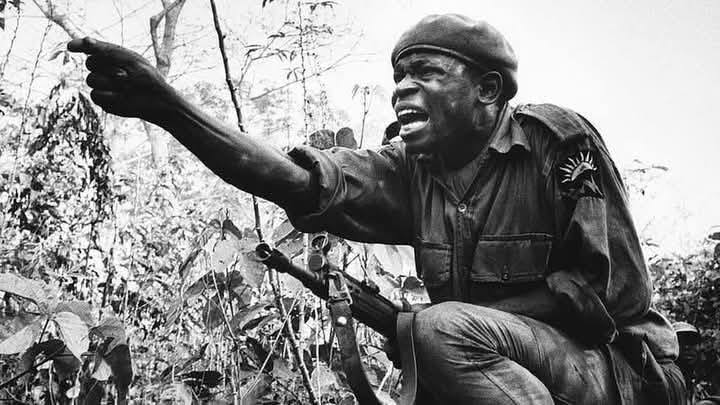
In August 1967, deep within the strategic crossroads of Ore, Federal Nigerian soldier Private Adisa Olanegan faced the harrowing reality of war.
This pivotal moment unfolded as Biafran troops launched an ambitious offensive, pushing westwards across the River Niger and into the Mid-Western State. Their advance threatened to engulf Western Nigeria and bring the conflict perilously close to Lagos, then the Federal capital. Olanegan’s experience offers a crucial counterpoint to the grand narratives of strategy and leadership.
Biafra’s audacious push into the Mid-West
The Republic of Biafra had declared its independence from Nigeria on May 30, 1967, under the leadership of Lieutenant-Colonel Chukwuemeka Odumegwu Ojukwu, then Military Governor of the Eastern Region. Tensions had escalated significantly following the political upheavals of 1966, culminating in armed conflict that July. Federal forces initially moved against the secessionist territory, but the landscape of the war shifted dramatically a month later.
On August 9, 1967, Biafran forces crossed the River Niger, opening a major new front in the war. This audacious move brought large sections of the Mid-Western State under temporary Biafran control. It marked Biafra’s most significant territorial expansion during the entire conflict, catching the Federal Government off guard.
Leading this westward offensive was Lieutenant-Colonel Victor Banjo, a former Nigerian Army officer. Banjo had been detained after the 1966 crises but was later released and became deeply involved with the Biafran military effort. His leadership propelled the rapid advance.
Biafran troops moved quickly through the Mid-West, capturing Benin City before continuing their push. Their trajectory eventually brought them to the critical Ore area, poised on the border with Western Nigeria. The speed of this advance sparked serious concerns within the Federal Government.
The strategic importance of Ore in 1967
Ore’s location made it an invaluable strategic prize in 1967. It lay directly along a key route towards Nigeria’s western regions and the Federal capital. The presence of Biafran troops there carried immense military and symbolic weight. Had their advance continued unchecked, the political fallout for Major-General Yakubu Gowon’s Federal Government could have been catastrophic.
The early success of the Mid-West campaign fundamentally altered perceptions of the war. Before August 1967, fighting had largely been confined to the Eastern Region’s boundaries. The move into the Mid-West demonstrated Biafra’s capability to launch major offensives far beyond its initial borders.
But the campaign couldn’t sustain its initial momentum. Federal forces, reorganising and mounting determined counter-offensives, began to push back. Long supply lines, internal political complexities within the occupied Mid-West, and growing Federal resistance gradually weakened the Biafran position in the west. This reversal would have profound implications for individuals caught in the fray.
A soldier’s fate amid the confusion at Ore
Private Adisa Olanegan’s story becomes intrinsically linked with this intense and chaotic phase of the war. He is remembered as a Federal soldier who sustained injuries and was subsequently captured during the fierce engagements around Ore. His experience lays bare an aspect of warfare often obscured by strategic maps and official reports.
Rapid advances and retreats invariably create immense military confusion. Soldiers can find themselves isolated from their units, wounded, captured, or simply declared missing. For families back home, this often meant months or even years of agonizing uncertainty, never knowing if their loved ones had survived the maelstrom.
The Biafran advance across the Mid-West happened so quickly that Federal forces hadn’t anticipated such swift losses. This disarray heightened the risks for individual soldiers on the ground. For Olanegan, the fighting at Ore wasn’t just another battle; it irrevocably altered the trajectory of his life.
His subsequent captivity stretched over a significant portion of the war’s thirty-month duration. By the time the conflict finally ended in January 1970, Nigeria had undergone monumental political, military, and social transformations. Olanegan’s capture made him one of the many human faces behind these changes.
The enduring human cost of the Nigerian Civil War
The Nigerian Civil War, a defining period in the nation’s history, is often narrated through the actions of its most prominent figures. Names like Major-General Yakubu Gowon, Lieutenant-Colonel Chukwuemeka Odumegwu Ojukwu, Lieutenant-Colonel Victor Banjo, and Major-General Philip Effiong loom large in these accounts.
However, this vast conflict involved millions more who never commanded armies or sat at negotiating tables. Their individual experiences, often unrecorded in official histories, provide crucial context.
Thousands of ordinary soldiers marched through unfamiliar terrains, endured brutal conditions, and faced injury, capture, or death. Civilians were displaced, families were torn apart, and communities were devastated. The humanitarian crisis, particularly within Biafra, became a poignant and defining feature, attracting global attention.
Hunger, disease, and mass displacement profoundly affected vast numbers of civilians, especially children. Federal soldiers, too, bore the brunt of prolonged military campaigns, battling across difficult landscapes and constantly shifting front lines. Every major military operation, beneath its strategic veneer, comprised countless smaller, individual histories.
Private Adisa Olanegan’s experience serves as a powerful reminder of this often-overlooked dimension. He wasn’t a policy architect or a commander, but rather one of the thousands who executed orders and lived through the direct consequences. His journey through capture and subsequent return embodies the personal toll of national conflict.
Capturing the conflict: Peter Obe’s lens
The visual record of the Nigerian Civil War is incomplete without acknowledging the vital contributions of photojournalists like Peter Oyeyemi Obe. Working for the Daily Times, one of Nigeria’s most influential newspapers of the era, Obe documented the political crises, military upheavals, and the brutal reality of the Civil War during Nigeria’s turbulent post-independence decade.
Photography played an especially critical role during this conflict, preceding the widespread impact of television and digital media. Newspaper photographs allowed Nigerians far from the front lines to witness the faces of soldiers, the plight of civilians, the damage to towns, and the stark scenes from military operations. These images, alongside other media of the era, played a crucial role in shaping public understanding.
Obe’s photographs became an indispensable part of this historical visual archive. In 1971, he published Nigeria: A Decade of Crises in Pictures, a collection that chronicled Nigeria’s tumultuous first decade after independence. This period encompassed profound instability, military coups, communal violence, and the civil war itself.
Through powerful images, such as those depicting soldiers returning from the conflict, the immense political crises of the era were distilled into individual human moments. These visuals helped shape the collective memory of the nation, making the war’s impact tangible and relatable.
The image of an ordinary soldier, like Private Adisa Olanegan, connected to specific campaigns such as Ore, reminds us that military history is ultimately human history, etched onto the faces of those who lived it.
The war’s winding path to January 1970
By late 1969, Biafra’s military position had severely deteriorated. Federal forces had steadily recaptured territory, tightening their grip on the secessionist state. Biafra faced critical shortages, widespread displacement, and relentless military pressure. The end was drawing near, but not without a final push.
January 1970 saw the Federal offensive reach its climax, bringing organised Biafran resistance to the brink of collapse. Recognizing the inevitable, Lieutenant-Colonel Chukwuemeka Odumegwu Ojukwu left Biafra. Major-General Philip Effiong then took on the difficult responsibility of formally ending the conflict, seeking to avert further suffering.
On January 14, 1970, a five-man Biafran delegation, including Effiong and the distinguished jurist Sir Louis Mbanefo, arrived in Lagos. Effiong formally accepted the authority of the Federal Government and announced the cessation of Biafran resistance. The war, after thirty months of brutal fighting, had finally concluded.
Major-General Yakubu Gowon’s government, in the immediate aftermath, heavily emphasised reconciliation as Nigeria moved into a challenging post-war period. His famous declaration, “no victor, no vanquished,” became synonymous with the Federal Government’s approach to national healing. A general amnesty accompanied the war’s conclusion, signaling a desire for unity. However, the path to peace was complex.
Return from captivity and the aftermath
The military surrender in January 1970 was just one facet of Nigeria’s transition from war to peace. Across the nation, countless soldiers had to make their way back to their formations and their waiting families. Civilians emerged from devastated communities, facing the daunting task of rebuilding their lives from scratch.
Displaced people desperately sought to return home, while families embarked on anxious searches for relatives who had vanished during the conflict. For prisoners and detainees, the end of the war brought the promise of release and the arduous journey back to freedom. This period of reintegration was filled with both hope and profound challenges.
For individuals like Private Adisa Olanegan, who had endured years of captivity, January 1970 represented something deeply personal. It offered the profound possibility of returning to a life violently interrupted by the conflict. Many soldiers who returned found their lives irrevocably altered, their experiences shaping their futures in unforeseen ways.
Their stories are not merely footnotes to history; they are integral to understanding the war’s enduring legacy. The struggle to reintegrate, to heal, and to make sense of their experiences continued long after the final shots were fired. It was a quieter, but no less significant, battle for many.
Beyond the generals and strategic maps
The Nigerian Civil War involved complex political manoeuvres, military strategies, and the leadership of powerful figures. But to truly comprehend its impact, we must look beyond these broad strokes to the granular level of individual experience. Private Adisa Olanegan’s story compels us to remember the thousands of anonymous servicemen whose lives were upended by decisions made in distant war rooms.
His experience at Ore, a microcosm of the wider conflict, underscores that national tragedies are ultimately borne by individuals. The strategic importance of a location, the movements of armies, and the declarations of leaders gain their profound meaning through the personal costs exacted on people like Olanegan. Understanding this personal dimension is crucial for any comprehensive historical narrative.
The visual memory of a captured or returning soldier, preserved through powerful photography, offers a raw, unfiltered glimpse into the realities of war. These images bridge the gap between abstract military history and the concrete human suffering it entails.
They ensure that the faces, emotions, and personal struggles of those who lived through the conflict are not forgotten, but instead serve as enduring lessons for future generations.
