




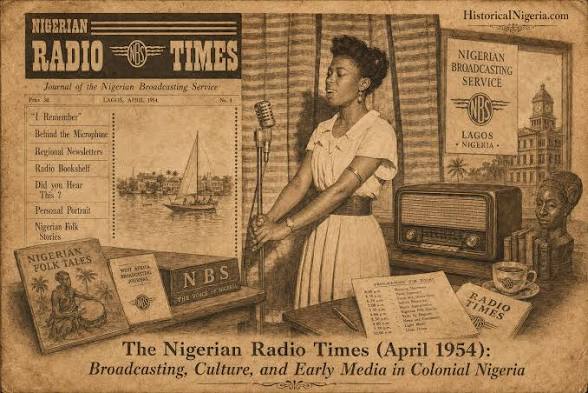
An issue of the Nigerian Radio Times publication, priced at just 3 pence, landed in Lagos kiosks in April 1954.
This was a time of intense political change, with the Lyttleton Constitution reinforcing regional autonomy and demands for self-government intensifying. The Nigerian Radio Times didn’t initiate Nigerian broadcasting, but its very existence signaled a crucial transition. It reflected a system that had matured enough to warrant a dedicated print guide, helping listeners navigate a new soundscape woven into the fabric of Nigerian life.
The printed bridge for Nigeria’s early airwaves
Long before the Nigerian Radio Times first hit newsstands, radio had already begun its quiet revolution across Nigeria. The British colonial government introduced the Radio Distribution System (RDS) in Lagos in 1932, operating initially under the Department of Post and Telegraph (P&T). This wasn’t broadcasting as we know it today, but a wired system.
It relayed programmes, predominantly from the BBC, through physical connections to subscribers. By 1935, this system became known as the Radio Diffusion System. It was a practical solution for extending reach within a specific framework.
The early days of wired radio distribution
The service expanded steadily beyond Lagos. By the 1940s, facilities had appeared in key urban centres including Ibadan, Abeokuta, Ijebu-Ode, Port Harcourt, Enugu, Kano, and Zaria. This expansion brought about 18.5 hours of programming a day to those who could afford to rent listening boxes.
By 1948, the system boasted approximately 8,000 subscribers across the country. But it remained largely a one-way street, heavily dependent on British content. This meant the early listening experience was filtered through a colonial lens, often lacking local flavour and direct engagement.
From colonial relay to national broadcast service
By April 1950, the Radio Distribution System transitioned into the Nigerian Broadcasting Service, introducing dedicated radio stations in cities like Lagos, Kaduna, Enugu, Ibadan, and Kano. A more formal institutional change came a year later, with the establishment of the Nigerian Broadcasting Service (NBS) in April 1951.
Based on a report submitted by Turner and Byron in August 1949, this new organisation brought broadcasting under a more developed national structure, expanding radio access across the country.
The programming diversified rapidly, incorporating music, educational talks, religious programmes, news, and other locally relevant content. Radio was no longer just a technological extension of British airwaves. It was increasingly embedded in Nigerian cultural and political life, speaking directly to Nigerian audiences and addressing their unique interests.
A magazine’s birth amid political shifts
The Nigerian Radio Times launched in January 1954, emerging during this crucial formative period for the NBS. Its April 1954 edition, Issue No. 4, was an early indicator of a broadcasting system gaining confidence and public importance. Its mere existence pointed to a new stage of development: broadcasting had become sufficiently organised and regular to sustain a printed programme journal.
The magazine itself reflected this burgeoning sophistication. It wasn’t just a dry listing of times and stations. Priced at 3 pence, it served as both a programme guide and a cultural platform. It included short stories, human-interest articles, and editorial features, integrating broadcasting into a broader literary and social context.
The Lyttleton Constitution and regional power
The timing of the magazine’s launch was deeply significant, coinciding with profound constitutional and political changes sweeping Nigeria. Constitutional negotiations during the early 1950s aimed to strengthen the country’s federal character, increasing the powers of its regions. This decentralisation would have lasting effects on Nigeria’s governance.
The Lyttleton Constitution, implemented in 1954, solidified a more federal arrangement between the central government and the Northern, Western, and Eastern Regions. As politics grew increasingly regionalised and demands for self-government intensified, broadcasting became a critical tool for both communication and political influence. It underscored the need for accessible schedules, particularly in urban centres where infrastructure was strongest.
Making the invisible visible
Radio, by its very nature, presented a challenge that print media did not: its content was ephemeral. Once a programme aired, it vanished into the ether. The Nigerian Radio Times offered a solution, transforming these invisible broadcasts into tangible, scannable schedules. This allowed listeners to plan their listening, making the broadcasting day visible on paper.
The magazine provided essential information about when programmes would begin, their subjects, and which services were transmitting them. This level of detail made radio more accessible and organised for a growing literate audience.
Later editions, such as a November 1957 issue, expanded to 22 pages, incorporating photographs and editorial material that gave faces to the voices heard on air. This created a richer, more engaging experience for listeners, extending the broadcast experience beyond the loudspeaker.
Nigeria’s shifting political landscape meant that media, both print and radio, would play an ever-more critical role in public life.
Listeners gain choice, broadcasters gain reach
The mid-1950s also marked a crucial shift in how Nigerians accessed radio programming. The distinction between wired distribution and independent wireless listening grew increasingly important. A wired service confined subscribers to its network, but an owner of a private wireless receiver enjoyed significantly greater freedom, provided they had adequate reception.
This technological leap complicated early attempts to segment audiences along administrative lines. Listeners could now tune into stations across Nigeria or even seek out international broadcasts. It was a subtle but profound democratisation of the airwaves, putting more power into the hands of the listener.
The freedom of private wireless receivers
The implications of this newfound freedom were immediately apparent. In 1954, officials in Northern Nigeria openly discussed the challenge of keeping local listeners tuned to regional programming. With private wireless sets, these audiences could easily pick up broadcasts from Ibadan or other distant stations, blurring regional boundaries for information and entertainment.
This rise of the private receiver meant audiences were no longer passive recipients of centrally-dictated content. They could actively choose, a dynamic that began to reshape the relationship between broadcasters and the public. This increased access helped forge a more informed and engaged citizenry.
Connecting Nigeria to the wider world
The international dimension of this change was equally significant. Radio waves transcended colonial borders, allowing Nigerian listeners to connect with political, religious, and cultural developments far beyond their immediate environment. The Emir of Gusau, for instance, famously requested information about frequencies for broadcasts from Egypt, the Gold Coast, Saudi Arabia, and Pakistan.
This desire for broader connections demonstrated a sophisticated awareness among some Nigerian listeners. It showed they were interested in global conversations, even as Nigeria navigated its own path to self-governance. Radio became a crucial link, bringing diverse narratives and perspectives into Nigerian homes. It also highlighted a growing demand for broader educational opportunities that radio could provide.
Evolution through corporation and television
The institutional framework of Nigerian broadcasting continued to evolve rapidly. The Nigerian Broadcasting Service (NBS) itself was soon succeeded by the Nigerian Broadcasting Corporation (NBC). This transition was legally formalized by the Nigerian Broadcasting Corporation Ordinance No. 39 of 1956.
On April 1, 1957, the NBC officially took over all functions of the NBS. Operating as a statutory public corporation, the NBC inherited responsibility for expanding broadcasting services in the final years of colonial rule, pushing towards a national identity through the airwaves. This shift was critical for positioning Nigeria’s media infrastructure for independence.
From Nigerian Broadcasting Service to corporation
The Nigerian Radio Times successfully navigated this significant change. A November 1957 edition of the magazine appeared after the NBC’s establishment, confirming its enduring role as a guide for listeners. This continuity suggested the magazine had become an integral part of the broadcasting ecosystem, an essential companion for a public hungry for programme information.
This institutional development happened just three years before Nigeria would gain full independence, highlighting the strategic importance placed on public information and cultural cohesion in the lead-up to self-rule. The formalization of broadcasting bodies was part of a larger trend, as various sectors of Nigerian society and government prepared for self-rule.
Western Nigeria Television shifts the landscape
The broadcasting landscape was fundamentally transformed yet again with the advent of television. In 1959, the Western Regional Government, under Premier Chief Obafemi Awolowo, established Western Nigeria Television (WNTV) in Ibadan. This was a pioneering effort, with WNTV beginning transmissions on October 31, 1959.
WNTV became the first television station in both Nigeria and Africa, marking a monumental step in the continent’s media history. Television expanded the very definition of electronic broadcasting, adding images to sound. Regional governments quickly recognised its power as an instrument for education, information, and cultural dissemination, intensifying political competition on a new front.
Nigerian Radio Times enters the radio and television era
The expansion of television naturally influenced the identity of the programme journal. By the 1960s, the publication had evolved to reflect this dual reality, adopting the title Nigerian Radio-TV Times. This change underscored a broadcasting environment where radio and television coexisted, each serving different, yet sometimes overlapping, audiences.
A June 1964 edition of the Nigerian Radio-TV Times showcases this adaptation. It appeared during a vibrant period for Nigerian music, entertainment, and broadcasting. The magazine continued its role as a comprehensive guide, indispensable for a public now navigating two electronic mediums.
The journal’s long journey through decades
The publication remained a fixture, associated with Broadcasting House in Lagos for much of the following decade. The Europa Year Book for 1971 listed the Nigerian Radio-T.V. Times and identified A. Y. S. Tinubu as its editor, confirming its continued importance. Its survival through these years speaks volumes about its utility to the public.
The magazine persevered into the later 1970s; broadcasting scholar Luke Uka Uche used an April 1977 edition for his study of Nigeria’s radio industry. Its tradition even extended into the 1980s. The National Library of Nigeria holds Radio-TV Times, Vol. 14, No. 1, dated January 1982, featuring content on education, entertainment, politics, sport, and finance, alongside schedules for both radio and television.
A legacy of adaptation in media
This remarkable longevity means the programme journal that began in the Nigerian Broadcasting Service era outlasted profound transformations in both broadcasting technology and Nigeria’s political landscape. It evolved from a guide for colonial-era wired radio to a comprehensive listing for a multi-platform national media system. This adaptability was key to its sustained relevance.
The journey of the Nigerian Radio Times illustrates how media institutions must adapt to survive and thrive. It also highlights the continuity of a core need: for audiences to understand and navigate the content available to them, regardless of the medium. The magazine’s evolution mirrors Nigeria’s own journey through decolonization and early nation-building.
Preserving a vanished soundscape in print
One of the most significant contributions of the Nigerian Radio Times lies in its permanence. Many early radio programmes, by their very nature, were not preserved for future generations. Broadcasts were transient, disappearing once transmitted. The magazine, however, offered a tangible, lasting record of this ephemeral art form.
Its printed schedules preserved the structure of a broadcast day, long after the original sounds faded. This allows historians and cultural observers today to understand what content broadcasters prioritised, how programmes were presented, and how these organisations communicated with their audiences. It serves as a vital historical artifact.
The enduring legacy of printed schedules
The value of these printed pages extends beyond mere listings. They offer a unique lens into the cultural values and public interests of the time. What was deemed worthy of broadcasting, from music to talks to news, reveals much about the society Nigeria was becoming.
The magazine’s content categories, like “I Remember” and “Behind the Microphone,” also provide glimpses into the human element of early broadcasting, connecting listeners to the personalities behind the voices.
Photographs and other editorial material further enriched this record, giving faces to voices previously known only through loudspeakers. This intimate connection helped build a sense of community around the emerging media. The magazine was an integral part of this process, solidifying the idea that broadcasting was a serious and structured endeavour. It is a critical piece of Nigeria’s broader cultural history.
A record beyond the airwaves
The Nigerian Radio Times doesn’t exist in isolation; it belongs to a wider historical record. This includes government reports, official broadcasting documents, newspapers, personal correspondence, memoirs, and any surviving audio recordings. Together, these materials paint a comprehensive picture of Nigeria’s early media development.
Instead, its foundations were carefully laid much earlier, through decades of innovation, adaptation, and formalisation. The magazine is a testament to the gradual, yet profound, process by which broadcasting became an organised and influential part of Nigerian public culture.
It captures a moment when the unseen world of radio was given a visible, enduring form, shaping how Nigerians would consume and engage with media for generations to come.
