




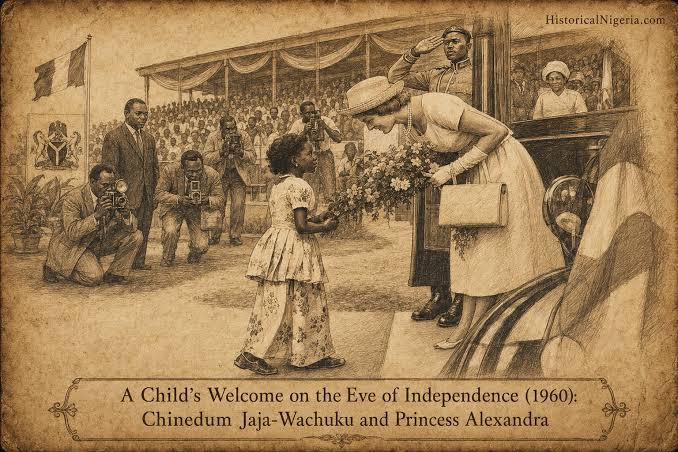
In 1960, eight-year-old Chinedum Jaja-Wachuku presented a bouquet to Princess Alexandra of Kent, cousin to the late Queen Elizabeth II, on Nigeria’s independence eve.
The photograph quickly became a touchstone, distilling a monumental political shift into a human encounter. But the story behind this charming scene extends far beyond a child’s gesture, encompassing decades of political struggle, constitutional negotiations, and the aspirations of a generation. It illuminates the delicate balance between continuity and change that defined Nigeria’s path to nationhood.
The path to self-rule and Nigerian sovereignty
Nigeria’s journey to independence was a protracted process, unfolding through various stages of constitutional development under British colonial administration. Nigerian political figures consistently advocated for greater autonomy, driving a series of constitutional conferences held both in London and within Nigeria itself. These discussions grappled with intricate issues like federalism, regional authority, and the framework of representation for the nascent state.
The culmination of these efforts arrived with the Nigeria Independence Act 1960, a legislative milestone passed by the British Parliament. This act formally paved the way for Nigeria to achieve full sovereignty within the Commonwealth, effective from October 1, 1960.
It meant more than a ceremonial change of flags; it fundamentally reshaped Nigeria’s relationship with Britain, placing the reins of national governance firmly in Nigerian hands.
Defining a nation’s new beginning
Lagos, then serving as the federal capital, became the central stage for the independence festivities. A grand programme of official ceremonies surrounded the transition, drawing Nigerian political leaders, foreign dignitaries, traditional rulers, and invited guests. These events were carefully orchestrated to publicly proclaim Nigeria’s arrival on the world stage.
The significance of Princess Alexandra’s presence during these celebrations cannot be overstated. As the Queen’s representative, her attendance underscored the diplomatic weight of the occasion. It also reflected a crucial aspect of Nigeria’s initial constitutional setup post-independence.
Jaja Wachuku: A central figure in the transition
The ceremonial encounter between Chinedum Jaja-Wachuku and Princess Alexandra gains deeper resonance when considering her father, Jaja Anucha Wachuku. Born in 1918, he was a pivotal figure in Nigeria’s nationalist movement, distinguishing himself as a lawyer, politician, and diplomat. By 1959, as the nation neared independence, Wachuku had already risen to become the first indigenous Speaker of the Nigerian House of Representatives.
His elevated position placed him at the very heart of the ceremonies marking Nigeria’s constitutional transformation. It was Jaja Wachuku who, during the independence proceedings on October 1, 1960, formally received the Instrument of Independence from Princess Alexandra. This act symbolically transferred authority from the British Crown to the newly independent Nigerian legislature, represented by its Speaker.
From the House to the world stage
The moment of receiving the Instrument of Independence brought together three entities undergoing historic change: Nigeria’s legislature, the British Crown, and the burgeoning Nigerian state. A photograph preserved by the National Library of Nigeria captures Jaja Wachuku, Prime Minister Sir Abubakar Tafawa Balewa, and Princess Alexandra together on that momentous day. It’s a potent visual testament to the senior figures who presided over the transition.
Jaja Wachuku’s contributions extended far beyond independence day. He became Nigeria’s first Ambassador and Permanent Representative to the United Nations from 1960 to 1961, and subsequently served as the first Nigerian Minister of Foreign Affairs from 1961 to 1965. His diplomatic efforts were instrumental in shaping Nigeria’s early international standing as an independent African nation.
His daughter’s participation in the independence ceremony thus linked a prominent political family directly to the public events of nation-building.
Princess Alexandra’s ceremonial duties and constitutional nuances
Princess Alexandra’s role during the independence celebrations was carefully defined and executed. Her presence as Queen Elizabeth II’s representative was not merely symbolic; it formed an integral part of the formal ceremonies that underscored Nigeria’s transition to sovereign statehood. British parliamentary records from shortly after the events acknowledged her diligent representation of the Queen.
The historical context reveals that Nigeria’s independence was the culmination of a vast and complex process involving Nigerian political leaders, nationalist groups, and extensive constitutional development. The royal presence was part of the public pageantry through which this historic handover was formally recognized.
Beyond the central independence day
Princess Alexandra’s official engagements didn’t conclude with Independence Day itself. Two days later, on October 3, 1960, she formally opened Nigeria’s independence Parliament. This occasion saw political officials, diplomats, and invited guests gather, further extending the public programme announcing Nigeria’s new status to both its citizens and the wider international community.
It’s a crucial distinction that while Nigeria achieved independence on October 1, 1960, becoming a sovereign nation within the Commonwealth, it did not immediately become a republic. Queen Elizabeth II initially remained Queen of Nigeria. Her constitutional functions were administered by the Governor-General, an arrangement that lasted for three years.
Nigeria officially transitioned to a republic on October 1, 1963, precisely three years after its independence. The Nigeria Republic Act 1963 ratified this new republican status within the Commonwealth. Dr. Nnamdi Azikiwe then became the President of the Federal Republic of Nigeria, marking another significant constitutional step.
The enduring impact of a single frame
The photograph of Chinedum Jaja-Wachuku and Princess Alexandra holds an enduring power, largely due to its inherent simplicity. So often, political history is chronicled through legislative acts, grand speeches, and the decisions of high-ranking statesmen. Yet, images like this reveal a different, more human dimension of historical moments.
They illustrate how profound political transitions were presented to the public, and how ceremonial encounters became etched into a nation’s collective memory. A Nigerian child presenting flowers to a British royal offers a perspective that contrasts sharply with formal portraits dominated by prime ministers and parliamentary leaders.
Symbolism beyond the bouquet
Bouquet presentations were standard protocol in royal and diplomatic circles. However, in the setting of Nigeria’s independence celebrations, this particular scene transcended mere formality. It became a powerful symbol within a much larger historical narrative, encapsulating the optimism and the complex interplay of relationships at the dawn of a new era.
At that moment, a Nigerian political establishment was formally assuming responsibility for an independent state. Representatives from foreign governments and the British Crown were present as witnesses. Photographers meticulously documented these carefully staged ceremonies, ensuring they would become an indelible part of Nigeria’s national heritage.
Echoes of the past in Nigeria’s present narrative
The ceremony of 1960, epitomized by the encounter between Chinedum Jaja-Wachuku and Princess Alexandra, was more than a singular event. It was the public culmination of a long and often arduous political struggle. Decades of demands for greater African participation in governance, fervent nationalist campaigns, and extensive constitutional reforms had led to this point.
Figures such as Nnamdi Azikiwe, Obafemi Awolowo, Ahmadu Bello, Sir Abubakar Tafawa Balewa, Anthony Enahoro, and Jaja Wachuku were central to this complex political landscape. They operated within an environment shaped by both national aspirations for unity and powerful regional interests, constantly navigating the path to self-determination.
The genesis of a nation’s character
Constitutional development gained significant momentum after the Second World War, with successive legal frameworks expanding Nigerian participation in government. Even so, debates continued robustly over issues like representation, the extent of regional autonomy, and the ultimate structure of the federation. By the late 1950s, Nigerian ministers held substantial governmental responsibilities, and political negotiations increasingly focused on the precise timetable and arrangements for full independence.
The federal election of 1959 played a critical role in solidifying the political leadership that would guide Nigeria into its independent future. Sir Abubakar Tafawa Balewa emerged as the country’s first Prime Minister, with Nnamdi Azikiwe taking on the role of Governor-General shortly thereafter.
Thus, the achievement of October 1, 1960, stood as the successful conclusion of a monumental constitutional and political journey, publicly marked by the ceremonies Princess Alexandra attended.
Nigeria entered independence on October 1, 1960, with considerable public expectation and grand ceremony. As Africa’s most populous state, it possessed immense economic potential and a political system designed to accommodate its diverse peoples and regions.
The photographs from these celebrations, capturing everything from Prime Minister Balewa addressing the nation to the Union Jack being lowered and Nigeria’s green and white flag rising, serve as invaluable historical records of that transformative moment.
The image of young Chinedum with Princess Alexandra remains a poignant reminder of the personal dimension within this national saga.
