




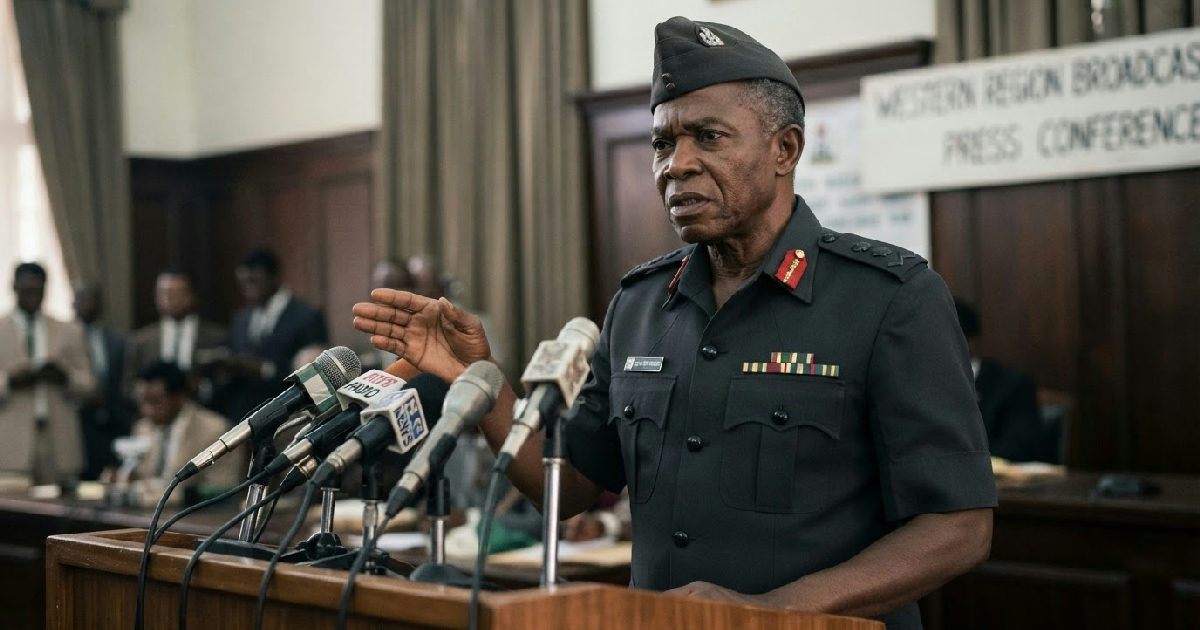
In May 1967, as Nigeria hurtled towards civil conflict, Robert Adeyinka Adebayo, then Military Governor of the Western Region, delivered a profound and chilling warning.
In a broadcast, Adebayo declared that any attempt to resolve the escalating crisis through force would lead only to “horror, devastation and extreme human suffering.” His words, a desperate plea for dialogue and political solutions, were largely ignored, paving the way for one of Nigeria’s most tragic chapters.
Robert Adeyinka Adebayo steps into the breach during turmoil
Appointed in August 1966 after the killing of his predecessor, Lieutenant-Colonel Francis Adekunle Fajuyi, Adebayo inherited a Western Region already reeling from intense political instability. His tenure began amidst a national collapse, marked by two military coups and rising ethnic tensions that threatened to tear the young nation apart.
Robert Adeyinka Adebayo was born on 9 March 1928 in Iyin-Ekiti, in present-day Ekiti State. He entered the West African military establishment in 1948 and was later commissioned as an officer.
He steadily rose through the ranks as the institution began transferring leadership from British officers to Nigerians. By 1964, Adebayo achieved a significant milestone, becoming the first Nigerian to hold the crucial position of Chief of Staff at Army Headquarters, a role he served in until 1965.
His extensive experience meant he was among the most senior officers when Nigeria’s political system fractured in 1966. The military coup of 15 January 1966 overthrew Nigeria’s civilian government, installing Major-General Johnson Aguiyi-Ironsi as Head of the Federal Military Government.
But Aguiyi-Ironsi’s regime struggled to stabilize the country, leading to a second, more violent coup on 29 July 1966. Both Aguiyi-Ironsi and Fajuyi, the military governor of the Western Region, were killed in Ibadan during this upheaval.
Lieutenant-Colonel Yakubu Gowon then emerged as Nigeria’s new military leader. On 4 August 1966, Adebayo was appointed military governor of the volatile Western Region, placing him at the epicenter of the looming national catastrophe.
The Western Region’s deep-seated unrest
Adebayo took charge of a region already scarred by years of political turbulence. The Western Region had experienced the divisive split within the Action Group, a federal declaration of a state of emergency in 1962, and controversial elections in 1965.
Widespread political violence had become a grim feature of its landscape. The military coups of 1966 added a national crisis to the existing regional tensions, marked by large-scale killings, particularly against Eastern Nigerians living in parts of Northern Nigeria.
Relations between Gowon’s federal government and Lieutenant-Colonel Chukwuemeka Odumegwu Ojukwu, the military governor of the Eastern Region, rapidly deteriorated. It was against this backdrop that Nigerian military leaders convened at Aburi, Ghana, on 4 and 5 January 1967.
The Aburi Accord aimed to avert armed conflict, with participants agreeing to renounce the use of force. But disputes over interpreting and implementing these decisions quickly emerged, pushing Nigeria closer to an irreversible rupture by spring 1967.
Adebayo’s prophetic words before the storm
Adebayo’s most enduring contribution to this critical period was his broadcast dated 4 May 1967. With Nigeria on the precipice, he explicitly warned that military action would inevitably lead to “horror, devastation and extreme human suffering.”
He argued that when the fighting eventually ended, military action would prove “futile, entirely futile, in solving the problems we set out to solve.” His address to Yoruba Leaders of Thought at Western Hall, Agodi, Ibadan, on November 16, 1966, had already set this tone, acknowledging the region’s prolonged struggle and calling for divine mercy for the wrongs committed by leaders.
The timing of Adebayo’s warning was particularly crucial. It came before Ojukwu’s declaration of the independent Republic of Biafra on 30 May 1967 and well before full-scale hostilities erupted in July.
He wasn’t reflecting on past destruction but actively cautioning against future horrors as negotiations crumbled. His core message was clear: a military victory could never truly settle a political dispute or restore trust.
A changing federal landscape and direct threats
Just weeks after Adebayo’s potent warning, Nigeria’s administrative map was redrawn dramatically. On 27 May 1967, Gowon announced the creation of twelve states, replacing the existing four-region structure.
This reorganisation split the Eastern Region into three states and reconfigured others. Lagos State, for instance, was carved separately from territory that included Lagos and areas formerly administered as part of Western Nigeria. Adebayo, who had been military governor of the Western Region, continued in office as military governor of the newly constituted Western State.
Three days later, Ojukwu declared the Republic of Biafra, escalating the constitutional crisis into its final pre-war phase. The Nigerian Civil War formally commenced in July 1967, testing Adebayo’s earlier stance against force.
Despite his calls for dialogue, Adebayo didn’t withdraw from the federal system once the war began. When Biafran forces crossed the River Niger in August 1967, invading the Mid-Western State and advancing towards Ore, a direct threat emerged for Western Nigeria and potentially Lagos. Adebayo responded decisively.
He ordered the demolition of bridges into the West to hinder the Biafran advance. His actions reveal a pragmatic understanding: while he opposed initiating war to solve political issues, he was a soldier responsible for defending his territory against an existing threat.
He recognized military force could repel an invasion but could not, by itself, heal the underlying political grievances. This distinction is central to understanding his complex legacy.
Facing down the Agbekoya uprising
Even as the Civil War raged externally, Adebayo’s government contended with another major crisis within the Western State: the Agbekoya farmers’ uprising. This movement, reaching its height in 1968 and 1969, emerged among Yoruba farmers, particularly around Ibadan and other western areas.
These farmers protested against what they viewed as unfair taxation, official assessments, and local administration policies that disproportionately burdened rural communities. What began as organised resistance soon escalated into direct confrontations with government authority.
In some instances, administrative facilities were attacked, prisoners freed, and clashes ensued as the state attempted to reassert control. This revolt highlighted the limitations of coercion, even within his own jurisdiction, demonstrating that government pressure alone couldn’t quell deep-seated discontent.
Negotiation and concessions eventually became necessary to achieve a settlement. Chief Obafemi Awolowo played an important mediating role, working alongside farmers’ representatives, local leaders, and government officials to broker a resolution. Adebayo’s administration ultimately engaged in this political settlement, helping bring the confrontation under control.
The uneasy path to post-war reconciliation
The Nigerian Civil War officially ended in January 1970, following the collapse of organised Biafran resistance. Gowon’s government announced that there would be no victor and no vanquished, presenting reconciliation, rehabilitation and reconstruction as the foundations of the post-war settlement.
For Adebayo, the war’s end brought a new, yet familiar, challenge. Gowon appointed him to chair a committee tasked with the reconciliation and integration of former Biafrans back into Nigeria. This assignment subtly echoed Adebayo’s earlier conviction that military triumph alone couldn’t resolve Nigeria’s fundamental problems.
But post-war reconciliation proved difficult and uneven. While Adebayo became associated with national healing, the broader political atmosphere reflected a harsher reality. The execution of notorious criminal Ishola Oyenusi in 1971, for instance, offered a stark look at the societal challenges of the immediate post-war era.
The _TIME_ magazine in January 1972 reported that Adebayo had expressed the view that the defeated Igbo should not be permitted to “win the peace,” reflecting the difficult political sentiments of the time.
Post-war reintegration itself was uneven. Some former Biafran officers were eventually readmitted into federal service, and many civilians rebuilt their lives. Yet numerous Igbo Nigerians also faced difficulties involving employment, property, economic recovery, and access to opportunities outside the former Biafran territory. Reconciliation therefore remained a long-term process rather than an immediate consequence of military victory.
Leaving the Western State and a lasting legacy
Adebayo remained military governor until April 1971. His tenure stretched across several distinct phases of Nigerian history: the aftermath of the July 1966 counter-coup, the final political crisis before the Civil War, the thirty-month conflict itself, the Agbekoya uprising, and the opening period of post-war reconstruction.
After leaving the governorship, he later served as Commandant of the Nigerian Defence Academy. He retired from the Nigerian Army in July 1975, with the rank of Major-General. In civilian life, he remained involved in Nigerian public affairs and became associated with political and Yoruba socio-cultural organisations. During the Second Republic, he was one of the prominent figures associated with the National Party of Nigeria.
In later years he was widely regarded as an elder statesman. Adebayo died on 8 March 2017, one day before his eighty-ninth birthday. Following his death, the Nigerian Senate formally honoured him, remembering his service as a former military governor and Commandant of the Nigerian Defence Academy.
The cultural narratives of figures like Celestine Ukwu, meanwhile, began to offer a different lens on Nigerian identity during these tumultuous decades.
A complex legacy of force and settlement
Robert Adeyinka Adebayo’s career unfolded during one of the most turbulent periods in Nigerian history. He entered the Western Region governorship after the killing of Fajuyi and inherited a country divided by military coups, communal violence, and competing ideas about the future of the federation.
Before the Civil War, he warned that military force would cause devastation without solving the political problems that had brought Nigeria to crisis. Once the fighting began, however, he remained a federal military governor and helped defend Western Nigeria when the Biafran advance threatened the region. His administration also confronted the Agbekoya uprising and eventually became part of a negotiated settlement.
After the war, Adebayo was associated with reconciliation and reintegration, although the wider post-war political environment remained difficult and contested. His legacy is therefore most meaningful when its complexity is preserved.
Adebayo was not a soldier who rejected force in every circumstance. He was a soldier who recognized something more difficult: force might defend territory or defeat an army, but military victory alone could not create political agreement, restore trust, or answer the constitutional questions that had produced Nigeria’s crisis.
That distinction remains the most enduring significance of his warning before the Nigerian Civil War. His story demonstrates why the history of the Nigerian Civil War cannot be understood solely through battlefield victories and defeats. His pre-war warning, wartime responsibilities, experience of the Agbekoya revolt and later involvement in reconciliation all point to the same historical lesson: political conflicts ultimately require political settlements.
Adebayo’s career was complex and sometimes contradictory, but his recognition that military power could not by itself resolve the grievances dividing a federation remains an important part of Nigeria’s twentieth-century history.
