




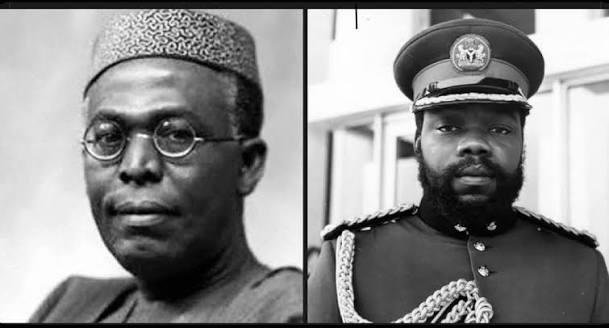
On May 30, 1967, Lieutenant-Colonel Chukwuemeka Odumegwu Ojukwu declared the Eastern Region an independent state, the Republic of Biafra. This act ignited Nigeria’s Civil War, a conflict that lasted until January 15, 1970, and was fought not just on battlefields but also through the ruthless logic of economic policy.
The decisions made during these years by figures like Chief Obafemi Awolowo would leave scars that persist decades later.
Question Awolowo Biafra’s currency war
Awolowo, as Federal Commissioner for Finance and vice-chairman of the Federal Executive Council under General Yakubu Gowon, held immense power over Nigeria’s economic and financial strategy. His influence shaped some of the most controversial measures of the war, policies that leveraged finance, currency, and even food supplies to undermine the secessionist state.
One of the most decisive economic maneuvers came on December 30, 1967. Nigeria’s Finance Commissioner, Chief Obafemi Awolowo, announced a swift, radical change: new Nigerian banknotes would replace the old between January 3 and January 22, 1968. It was a move designed to sever Biafra’s financial lifeline, preventing the secessionist government from using Nigerian currency to fund its war efforts.
This strategy of economic warfare aimed to invalidate the substantial holdings of Nigerian notes within Biafran territory. These notes represented a crucial asset for purchasing weapons and essential supplies abroad. The Central Bank of Nigeria described it plainly as a wartime strategy to prevent the “misuse” of currency by rebels. Such wartime economic shifts reveal critical aspects of Owerri recapture.
Biafra responded by introducing its own currency, the Biafran Pound, on January 28, 1968, with Sylvester Ugoh serving as the first governor of the Bank of Biafra. But the damage was already done. The Nigerian government claimed rebels had seized £37 million, while Biafrans asserted they had collected over £53 million by late January 1968.
Rendered largely unusable, these sums became a stark reminder of the financial isolation imposed on the breakaway state.
Starvation as a Strategic Weapon
Perhaps no aspect of the Civil War generates more enduring anguish than the deliberate use of starvation. As federal forces advanced, the shrinking Biafran enclave became a trap for millions of civilians and displaced people. The federal blockade of trade and conventional import routes created a humanitarian catastrophe.
International Committee of the Red Cross (ICRC) reports from 1968 painted a grim picture: widespread malnutrition, kwashiorkor, and severe hunger, particularly among displaced populations. Between 500,000 and 2 million Biafran civilians would ultimately die of starvation during the 2.5 years of the war, alongside approximately 100,000 military casualties on both sides.
Awolowo’s name became indelibly linked to the controversy surrounding food supplies. During a British House of Commons debate on July 10, 1969, Scottish MP Winifred Ewing referenced a June 26 Daily Times report.
She quoted Awolowo as saying: “All is fair in war and starvation is one of the weapons of war.” While British ministers noted General Gowon’s objection to starvation as a legitimate weapon, the quote amplified the ethical dilemma.
Humanitarian aid became entangled with military strategy. Federal authorities feared that night flights for relief operations could mask arms shipments. They insisted on inspected daylight flights or controlled surface routes. Biafran leaders, in turn, worried about the security risks of daylight flights and opening defensive lines for surface corridors.
Both sides, as American diplomatic reports confirmed, often placed security concerns ahead of the desperate need for aid.
The Post-War £20 Policy and Its Bitter Legacy
When the war ended, a new chapter of economic pain began with the controversial £20 payment. In 1971, though not fully implemented until January 1, 1973, the Nigerian Ministry of Finance issued a circular: former Biafrans whose bank records were lost or who held Biafran Pounds would receive a blanket payment of £20.
This was an ex-gratia award, a measure Awolowo reportedly initiated personally, bypassing the Federal Executive Council.
The policy meant that even those who had accumulated substantial wealth before the war, like Onitsha resident Chief J. J. Enwezor, faced near-total financial ruin. Enwezor, who deposited £26,659 in old Nigerian currency with the Central Bank on April 7, 1970, was later informed he was entitled only to the £20 ex-gratia award.
The Supreme Court of Nigeria rejected his claim for the full amount on March 19, 1976. Yet, some individuals like Arthur Nzeribe, who could prove their account balances, received their full funds, and Alex Ekwueme, with accounts outside the Eastern Region, also accessed his money.
But not all pre-war accounts were treated identically. The Banking Obligations (Eastern States) Decree No. 56 of 1970 provided a separate framework. It stipulated that some deposit accounts active on May 30, 1967, and unoperated during secession, could be honored at par. Other accounts varied based on transaction history and the decree’s provisions.
While this legal distinction existed, for the average person emerging from a devastating conflict, with businesses collapsed and financial records gone, the economic hardship remained severe.
The impact of this policy was profound and personal. Evelyn Okororie, a Biafran survivor, shared her story with CNN in 2020, recounting the devastating effect of the £20 payment. The policy remains a symbol of the economic inequalities and injustices that shaped the post-war settlement, demonstrating how economic decisions during wartime can have profound and lasting human consequences.
After the conflict, the government also acted to support some institutions. Chief Awolowo ensured the African Continental Bank (ACB) received £3.5 million to begin its rehabilitation, with another sum following later. He also paid the East Central State all their accumulated monies from the Federation Account for 1967-1970, having invested these funds during the war.
Awolowo’s Central Role in Federal Policy
Chief Obafemi Awolowo’s position as Federal Commissioner for Finance placed him at the heart of Nigeria’s wartime economic strategy. While General Yakubu Gowon insisted the £20 policy was a collective Federal Government decision, Awolowo’s influence on financial matters was undeniable. He openly defended measures designed to weaken Biafra’s capacity to fight.
However, reducing the entire federal strategy to one politician’s actions oversimplifies the reality of Nigeria’s military regime. The government comprised military commanders, Federal Executive Council members, various ministries, civil servants, and Central Bank officials. They all participated in developing and implementing wartime policies, even as individuals like Brigadier Murtala Muhammed, described as “virulently anti-Igbo,” held strong hawkish views within Gowon’s cabinet.
The complexities of governance during such a turbulent period meant that while Awolowo was a powerful voice, he operated within a broader institutional framework. His decisions, nevertheless, were instrumental in deploying finance as a weapon, shaping the course and duration of the conflict. Understanding this collective action provides deeper insight into Nigeria’s military system during this era.
The Lingering Questions of Economic Warfare
The Nigerian Civil War stands as a brutal lesson in how economic measures, intended to cripple a military foe, can devastatingly impact civilian populations. The 1968 currency change isolated Biafra financially. The federal blockade, while militarily strategic, led to mass starvation. And the £20 ex-gratia payment left many emerging from the war with little but shattered economic lives.
These events underscore a critical and painful truth: the distinction between attacking an enemy’s military and harming its civilians blurs when food, money, and trade become instruments of war. Millions of vulnerable civilians paid the highest price. This tragic intersection helped reshape modern international humanitarian law, particularly through the 1977 Additional Protocols.
The experiences of the Nigerian Civil War, especially the economic policies implemented, continue to resonate. They remind us that the decisions made in moments of profound national crisis can cast long shadows, shaping not just the immediate outcome of a conflict but also the generational memory and economic future of a nation.
It’s a powerful echo of how post-war economic policy can still feel the weight of past choices.
Beyond the Battlefield: The War’s Economic Aftershocks
The economic strategies employed during the war did more than just influence its outcome; they profoundly altered the lives of millions. The destruction of businesses, the loss of property, and the disappearance of financial records created a vacuum of opportunity for many in the Eastern Region. This widespread economic dislocation, coupled with the currency changes, forced a generation to rebuild from almost nothing.
The Civil War’s economic dimensions offer a crucial lens for understanding the deep-seated challenges Nigeria has grappled with since. The questions of resource control, regional economic disparity, and the psychological toll of financial devastation are all rooted, in part, in the deliberate policies of this era. They present a complex legacy, asking how a nation heals when its foundations are deliberately fractured.
Even decades later, discussions about Awolowo and Biafra often return to these financial and humanitarian policies, testifying to their lasting impact. The war did not just redefine Nigeria’s borders; it reshaped its economic landscape and the collective memory of its people. Understanding this period is crucial for grasping the ongoing struggle for unity and economic justice within the country.
A Nation Forged by Hardship and Policy
The Nigerian Civil War, a period of intense national strife, was undeniably influenced by the deliberate economic actions taken by the Federal Government. Chief Obafemi Awolowo, a central figure in General Yakubu Gowon’s administration, championed policies that crippled Biafra’s financial capacity and, by extension, its ability to sustain its fight.
These included the controversial 1968 currency change, the strict federal blockade, and the contentious £20 payment introduced in the war’s aftermath.
These measures, while serving the strategic goal of preserving Nigeria’s territorial integrity, inflicted immense suffering on the civilian population, particularly through widespread starvation. The humanitarian crisis that unfolded in Biafra remains a stark reminder of the devastating human cost when economic tools become weapons of war. It’s a story where the lines between military necessity and human tragedy became tragically blurred.
The financial decisions of this era, especially the £20 policy and its implications for pre-war bank accounts, continue to evoke strong emotions and debates about equity and justice. They speak to the profound challenges of post-conflict reconciliation and the economic rebuilding of a nation scarred by civil strife.
The history of Awolowo and Biafra is more than just a recounting of battles; it’s a deep dive into the complex interplay of politics, economics, and human suffering that defined a pivotal chapter in Nigeria’s making.
It compels us to examine how strategic choices in war leave indelible marks on the fabric of a society, long after the last shot is fired. This period offers enduring lessons on the responsibilities of leadership during conflict and the far-reaching consequences of policies on everyday lives.
