




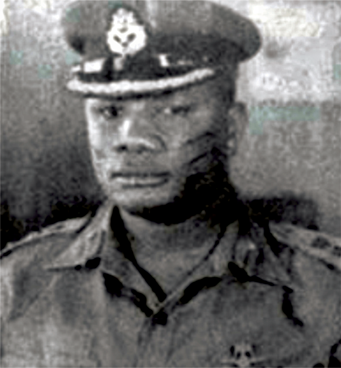
On Sunday, August 6, 1967, Colonel Joseph Akahan’s journey ended abruptly, a life cut short that mirrored Nigeria’s own tumultuous entry into nationhood. His career and the challenges he faced offer a unique lens through which to understand the development and complexities of Nigeria’s military system during a critical period.
Akahan, whose full name was Joseph Akaahan Agbo, was commissioned into the Nigerian Army just two months before independence. News of his life being cut short on August 6, 1967, near Makurdi, Benue Province, was reported the next day by the Daily Times. His story became a lens through which to view the profound evolution of Nigeria’s national structures and its nascent military system.
the colonial blueprint of Nigeria’s military system
Joseph Akahan was born on April 12, 1937, in Gboko, within what was then British-ruled Nigeria. He came of age during a period when the officer corps was still largely a product of British institutions and training. This colonial legacy dictated much about how Nigeria’s military would initially function.
His education at Government College, Keffi, from 1952 to 1956, led him to the Cambridge School Certificate. His formal military training began at the RWAFF Training School Teshi, Ghana, from 1957 to 1958, before he moved on to the Royal Military Academy Sandhurst in Britain from 1958 to 1960.
Akahan received his commission as a second lieutenant on July 23, 1960. This was a pivotal time, as Nigeria gained independence just over two months later on October 1, 1960. He belonged to a generation of Nigerian officers who joined the service as the armed forces underwent rapid Nigerianisation, with British officers steadily stepping back.
Despite this shift, the Army retained deep imprints of British organisation, drill, doctrine, and overall military culture. But the responsibility for command and decision-making was increasingly falling to Nigerian officers, marking a fundamental change in the system’s ownership. This era highlights how economic hardship and social shifts often intersect with military development.
the fracturing of the command structure in 1966
The stability of the newly independent Nigerian armed forces shattered dramatically in January 1966. A coup on January 15 saw the assassination of key political figures like Prime Minister Sir Abubakar Tafawa Balewa and Northern Region Premier Sir Ahmadu Bello.
Several senior military officers also lost their lives, including Lieutenant-Colonel Abogo Largema, who commanded the 4th Battalion at Ibadan. Major M. O. Nzefili, the second-in-command, initially took charge, but his position became difficult amid growing ethnic distrust. Major Joe Akahan then assumed leadership of the formation.
Akahan, a Tiv officer from the Northern Region, stepped into command at a volatile moment. Northern officers and soldiers were growing increasingly hostile towards the military government led by Major-General Johnson Aguiyi-Ironsi. This simmering tension erupted violently in July.
The night of July 28-29, 1966, witnessed the counter-coup launched by northern officers and soldiers, which quickly spread through military formations. General Ironsi was visiting Ibadan at the time, staying at Government House with Western Region Military Governor, Lieutenant-Colonel Francis Adekunle Fajuyi.
Elements of the 4th Battalion played a direct role in cordoning off Government House. Ironsi and Fajuyi were subsequently abducted and killed. Akahan, as commanding officer, was right at the heart of this upheaval, which saw Eastern officers killed by northern soldiers within the 4th Battalion.
This period exposed how severely military discipline had deteriorated. Formations were fractured by ethnicity, anger, and demands for revenge. Formal rank no longer guaranteed effective control over subordinates. The system, designed for a unified nation, was fraying along internal fault lines.
Akahan’s ascent within a new military order
The counter-coup brought an end to Ironsi’s government. After days of intense negotiations and uncertainty within the military hierarchy, Lieutenant-Colonel Yakubu Gowon emerged as the new Head of the Federal Military Government and Commander-in-Chief on August 1, 1966.
Akahan’s career continued its rapid ascent under this new military order. By 1967, he had reached the senior leadership of the Nigerian Army. His appointment, then styled Chief of Staff (Army), was the highest Army position. This title would only officially change to Chief of Army Staff in 1975, when Brigadier Theophilus Danjuma replaced Major-General David Ejoor.
The Federal Republic of Nigeria Official Gazette of June 22, 1967, confirmed Ministry of Defence promotions effective June 10. Government Notice No. 996 records J. R. I. Akahan, N/98, as receiving substantive promotion to lieutenant-colonel and temporary promotion to colonel. This meant Akahan held temporary colonel rank when the Nigerian Civil War began.
His swift promotion underscored the extraordinary speed at which younger officers were rising into senior command. The institutional upheaval of the 1960s, coupled with the depletion of Nigeria’s pre-1966 senior officer corps from the January coup, July counter-coup, and subsequent political reorganisation, created vast leadership vacuums.
At just 30, Colonel Joseph Akahan found himself in one of the military’s most demanding roles, a revealing moment for the country’s governance and resource allocation systems.
the exigencies of wartime operations: bonny and beyond
The Republic of Biafra had been declared by Lieutenant-Colonel Chukwuemeka Odumegwu Ojukwu on May 30, 1967, plunging Nigeria into war. Federal military operations commenced on July 6, 1967. While initial federal advances focused on Biafra’s northern flanks, plans were simultaneously underway for a crucial amphibious assault on its southern coastline.
Bonny represented a strategically vital objective. Its location in the Niger Delta was key to petroleum exports, and establishing a federal presence there would open a southern front against Biafra. The operation was a combined effort, involving both the Nigerian Army and Navy.
Akahan played a central role in developing the Army-side operational planning for the landing. Operational command of the participating land forces was entrusted to Lieutenant-Colonel Benjamin Adekunle. Naval involvement was equally critical, with Captain Nelson Soroh commanding the naval task force and Commander James Rawe contributing significantly to planning and coordination.
The Bonny operation demanded precise execution: troops moved by sea, supported by naval gunfire, complex communications, and intricate logistics. This required unprecedented cooperation between Army and Navy units. The federal task force sailed from Lagos, positioning itself off Bonny, and launched its assault on July 25, 1967, quickly establishing control.
This operation showcased the increasing sophistication of combined Army and Navy warfare within the evolving Nigerian military system. It secured a strategic position on Biafra’s southern approaches, opening a new theatre that would become increasingly important as the war progressed.
For Akahan, Bonny was a high point in his brief tenure at Army Headquarters, demonstrating the system’s capacity to adapt and execute complex operations under pressure.
the systemic shock of a wartime chief’s death
Less than two weeks after the Bonny operation began, Colonel Joseph Akahan was dead. On Saturday, August 5, 1967, he was travelling aboard Nigerian Air Force helicopter NAF501 when it crashed in the Benue area. Akahan and the two pilots aboard the aircraft were killed instantly. He was just 30 years old, with his official death date recorded as August 6, 1967.
His death came at a truly critical juncture, with the Nigerian Civil War still in its nascent stages. Federal military operations were rapidly expanding, new formations were being organised, and multiple fronts were taking shape. The Nigerian Army was transforming from a relatively small peacetime institution into a much larger wartime force, all while the political aftermath of the 1966 coups continued to reverberate.
Akahan’s sudden demise ignited political suspicion in the period’s tense atmosphere. Whispers and rumours circulated about the crash, and the political tensions within the former Northern Region, especially concerning relations between Middle Belt communities and other northern political interests, were amplified. His loss also created an immediate leadership void at Army Headquarters.
Lieutenant-Colonel Iliya Bisalla temporarily performed the duties of Chief of Staff (Army) in an acting capacity. Major-General Hassan Usman Katsina then formally assumed the senior Army staff position in early 1968. Akahan’s untimely death, though tragic for an individual, also highlighted the vulnerability of a command system still in its infancy, forcing rapid adjustments in a period of intense conflict.
The swift succession underscores the inherent fragility of leadership structures during wartime. Every appointment, every vacancy, carried immense weight. The systemic changes brought on by the war meant that roles had to be filled almost instantly, adapting to the relentless demands of conflict. Such moments reveal the pressures shaping Nigeria’s collective memory and its institutional responses.
a career mirroring military evolution
Joseph Akahan’s military life, though extraordinarily compressed, offers a clear mirror to the broader evolution of the Nigerian military. Commissioned just before independence, he gained critical overseas experience during the United Nations operation in the Congo. He then commanded the politically sensitive 4th Battalion during the 1966 upheavals, ultimately reaching the Army’s highest staff leadership at an incredibly young age.
His trajectory reflected the profound fractures that reshaped the Nigerian military during those turbulent years. The Army of the early 1960s, a relatively small institution emerging from colonial rule, was by 1966 shaken by two coups, assassinations, ethnic killings, regional distrust, and the near-destruction of its previous command structure. Akahan stood directly within this transformation, both a participant and a product of its forces.
His command of the 4th Battalion intrinsically linked him to the violence of July 1966. His subsequent work at Army Headquarters placed him squarely within the Federal Military Government’s preparations for war.
His involvement in planning the Army component of the Bonny operation connected him to one of the most significant early federal amphibious operations of the conflict. His story is a human thread running through the larger story of a military system in flux.
Even after his death, Akahan’s name remained part of Nigerian military memory. Joe Akahan Barracks in Makurdi was named in his honour, serving as a permanent association with the Army and with Benue State. This institutional memory, though honoring an individual, also serves as a subtle reminder of the profound costs and rapid evolution of the military system during Nigeria’s foundational crises.
