




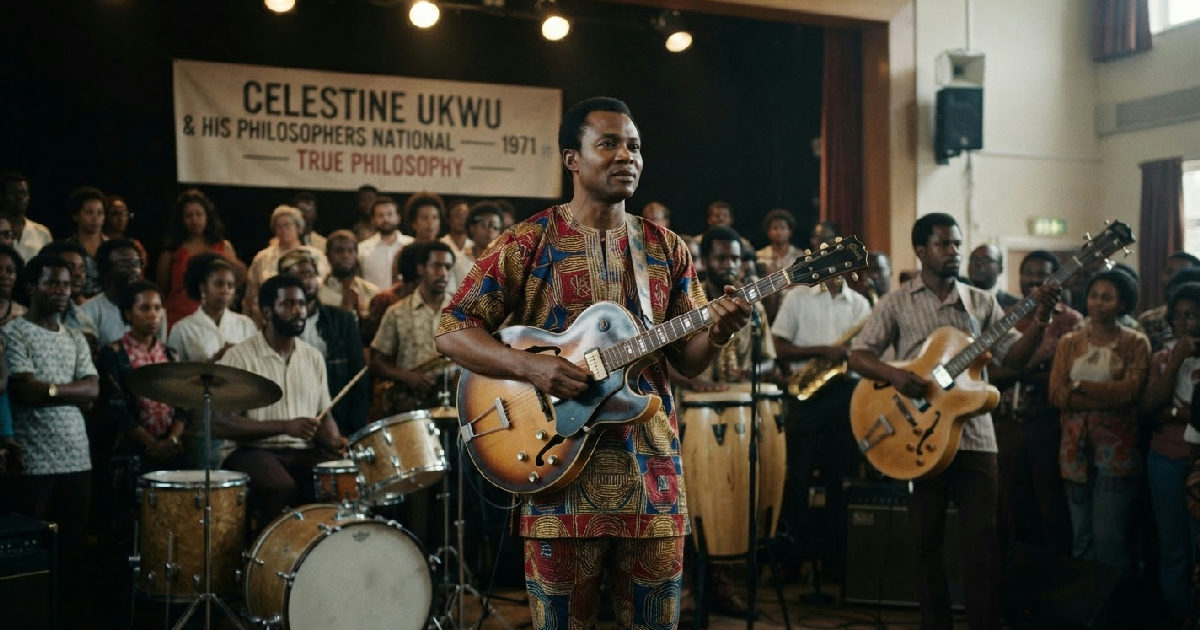
In 1971, Celestine Ukwu, Nigeria’s philosophical highlife maestro, released his album True Philosophy, offering solace and contemplation after a civil war. A nation still reeling from the ravages of a brutal civil war sought solace, meaning, and a path forward.
From this crucible emerged an album titled True Philosophy, delivered by Celestine Ukwu, Nigeria’s philosophical highlife maestro. His music wasn’t just for dancing; it was an invitation to contemplate life’s deepest questions.
Celestine Onwurah Ukwu, born on June 27, 1940, in Umuavulu-Abor, Enugu State, crafted a unique sound that fused traditional Igbo thought with modern highlife rhythms. His work offered a profound commentary on existence, morality, and human responsibility, securing his place as a seminal figure whose influence continues to be felt today.
The musical roots of a highlife pioneer
Ukwu’s journey into music began early, nurtured within a family deeply connected to sound. His mother, Udenwo Ukwu, was a respected lead singer in local women’s musical groups. His father, Anigbogu Ukwu, engaged with traditional forms including Igede, Ikpa, and Ode, creating an immersive musical environment.
A pivotal figure in his early development was his uncle, Vincent Ukwu. An organist, Vincent introduced the young Celestine to musical notation and the harmonium. Ukwu pursued teacher training in Zaria, obtaining a Teacher’s Grade Three Certificate in 1958. He worked in education before music became his singular focus.
His professional career truly launched in 1962, when he joined Mike Ejeagha’s Paradise Rhythm Orchestra in Enugu. There, he honed his skills as a vocalist and maraca player. He expanded his horizons further by touring the Democratic Republic of Congo with Mr. Picolo’s band, gaining exposure to diverse musical landscapes.
Forging an identity in 1960s Nigerian highlife
By the mid-1960s, Celestine Ukwu was navigating a vibrant yet competitive Nigerian highlife scene. It was an era defined by luminaries such as E. C. Arinze, Bobby Benson, Victor Olaiya, Rex Jim Lawson, Stephen Amechi and Stephen Osita Osadebe. Ukwu steadily built his reputation, performing with various groups before leading his own.
His early recordings, including No Condition Is Permanent, Artificial Beauty, Appolonia, and Ije Enu, started to establish his name. These tracks hinted at the reflective depth that would later define his sound. By 1966, he had formed Celestine Ukwu & His Music Royals of Nigeria, a band that played regularly at the Phoenix Hotel in Onitsha.
The Music Royals represented his burgeoning musical identity. But the optimism of the mid-decade soon collided with the grim realities of the Nigerian Civil War. This conflict would irrevocably alter the course of Ukwu’s career and the broader cultural landscape.
War, displacement, and evolving musical sounds
The Nigerian Civil War, spanning from 1967 to 1970, brought immense disruption, particularly to the social and cultural fabric of eastern Nigeria. Highlife music, once a unifying force, found its performance circuits and commercial networks shattered. Musicians like Ukwu, who hailed from the East, were displaced and their opportunities to tour and record dried up.
Amidst the turmoil, Ukwu remained musically active, even recording “Hail Biafra!” to rally support and boost morale. His experience during the war, like many others, was shaped by circumstances far beyond the usual pressures of the entertainment industry. The war years were a stark reminder of life’s impermanence, a theme that would deeply infuse his later compositions.
When the war concluded in January 1970, Nigerian popular music entered a period of profound transition. While highlife retained its importance, it faced increasing competition from emerging genres like Jùjú, Afro-rock, and funk. These new sounds began to capture the attention of younger musicians and audiences across the country.
Yet, in eastern Nigeria, highlife endured as a vital musical tradition. Artists including Stephen Osita Osadebe, Mike Ejeagha, The Peacocks, and Celestine Ukwu himself worked to sustain and reshape the genre. They adapted it to reflect the changed realities of a society grappling with loss and reconstruction. The period immediately following the war saw a post-war shift in the nation’s collective psyche.
The birth of Philosophers National and True Philosophy
The year 1971 marked a crucial turning point for Celestine Ukwu. It was then that True Philosophy, an album that would cement his legacy, appeared under the banner of Celestine Ukwu and His Philosophers National. The album, featuring ten tracks, was a bold statement of his artistic vision.
Songs like Igede, Ilo Oyi, Ije Enu, Onwu Bu Ugwo, Uwa Bu Olili, Akwa Ana Ebe L’Ego, Onye Akwana Uwa, Uso Ndu, Ife Si Na Chi, and Onwunwa showcased his intellectual depth. They explored profound questions of human existence, conduct, suffering, and destiny.
The album title itself perfectly encapsulated the intellectual character of his music, setting him apart in the highlife genre.
His philosophical approach resonated widely, earning him recognition beyond musical circles. In 1972, students at the University of Nigeria, Nsukka, honored Ukwu during an appearance at Margaret Ekpo Hall. They celebrated his unique contribution, acknowledging how he made popular music a vehicle for serious thought. Building new institutions and financial structures became a priority for the nation during this era of rebuilding.
More acclaimed recordings followed throughout the 1970s, including Tomorrow Is So Uncertain, Ndu Ka Aku, Ilo Abu Chi, Ejim Nk’Onye, and Igede Fantasia. These works collectively formed the bedrock of his enduring reputation, solidifying his status as a maestro who made people think as well as dance.
Melodies of meaning: Ukwu’s philosophical message
Celestine Ukwu elevated highlife beyond mere entertainment, transforming it into a medium for sustained philosophical reflection. He consistently returned to themes of human impermanence and the transient nature of worldly possessions. His songs underscored that wealth and social status could vanish in an instant, and that death remained an unavoidable certainty.
He challenged listeners to consider not just their material gains, but the morality of their actions and how they treated others. His compositions explored ideas of equality, personal responsibility, forgiveness, and the consequences of human conduct. Ukwu also considered concepts of destiny, examining the interplay between individual effort and forces beyond human control.
These profound concerns were deeply rooted in Igbo systems of thought and oral expression. Ukwu masterfully wove proverbs, moral concepts, and ideas about personal destiny and communal responsibility into the intellectual foundation of his music. This allowed his work to resonate deeply with an Igbo audience, who recognized the cultural echoes within his lyrics.
Yet, the questions Ukwu posed were universally human. What value does wealth hold if life itself is temporary? How should individuals interact with one another? What happens when fortune inevitably shifts? How much agency does a person truly possess over their own future?
These timeless inquiries allowed his music, though rooted in Igbo culture, to transcend geographical boundaries and speak to listeners far beyond his immediate community. Discussions about Nigeria’s civic space continue to shape contemporary Nigerian discourse.
The distinctive sound of Igbo highlife
Ukwu’s philosophical depth was complemented by a meticulously crafted musical language. He blended modern highlife instruments like guitars, keyboards, and percussion with traditional Igbo elements. His signature sound incorporated instruments such as the ogene and the vibraphone, along with lush group vocal harmonies.
The vibraphone, in particular, became synonymous with the introspective atmosphere of his recordings. Its unique tonal quality contributed to the spacious and reflective character that defined many of his compositions. Ukwu’s vocal delivery was controlled and nuanced, ensuring that the lyrical messages remained central. The instrumental arrangements then provided rhythm, atmosphere, and melodic richness.
While his music was thoughtful, it was never uniformly slow or melancholic. Tracks like Igede, for instance, pulsate with the rhythmic energy and instrumental vitality characteristic of highlife. Ukwu possessed a rare ability to create music that simultaneously encouraged physical movement and deep contemplation.
Language was another crucial tool in his artistic arsenal. He sang extensively in Igbo and also recorded material in English and Nigerian Pidgin. He leveraged Igbo’s proverbs and forms of expression directly connected to the culture from which his philosophy sprang. His compositions were modern, yet they never strayed from their profound cultural origins.
A sudden end, an enduring legacy
Celestine Ukwu’s remarkable career was tragically cut short in May 1977. He died following a road accident at the age of 36 or 37, a stark reminder of the very impermanence his songs often addressed. While some sources cite May 7, 1977, others suggest May 8, 1977, as the date of his passing.
The accident occurred along the Onitsha-Owerri Road, near Ogidi. Emma Ikediashi, a guitarist who worked closely with Ukwu, recalled that the musician had been traveling with a friend named Nwobodo when their vehicle collided with a trailer. This sudden loss came just as further opportunities for his career were beginning to emerge, with Ukwu reportedly preparing for an overseas musical engagement.
His death meant that The Philosophers National could not maintain its original identity without its central figure. Yet, Ukwu’s extensive recordings continued to circulate, preserving his distinctive musical voice for generations to come. Today, interest in Celestine Ukwu remains strong, long after the vinyl era of his most influential work.
In May 2025, the documentary Ije Enu, produced and directed by Chikezie Ifedobi of Q-Toz Productions, received its first public showing during the second Celestine Ukwu Memorial Symposium in Enugu. This film drew on interviews with his relatives, classmates, friends, and surviving musical collaborators, weaving together a rich tapestry of memories about the musician and his world.
The commitment to preserving his legacy continued on 10 May 2026, with the third edition of the “When Music Meets Philosophy” symposium. Held by the Celestine Ukwu Memorial Foundation at the Art and Culture Cinema Hall in Area 10, Garki, Abuja, the event featured discussions, documentary screenings, and musical performances.
These gatherings highlight the enduring appeal of recordings made over half a century ago, proving that Ukwu’s central themes of life, death, and human responsibility remain as relevant as ever.
The enduring questions Celestine Ukwu asked
Celestine Ukwu stands as one of the most distinctive philosophical voices in Nigerian highlife. His genius wasn’t confined to musical artistry; it lay in his singular ability to place sustained reflection on the human condition at the very heart of popular entertainment.
From his upbringing in Abor to his early career as a teacher, through the professional highlife world of the 1960s, the upheaval of the Nigerian Civil War, and the celebrated recordings of the 1970s, Ukwu’s career mirrored the sweeping changes occurring within eastern Nigerian society.
His music masterfully combined guitars, percussion, keyboards, traditional musical elements, and a distinctive vocal delivery. These sounds carried profound questions about wealth, mortality, destiny, morality, inequality, human relationships, and the inherent uncertainty of tomorrow. His tragic death in 1977 silenced the man, but it did not, and could not, silence his music.
Decades later, listeners continue to encounter Celestine Ukwu not merely as a highlife musician, but as an artist who brilliantly demonstrated that popular music could both move people to dance and compel them to think deeply about the intricate dance of life itself. What insights might his reflections offer to a generation still grappling with similar existential questions?
Author’s Note
Celestine Ukwu’s legacy demonstrates how popular music can preserve cultural thought while remaining entertaining and accessible. His career connected the flourishing Nigerian highlife tradition of the 1960s, the upheaval of the Civil War and the rebuilding of eastern Nigerian musical life during the 1970s.
Most importantly, his recordings carried enduring ideas about morality, destiny, mortality, wealth and community from Igbo cultural traditions into modern popular music. Understanding Ukwu therefore means listening not only to his melodies, but also to the worldview and human questions carried within them.
