



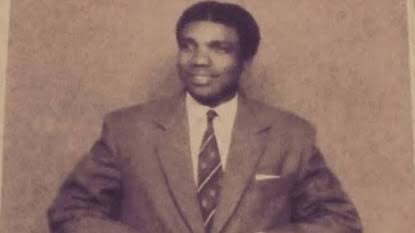
On March 8, 1957, Ernest Chidokwe Okonkwo stepped into the world of Nigerian broadcasting.
Okonkwo’s profound impact stretched beyond mere play-by-play. He gave life to the game’s heroes through unforgettable nicknames and crafted a narrative that made listeners feel they were part of a national event. His career, cut short by his death on August 7, 1990, at just 54, offers a window into Nigeria’s cultural development and the enduring power of language.
From Studio to Legendary Voice of Nigerian Football
Ernest Chidokwe Okonkwo’s journey into the public ear began at the Nigerian Broadcasting Corporation (NBC) in 1957. He started behind the scenes, working in studio and programme operations. This early exposure to the mechanics of broadcasting likely honed his understanding of how to craft a compelling audio experience.
The NBC, which predated the Federal Radio Corporation of Nigeria (FRCN) established in 1978, was the foundational platform for many pioneering broadcasters. It was here that Okonkwo began to develop his announcing abilities, eventually moving into the demanding realm of outside broadcasting and live commentary.
His transition wasn’t just about having a pleasant voice. Live commentary required quick observation, unerring accuracy, and a vast vocabulary. Okonkwo had to translate rapidly unfolding physical action into clear, vivid verbal pictures, a skill he meticulously cultivated over many years.
The Unseen Preparation Behind the Broadcast
Many listeners remembered Ernest Okonkwo’s commentaries as effortless, almost magically spontaneous. But this apparent ease concealed substantial and disciplined preparation. Dr. Emeka Odikpo, a broadcaster who worked closely with him, recalled Okonkwo’s constant practice of describing ordinary events.
Okonkwo was an avid reader, continually collecting expressions, quotations, statistics, and historical information. He amassed observations that he believed might be useful during broadcasts. This dedication to continuous learning was central to his professional philosophy.
He maintained extensive notebooks throughout his career. One, famously dubbed his “Ernescopaedea,” was a personal compendium of knowledge. Another contained material specifically related to commentary, sporting events, and his travels, showcasing his commitment to thorough research.
These detailed records underscored Okonkwo’s belief that excitement alone wasn’t enough for a commentator. A broadcaster needed to build a deep well of knowledge, ensuring the right information or expression was ready for any unexpected moment in a match. He even recorded some of his own commentaries, refining his craft through observation, memory, research, and repeated practice.
Radio’s Golden Age and Okonkwo’s Ascendancy
Ernest Okonkwo belonged to a revered generation of Nigerian broadcasters. This group, including figures like Ishola Folorunsho and Yinka Craig, established live sports commentary as a cornerstone of Nigerian popular culture. During the 1970s and 1980s, football broadcasting held immense sway across the nation.
While television was available, radio remained the most widespread, portable, and immediate medium for following major matches. It was the principal way millions connected with the game, bringing the stadium experience directly into homes, cars, and workplaces.
Former national team left-winger, Segun Odegbami, once recounted a peculiar habit of the era. Some people watching football on television would actually mute their screens to listen to Okonkwo’s radio commentary instead. Even spectators inside stadiums would carry transistor radios, following his words as they watched the action unfold before them.
This behavior vividly illustrates the profound importance broadcasters like Okonkwo held. Audiences weren’t just listening because they couldn’t see the match. They tuned in because the commentary enhanced what they *could* see, adding depth, emotion, and an inimitable narrative flair. Okonkwo’s rich voice, poetic delivery, and ability to paint clear pictures made him a celebrated figure on Nigerian radio.
Okonkwo excelled in this environment, his vocabulary and descriptive imagination transforming players into vivid characters. Matches became unfolding national narratives, not just contests of goals and results. He elevated football from a sport to a shared public drama, broadcast across the airwaves.
The Enduring Power of a Nickname: Crafting Football Folklore
Perhaps Ernest Okonkwo’s most enduring contribution to Nigerian football is his remarkable collection of nicknames. These weren’t just amusing tags; they helped forge the public identities of some of the nation’s most celebrated footballers. These monikers transcended individual matches, becoming integral to the vocabulary of Nigerian football decades after their coiner’s passing.
Segun Odegbami, the famed “Mathematical,” often credited Okonkwo for bestowing the name upon him. It became so deeply associated with Odegbami that it functioned almost as a second name. This was a testament to Okonkwo’s ability to capture a player’s essence in a few well-chosen words.
He applied this same insightful instinct to a host of other players. Christian Chukwu, the formidable defender, became “Chairman,” a descriptor that perfectly encapsulated his leadership and authority on the pitch. Striker Aloysius Atuegbu was known as “Blockbuster,” while Adokiye Amiesimaka, who pursued a law degree during his football career, earned the fitting title of “Chief Justice.”
The commentator’s creative spirit knew no bounds. Idowu Otubusen was christened “Slow Poison.” Kelechi Emetole became “Caterpillar,” and Sylvanus Okpala was remembered as “Quicksilver.” Dominic Nwobodo acquired the nickname “Alhaji” after returning to the field with a bandaged head that resembled a turban, an instant classic of visual commentary.
Even Yisa Sofoluwe, who represented Nigeria in the 1980s, became widely known as the “Dean of Defence,” another identity strongly linked to Okonkwo. Emmanuel Okala, the imposing goalkeeper, initially received the “Chairman” title from Okonkwo. But once Christian Chukwu claimed that moniker, Okonkwo swiftly rebranded Okala as “Man Mountain” or “Tallest,” reflecting his remarkable stature.
These names were far more than broadcast flourishes. In an era before players could cultivate personal brands through digital platforms, Okonkwo’s nicknames served to establish recognizable public personas. He effectively became part narrator and part creator of football folklore, shaping how fans perceived and remembered their heroes.
The 1977 Own Goal and Radio’s Unforeseen Power
The extraordinary reach of Ernest Okonkwo’s radio commentary was starkly illustrated by one of Nigerian football’s most painful moments. On November 12, 1977, at the National Stadium in Lagos, Nigeria faced Tunisia in a crucial 1978 FIFA World Cup qualifier. The Green Eagles, then known as the national team, were hoping to reach the World Cup for the very first time.
But destiny had a different plan. Tunisia won the match 1–0, and Nigeria’s hopes were dashed. The decisive moment came when Nigerian defender Godwin Odiye inadvertently turned the ball into his own net. Tunisia eventually secured Africa’s place at the 1978 tournament in Argentina.
The aftermath for Odiye was severe. He later recounted the intense public reaction to the own goal, vividly recalling Okonkwo’s repeated exclamation on air: “Nigeria score Nigeria.” Odiye believed that this specific commentary contributed significantly to the anger and blame directed at him by passionate supporters. He was reportedly taken secretly from the stadium that day, carrying the burden of that mistake for many years.
The incident, seared into Nigerian football memory, gave rise to the enduring expression “Nigeria has scored Nigeria.”
It serves as a powerful reminder of how a commentator’s words, amplified by the widespread influence of radio in Okonkwo’s time, could not only define a single sporting moment for millions but also shape how that moment was remembered for generations.
This echoes the impact of media on public perception, much like the stories of individuals during Nigeria’s civil war, whose experiences were often filtered through available information channels.
A Broader Legacy: Beyond the Colourful Language
While his elaborate English and entertaining nicknames are what many remember, Ernest Okonkwo’s contribution to Nigerian broadcasting ran much deeper. He upheld a rigorous professional tradition where commentators were expected to thoroughly research players, venues, competitions, and historical contexts before stepping to the microphone.
Crucially, radio demanded commentators describe movement with such precision that listeners, lacking visual cues, could perfectly construct the match in their minds. Okonkwo understood that words were the pictures. A radio commentator couldn’t rely on television images to compensate for an unclear description; his language *was* the visual experience.
He masterfully combined this responsibility with an extraordinary talent for expression. His language built tension before a shot, articulated the rhythm of an attack, and differentiated individual players by their unique movements and personalities. Yet, his most profound legacy might be his ability to immerse listeners, making them feel like active participants in a national occasion, rather than passive recipients of a score update.
Segun Odegbami, a keen observer of the game and its history, has emphasized that this older generation of radio commentators, led by figures like Okonkwo, played a vital role in building audiences for Nigerian football. They contributed to filling stadiums and were instrumental in creating the stars that captivated the nation.
Okonkwo stands as one of the outstanding symbols of this rich and influential broadcasting tradition.
A Career’s Premature End and Lasting Reverberations
By the close of the 1980s, Ernest Okonkwo had dedicated over three decades to Nigerian broadcasting. His voice was synonymous with football, his commentaries a staple for fans across the country. Yet, as the 1990 FIFA World Cup approached, illness began to take its toll. Dr.
Emeka Odikpo recalled that Okonkwo was prevented from traveling to Italy for what would have been his first senior FIFA World Cup assignment.
His health continued to decline after that missed opportunity. Ernest Chidokwe Okonkwo died on August 7, 1990, at the age of 54. He was laid to rest on October 13, 1990, leaving a void in Nigerian sports broadcasting that was keenly felt. His death silenced one of the most distinctive voices of his generation.
But the language he crafted, and the enduring connection he forged with millions of listeners, continued. The footballers he had nicknamed continued to be known by those monikers. Future broadcasters inherited a new standard for descriptive radio commentary, a benchmark against which their own performances would be judged.
Even football supporters born long after Okonkwo’s passing encounter his pervasive influence through the very vocabulary of Nigerian football. His work created a linguistic legacy, shaping the cultural memory of the sport in Nigeria. His story is a powerful reminder of how individual voices can have a lasting impact on a nation’s cultural landscape.
Why Ernest Okonkwo Still Resonates Today
The broadcasting landscape Ernest Okonkwo operated within has largely vanished. Today, football reaches audiences through an array of platforms: satellite television, streaming services, smartphones, social media, and instant video clips. A goal can be replayed repeatedly within minutes, and fans can engage directly with players online.
Okonkwo’s era, however, demanded something different. Radio required immense imagination from both the broadcaster and the listener. The commentator had to construct the entire stadium experience through sound alone: the precise run of a winger, the strategic positioning of a defender, the trajectory of the ball, the building anticipation of the crowd, and the overarching significance of the occasion.
For countless Nigerians, Okonkwo was the orchestrator of this immersive experience. His importance, therefore, transcends mere nostalgia. His career is an integral part of the broader history of Nigerian mass communication. It also played a crucial role in the development of football as a shared national cultural phenomenon.
His legendary nicknames stand as testament to the lasting power of language. “Mathematical” and “Chairman” weren’t just catchy; they endured because they captured something intrinsically recognizable about the players themselves. Through consistent repetition on national radio, these descriptions became interwoven with the historical identities of the men who carried them.
Ernest Okonkwo didn’t just describe the game; he helped define it, leaving an indelible mark on Nigerian consciousness.
