




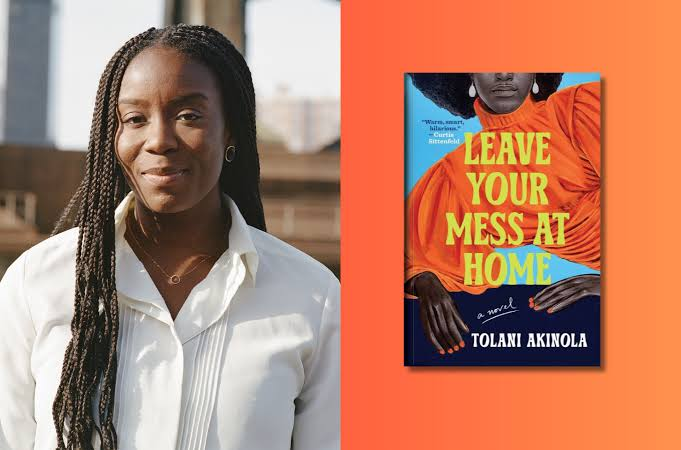
On September 2, 2026, author Tolani Akinola spoke with Brittle Paper about ‘Leave Your Mess at Home’.
Her novel follows the four Longe siblings, each navigating distinct struggles under the weight of familial and societal expectations. Akinola’s insights into the Longe family’s dysfunctions, the pressures faced by immigrants, and the universal quest for self-acceptance offer a compelling lens into contemporary Nigerian-American experiences. The discussion revealed not just the mechanics of her storytelling, but the deeply personal philosophy underpinning her artistic vision.
Tolani Akinola Leave Your Mess at Home: Crafting Family Narratives
The title itself, Leave Your Mess at Home, carries an almost imperative tone, yet Akinola readily admits its origin was pragmatic. She explained to Brittle Paper that finding the right title was a struggle, her editor pushing for a decision. Initial suggestions included Sorry for the Mess, but Akinola rejected the apology.
“You know, I do like the mess part, but I’m not sorry for it,” she recounted. “We can never be sorry for it. Maybe the point of the novel is that we perhaps should not be sorry for it.”
The concept of “mess” resonated deeply with her thematic intentions. Akinola had initially considered a title like How The Longes Had Gone Astray, signaling an interest in characters falling short of expectations. But “mess” felt more authentic.
“This is a very messy, dysfunctional family,” she stated, adding that the novel served as a “mirror for me in a sense, because I’m like, ‘Oh, we are all very messy and imperfect people.’” This perspective extends beyond individual flaws to the broader immigrant experience, where the pressure to project an image of success is acutely felt.
The Compounded Pressure of the Immigrant Experience
For many immigrants in the United States, the need to present a flawless exterior is not merely a personal preference but a perceived necessity. Akinola articulated this profound burden: “I think that often with immigrants in the US, the feeling of needing to put on a good face in the world is even more compounded.”
It moves beyond a universal desire to hide shame. Instead, she argues, “the experience of being in a country that’s not your home means you, in particular, need to look like you have it together to justify your being here.” This external pressure becomes another layer in the complex tapestry of familial and individual struggles.
This compounded expectation shapes how characters, and indeed real people, navigate their lives and relationships. It forces a certain performance, a constant curation of self for an external gaze that is both familial and societal. The novel deftly explores the internal costs of maintaining such a façade.
It asks what happens when the carefully constructed image inevitably cracks under the weight of unspoken truths and unfulfilled desires, especially when one is trying to balance cultural expectations with a new environment.
Weaving Individual Threads into a Family Tapestry
Tolani Akinola designed her characters to embody distinct struggles, yet their individual narratives are deeply intertwined by the Longe family unit. Sola, the eldest, returns to Chicago disgraced and newly single. Jola battles unrequited love, while Karen grapples with her sexuality and self-image.
Ola, the “golden child,” questions his marriage and identity as a Black father in America. Akinola began with Anjola, but quickly realised the necessity of presenting multiple perspectives.
“I knew she had three other siblings, and I had come up with a brief character sketch,” Akinola explained. “I’d been really fascinated by each of them.” The early versions of the novel featured these characters in vignettes, offering windows into their separate lives.
The real craft, she noted, became braiding these distinct individuals together, ensuring their unique ways of loving and struggling made sense within the context of their shared family history. Their lives became mirrors for one another, creating a richer, more comprehensive portrait of their collective experience.
Siblinghood: A Personal Wellspring for the Longe Family Dynamic
The intricate sibling relationships within Leave Your Mess at Home are not born purely from imagination; they draw deeply from Akinola’s own life. While her family is smaller than the Longes, she intimately understands the complexities of siblinghood.
She reflected on a childhood relationship with her younger sister that wasn’t always smooth, marked by the typical squabbles over hand-me-downs and differing personalities. This personal history provided a foundational understanding for the Longe siblings’ confrontations and affections.
Akinola sees her relationship with her sister as profoundly enriching, sparking empathy for only children. This lived experience allowed her to infuse the Longe siblings’ interactions with a raw authenticity.
Their sparring and eventual reckonings mirror the nuanced dynamics many share with their own brothers and sisters, highlighting how formative these bonds are in shaping individual identities and collective family narratives. The novel, at its core, delves into the complex expectations inherited from those we love most, particularly siblings.
The Weight of Parental Expectations and Nigerian Identity
A central tension in Akinola’s novel stems from the chasm between the lives the Longe parents envisioned for their children and the realities their children actually inhabit. This dynamic, Akinola suggests, is particularly acute for Nigerians, though it resonates universally.
Parents often view their children as extensions of themselves, reflections meant to fulfill their own unaccomplished dreams. “Maybe the purpose of the child’s life is to, in a sense, make up for what the parents could not accomplish,” she pondered.
This parental approach, while common across cultures, can be a heavy burden. Each Longe sibling carries this weight, some grappling with guilt, others resisting it outright. It ultimately hinders their ability to fully own their own lives, forcing them to live in the shadow or as extensions of their parents’ aspirations.
Akinola observes that while her characters are adults, the novel functions as a kind of coming-of-age story because they are still striving to become individuals outside of these inherited expectations.
Navigating the Nigerian-American Duality in Expectation
The pressure on children to uphold familial honour is famously encapsulated in the Nigerian adage, “remember the child of whom you are.” This collective value emphasizes the child as an extension of the family name and reputation.
However, for Nigerian-Americans like the Longe siblings, this deeply ingrained cultural value clashes with the prevailing American ethos of fierce individualism and self-determination. This creates a unique and often fraught landscape for personal development.
Akinola points out the dilemma: if one lives in Nigeria, where collective values are widely understood, the pressure might feel less isolating. But as an “island” within a society that champions carving one’s own path, the conflicting messages from family can become “really tricky.”
This cultural chasm forces characters to reconcile two powerful, often opposing, forces defining success and personal fulfillment. It raises questions about how much one owes to heritage versus individual autonomy, a theme that many contemporary Nigerian authors explore.
Thanksgiving Debacle: A Universal Truth in a Nigerian Setting
The novel’s climax unfolds at a Thanksgiving dinner, a setting Akinola chose to allow years of unsaid secrets and resentments to explode. This choice taps into a widely recognized phenomenon within Nigerian family gatherings.
“There’s always a quarrel at a family gathering,” the interviewer noted, a sentiment Akinola confirmed by recounting her own experiences of intergenerational disputes at such events. This shared cultural understanding affirmed her decision to use the festive occasion as a pressure cooker for familial tensions.
For immigrant families in the US, Thanksgiving itself can be a complicated affair—a blend of adopted tradition and cultural adaptation. Akinola found humor in the hybridity, noting, “why am I stuffing two and a half hams?” This setting provided a natural, even humorous, excuse to bring disparate characters together.
While she may not have consciously thought of the “Nigerianness” of arguments erupting at family events, the resonance with readers from across the diaspora—who affirmed, “Oh yeah, yeah, no, that tracks”—was profoundly validating.
This recognition speaks to a shared understanding of how deep-seated issues surface during these obligatory familial convergences, reflecting broader trends in Nigerian literary culture.
Navigating Love, Accountability, and Unresolved Harm
At the core of Leave Your Mess at Home lies the profound question: “What do we owe to our families, and what do we owe to ourselves?” Akinola admitted she didn’t begin with a definitive answer, but the writing process itself transformed her understanding.
Initially, she leaned towards the idea that parental expectations were unfair and that individuals owed less to their families than they often felt. However, the Longe siblings’ journey pushed her towards a more nuanced truth: family is a place of mutual responsibility and care, a principle sometimes overlooked.
Akinola believes genuine love often demands accountability. For the characters whose wounds run deep, the path to forgiveness is arduous, especially when the harm is profound. She explored how individuals might find their way to a place of forgiveness, even when direct accountability is absent.
“How do you then change the shape of your love in order to accept that person just can’t meet you in that way?” she mused, highlighting the complex emotional navigation required to maintain connection amidst unresolved pain.
Rethinking Bell Hooks: The Coexistence of Love and Abuse
The conversation also delved into Bell Hooks’ influential assertion that love and abuse cannot coexist. Akinola offered a perspective forged in the messy realities of human relationships, respectfully disagreeing with the neatness of this theoretical boundary. “The reality is that people do love people who are abusive to them. It happens,” she stated.
She acknowledged the imperative for self-preservation and distance in abusive situations but recognized that love can, and often does, exist alongside abuse.
This nuanced view acknowledges the complexities of family bonds, particularly in contexts where discipline might blur into abuse, yet parental love remains fierce.
“You can have a parent who physically abused you—I mean, we’re in Nigeria; you get flogged—but you also know that your mother would cut herself open just to save you,” the interviewer posited. Akinola agreed, affirming that life often defies such clear-cut binaries, particularly within the deep, often contradictory, attachments of family.
Her novel, by its very title, confronts this lack of neatness head-on.
The Enduring Embrace of Imperfection
Akinola’s novel doesn’t offer a magical resolution where the Longe siblings are suddenly “fixed.” They remain burdened by their histories, flaws, and complicated relationships. For Akinola, the true work isn’t about erasing one’s “mess” but about learning to live honestly with it. “It’s definitely the latter,” she confirmed.
The directive to “leave your mess at home” becomes an impossible instruction, as individuals inevitably carry the experiences that have shaped them.
The ending of Leave Your Mess at Home reflects this acceptance. The siblings have not transformed entirely, nor are they far from where they began.
Yet, a crucial shift has occurred: “they have each, in their own way, learnt to accept and reclaim the parts of themselves that were messy, or maybe that they had sought to exile or hide.” This journey of internal acceptance, of allowing oneself to exist in previously avoided psychological spaces, is the novel’s ultimate takeaway.
Akinola hopes readers will be inspired to examine and reclaim their own hidden, messy parts, finding strength in their whole, imperfect selves.
Tolani Akinola’s contribution to understanding the Nigerian diaspora’s complex family dynamics marks her as a compelling voice. Her work invites readers to look inward, confronting uncomfortable truths about inherited burdens and the enduring power of family, even in its most flawed forms.
It’s a vital addition to the ongoing conversation about identity, belonging, and the stories we tell ourselves to make sense of our messy, beautiful lives. Her ability to translate personal experiences into universally resonant themes promises a lasting impact on contemporary literature, especially as discussions around evolving systems of identity continue to take shape.
