




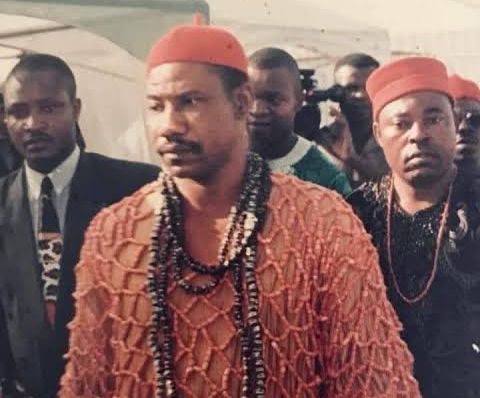
In March 1998, in the bustling heart of Lagos, a formidable businessman known across Nigeria as Joneb appeared before the Miscellaneous Offences Tribunal. This wasn’t just any entrepreneur. Ejikeme Nebolisa, a multi-millionaire, was already publicly identified as Igwe John Nebolisa, the traditional ruler of Awkuzu, an ancient Igbo community in Anambra State.
His ascent to the throne, however, was steeped in controversy, intertwining immense personal wealth with the deep-rooted customs of his hometown.
The Controversial Ascent of Igwe John Ejikeme Nebolisa
Nebolisa’s reign didn’t merely mark a personal triumph; it dramatically reshaped Awkuzu’s traditional institution. His story became a living case study, illustrating how individual affluence and external political forces began to intersect with centuries-old systems of lineage and community authority, challenging the very foundations of kingship in Igboland.
Before Nebolisa, Awkuzu’s traditional stool had seen figures like Anaegboka Odife, who ruled from 1967 until his death in 1982. Following him, Chief J. C. Ogamba eventually assumed the position. But it was Ogamba’s relationship with Nebolisa that would define a dramatic shift in the community’s leadership.
Chief Michael Ozua-Okoye, a former Onowu, or traditional prime minister of Awkuzu, vividly recalled the unusual circumstances. He recounted that Chief J. C. Ogamba relinquished his royal duties while still alive, a departure from typical succession patterns. Ogamba himself asked Ozua-Okoye to accompany him to Nebolisa’s opulent residence, explaining his desire to thank the wealthy businessman.
Accounts from senior Awkuzu figures later linked Nebolisa’s wealth to significant gifts made to Ogamba, including a white horse and a substantial sum of money. While the precise terms of this arrangement remained private between the two principal figures, Nebolisa subsequently occupied the Awkuzu throne. This occurred even as Ogamba, the previous ruler, was still alive and well.
This unprecedented transition fueled the enduring perception that Nebolisa’s immense wealth had paved his way to traditional power. For many, it epitomized a new era where economic might could ostensibly override customary protocols, forever linking Joneb’s fortune to his royal status.
Wealth and a Wider Reach: The Joneb Phenomenon
John Ejikeme Nebolisa’s public identity was inextricably tied to his wealth. Known affectionately as Joneb, a moniker stemming from his business empire, he was a multi-millionaire whose influence stretched across Nigeria’s Eastern region and beyond. The Igbo apprenticeship system often serves as a foundation for such business acumen, though Nebolisa’s scale was extraordinary.
His business interests included hotels, travel agencies, and other ventures described as “controversial setups.” The Joneb Holiday Inn in Awkuzu became a symbol of his prominence, as did his imposing residence which doubled as his palace. He moved with bodyguards, in convoys, and owned a fleet of expensive cars, including limousines, Porsches, and Peugeot Chasis.
Nebolisa’s lifestyle and generous patronage earned him widespread acclaim, particularly from highlife musicians such as Oliver de Coque and Prince Morokco Maduka, who celebrated his name in their albums. Morokco Maduka even dedicated an entire album to him, solidifying his larger-than-life image as “Alusi Awkuzu” (Oracle of the whole kingdom) and “Ibilibe Ogada” (The biggest the town has ever seen).
This lavish display of wealth and the accompanying praise names cemented Nebolisa’s legendary status. Popular retellings often suggested he could overcome any obstacle with money, implying that any resistance to his ambition to become Igwe was met with an offer too grand to refuse. His career thus showcased how personal wealth became a powerful force within traditional political structures.
State Intervention and the Igwe’s Deposition
Nebolisa’s tenure as Igwe of Awkuzu was not without its tumultuous moments, particularly concerning his relationship with the Anambra State government. His position became entangled in the volatile politics of the state during the administration of Governor Chinwoke Mbadinuju. This period was marked by the rise of vigilante groups like the Bakassi Boys, and a broader confrontation between political authority and local power.
The state government ultimately accused Nebolisa of involvement in partisan politics, which allegedly created a “sour relationship” between him and Governor Mbadinuju’s administration. This strained relationship escalated to a dramatic conclusion: on July 24, 2001, Governor Mbadinuju officially deposed Igwe John Ejikeme Nebolisa.
The deposition was publicly announced on the Anambra State Broadcasting Service (ABS) by Dr. Fred Odua, the Special Assistant to the Governor on Chieftaincy Affairs. This official act highlighted the growing power of the state in regulating traditional institutions, even to the point of removing a sitting monarch. It underscored a fundamental shift in the locus of authority, away from purely customary selection processes.
Allegations of Criminality and Political Fallout
Beyond the political friction, Nebolisa also faced grave accusations. He had appeared before the Miscellaneous Offences Tribunal in Lagos on March 27, 1998, in connection with an alleged advance-fee fraud case. This public entanglement with legal issues further complicated his image as a traditional ruler.
More disturbingly, arrested robbers reportedly confessed to authorities, claiming, “Igwe Nebolisa is our sponsor and protector.” They accused him of being “the brain behind 60 percent of robbery incidents in the state.” These serious allegations, whether proven or not, stained his reputation and contributed to the government’s justification for his removal.
This level of official intervention in royal affairs is not unique, but it showcases the modern challenges to traditional power.
The political and criminal allegations surrounding Nebolisa illustrate the increasing vulnerability of traditional rulers to state scrutiny and the impact of public perception. His deposition became a stark reminder that even immense personal wealth and widespread community recognition could not fully insulate a monarch from the dictates of modern governance.
The Enduring Succession Crisis in Awkuzu
John Ejikeme Nebolisa died in 2005. He had been deposed on July 24, 2001. His death, however, did not bring an immediate end to the controversies surrounding the Awkuzu traditional stool. He had occupied the throne for 10 years before his death, according to some accounts. Instead, the community was plunged into a prolonged and complex struggle over succession, one that continues to this day.
At the heart of the dispute are two fundamentally different understandings of how an Igwe should be chosen in Awkuzu. One faction champions a rotational arrangement, suggesting the stool should circulate among the town’s constituent areas. This view reflects a more egalitarian approach to traditional leadership.
Conversely, another significant group asserts that Awkuzu kingship is inherently hereditary, belonging specifically to the Aganama royal family. This perspective prioritizes ancestral lineage and the continuity of a specific bloodline. The contention goes beyond individual candidates, touching upon the very essence of Awkuzu’s traditional constitution, the role of kingmakers, and the critical issue of government recognition.
Competing Claims to the Awkuzu Stool
The succession battle manifested dramatically in recent years. On May 2, 2019, the Anambra State Government issued a certificate of recognition to Professor Charles Maduegbuna Anikweze as the traditional ruler of Awkuzu, bestowing upon him the title Igwe Nnamenyi III. This state endorsement seemingly solidified his position within the formal system.
But the traditional dispute persisted. In April 2023, a rival coronation took place where Chief Chibuike Okafor was crowned Ezeaganama III by traditional figures, including the Okpala Awkuzu. These supporters argued for the hereditary nature of Awkuzu kingship and the right of customary authorities to install their monarch, independent of state recognition.
Professor Anikweze promptly rejected Okafor’s installation, maintaining his role as the government-recognized Igwe. The emergence of two competing royal claims – one backed by the state, the other by traditional community figures – vividly illustrates the deep rift within Awkuzu. This ongoing struggle reflects the tension between evolving community rules, inherited custom, and the modern state’s administrative power.
Unpacking Modern Traditional Authority in Igboland
John Ejikeme Nebolisa’s remarkable journey from multi-millionaire businessman to deposed monarch provides a unique lens through which to examine the evolving systems of traditional authority in southeastern Nigeria. His story is not just about one man; it reflects a broader transformation in how Igbo communities navigate leadership in the modern era.
In contrast to the mythical origins of Yoruba kingship, Igbo traditional institutions have often been characterized by less centralized, more consensual leadership.
Historically, leadership in many Igbo communities relied on lineage rights, community consensus, and councils of elders. Strictly hereditary monarchies, while present in some areas, were not universally the norm. The twentieth century brought significant changes, as these older ideas began to interact with written community constitutions and the expanding reach of the Nigerian state.
Nebolisa’s career starkly illustrated how personal wealth and political influence could become powerful determinants in who ascended to a traditional stool. His ability to reportedly make significant payments to an incumbent ruler, his lavish lifestyle, and his entanglement with state politics all highlight a period where the boundaries of customary leadership blurred.
The enduring succession dispute in Awkuzu, long after Nebolisa’s death, further underscores this systemic evolution. The conflict between rotational and hereditary claims, coupled with the state’s role in recognizing (or de-recognizing) traditional rulers, reveals a complex interplay of forces. It’s a struggle over who ultimately holds legitimate authority: inherited custom, community will, or government decree.
His story serves as a critical chapter in understanding how traditional institutions, once solely governed by internal customs, are now deeply influenced by external factors like economic power and state administrative control. It leaves us with a fundamental question: In a modern Nigeria, what truly constitutes legitimate traditional authority, and who has the power to define it?
