




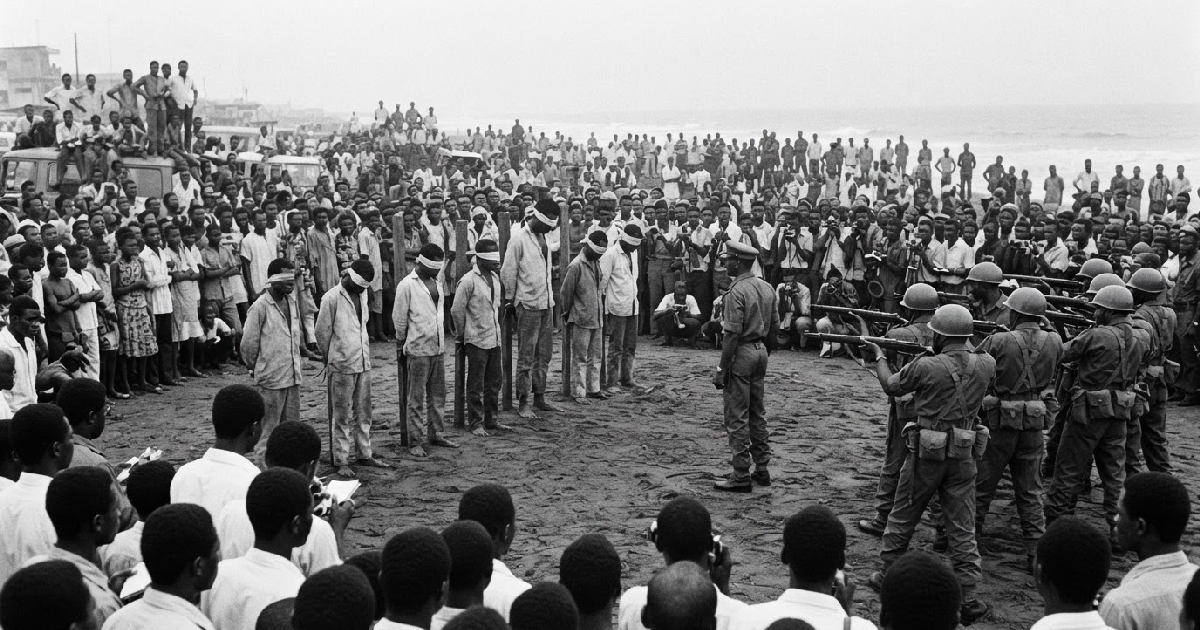
At approximately 10:00 AM on September 8, 1971, a palpable tension hung over Bar Beach in Lagos. Trucks carrying Ishola Oyenusi, a notorious armed robber, and six of his gang members arrived for their public execution by firing squad.
A large crowd had gathered, cameras flashed, and newspaper reporters scribbled furiously, turning a grim act of state justice into a national spectacle. This moment wasn’t just the end of a criminal’s life; it was a potent symbol of post-Civil War Nigeria’s battle against surging crime and the military government’s brutal response.
A notorious robber’s early reign
Ishola Oyenusi’s criminal career reportedly began in 1965, marking him as a significant figure in Nigeria’s underworld long before his infamous end. He quickly established a reputation for audacious operations.
In March 1965, his gang robbed a stationery business in Apapa, making off with approximately £1,400. Two years later, in May 1967, another major heist connected to Standard Bank netted around £14,000.
Newspaper accounts of the era frequently linked Oyenusi and his associates to a string of attacks. These operations spanned Lagos, Maiduguri, and Ibadan, targeting commercial premises, private residences, and locations believed to hold substantial cash or valuables.
A 1969 robbery at the Maiduguri Rest House, for instance, reportedly yielded about £2,850. Other incidents attributed to Oyenusi’s circle occurred in areas like Apapa, Robertson Street, and Bode Thomas Street in Surulere.
By March 1971, Oyenusi was associated with ten major robbery operations, becoming one of Nigeria’s most feared criminal leaders. Stories of his daring prison escapes and apparent ability to evade arrest only amplified his fearsome reputation among the public.
Post-Civil War surge in violent crime
While armed robbery existed before Nigeria’s Civil War, the conflict profoundly deepened the crisis. The war, which raged from July 1967 to January 1970, left a legacy of widespread firearms circulation and economic instability.
Cities swelled with displaced populations, and economic disruption hit communities nationwide, creating fertile ground for organized crime. Newspapers increasingly detailed how gangs used stolen vehicles, sophisticated weapons, and inside information to target banks, businesses, and company payrolls.
Public apprehension grew as criminals demonstrated enhanced organization and mobility, with some gangs operating across multiple regions. They often focused on employees transporting large sums of money, reflecting a calculated approach to their illicit activities.
The Federal Military Government, under Yakubu Gowon, responded to this escalating threat with decisive legislation. In 1970, it enacted the Robbery and Firearms (Special Provisions) Decree No. 47.
This decree established special tribunals specifically for robbery and firearms offenses, introducing the death penalty for aggravated armed robbery. The government aimed for swift justice and visible control, making public executions by firing squad a stark feature of its policy.
The WAHUM robbery and Oyenusi’s capture
Oyenusi’s reign of terror reached its dramatic conclusion with the West Africa Household Utilities Manufacturing Company (WAHUM) payroll robbery in Ikeja, Lagos. On March 27, 1971, the company was moving funds designated for workers’ wages.
A police constable, Mr. Nwi, had been assigned to protect the payroll vehicle. Oyenusi’s gang, however, arrived meticulously prepared for the operation.
They had reportedly stolen a vehicle shortly beforehand, positioning members strategically around the WAHUM premises. During the violent assault, Constable Mr. Nwi was killed, his firearm taken, along with a cash box containing approximately £10,000.
This operation was far from an impromptu street attack. Its precise timing and execution suggested the gang possessed intimate knowledge of the payroll movement. Investigators later confirmed that company employees had collaborated with the robbers, underscoring the organized nature of such crimes.
The killing of the police escort elevated the WAHUM robbery into one of the era’s most serious criminal cases. It guaranteed that authorities would commit substantial resources to apprehending those responsible, intensifying the hunt for Oyenusi.
Oyenusi wasn’t apprehended at the WAHUM factory that day. He and his accomplices initially escaped, leaving police to piece together the events through the stolen vehicle and early arrests. But the investigation eventually led law enforcement to Ibadan.
On May 7, 1971, Oyenusi was captured in Gate, a bustling area of the city. Police accounts indicated he attempted to flee before he was finally caught, ending a period of apparent invincibility.
His arrest dealt a blow to the popular image of a criminal who could never be caught, an image fueled by tales of charms and supernatural protection. The police, through diligent information gathering and tracing associates, dismantled that myth. The man once presented by newspapers as nearly invincible was ultimately brought to justice by determined investigative work.
Military tribunals and the media spectacle
The legal proceedings against Ishola Oyenusi and his co-defendants commenced swiftly on August 11, 1971. These trials were held under the special robbery legislation established by the military government.
The system was designed for speed, bypassing the slower pace of ordinary criminal courts, and to impose severe penalties on individuals convicted of aggravated armed robbery. The tribunal examined evidence related to the WAHUM attack, the fatal shooting of the police escort, and the involvement of various gang members.
Two WAHUM employees were also identified as collaborators in the case. By August 26, 1971, the tribunal delivered its verdict: Oyenusi and six other defendants were condemned to death by firing squad, while two accused persons were acquitted. The next day, the Daily Times announced the outcome with the chilling headline: "7 Armed Robbers to Face Firing Squad in Lagos: Two Others Set Free."
For a public gripped by fear from rising violent crime, the tribunal’s swift judgment offered a sense of decisive state action. For the Nigerian press, it provided the climactic conclusion to a narrative that had already seized national attention.
Newspapers played a pivotal role in this drama, meticulously documenting Oyenusi’s operations, the police investigation, the tribunal proceedings, and even preparing readers for the public execution. They preserved crucial details, including dates, locations, and the financial sums involved in the robberies.
The media coverage also transformed Oyenusi into a recognizable, almost mythical, public figure. He even acquired the moniker "Dr.", despite lacking any formal medical qualification, a title that became integral to his public identity. Nigerian business reporting often details economic shifts, but Oyenusi’s story highlighted a different kind of public concern.
Headlines and photographs magnified his reputation, while anecdotes of prison escapes and his perceived fearlessness cemented his image as a criminal celebrity. On August 29, 1971, the Sunday Times published a feature titled "MY LIFE BY ‘Dr’ OYENUSI," presenting his criminal career in a confessional format just days before his execution.
This kind of reporting exemplified a journalistic culture where crime stories blended factual information with public warnings and dramatic storytelling. Through careful selection of details, arrangement of facts, and compelling headline writing, newspapers crafted a compelling narrative for readers.
The extensive coverage surrounding Oyenusi demonstrates how journalism doesn’t merely record events. It actively influences how those events are perceived, remembered, and ultimately, how they enter the collective public memory of a nation.
Bar Beach execution: A performance of state power
The execution of Ishola Oyenusi and his six gang members at Bar Beach on September 8, 1971, was more than just a legal penalty. It was a carefully orchestrated public performance of state power, designed to be seen, remembered, and feared.
A massive crowd converged on the beach, drawn by morbid curiosity and a desire to witness justice. Press photographers documented every detail of the condemned men and the preparations, producing images that would circulate for decades, seared into the national consciousness.
While Oyenusi wasn’t the first armed robbery convict publicly executed in Nigeria that year, his death resonated more deeply. His existing notoriety, the high-profile WAHUM case, and the intense media attention preceding his execution all contributed to its lasting impact.
Accounts from the time spoke of his reported laughter, his composure, and his seemingly unshakeable demeanor before the firing squad. These stories further solidified the image of a man who faced death with defiance, contributing to his legendary status.
The government’s intention was clear: to demonstrate its unwavering resolve against violent crime. Soldiers and police carried out the sentence before a captive audience, but newspapers amplified this message, extending the reach of the "spectacle" far beyond the Lagos shoreline. Nigerian financial institutions often warn about economic instability, but this execution was a stark warning about social order.
Through vivid photographs and detailed reports, the execution of Ishola Oyenusi transcended a local punishment. It became a national event, symbolizing the military regime’s firm stance against the prevailing insecurity.
The enduring question of deterrence
The military government presented these severe punishments, particularly public executions, as a direct solution to the widespread fear generated by armed robbery. The hope was that witnessing such a brutal end would deter potential offenders, convincing them that armed robbery would inevitably lead to the firing squad.
However, the policy didn’t achieve its ultimate goal of eradicating armed robbery. Serious attacks continued to plague the nation even after Oyenusi’s execution, and new criminal gangs emerged throughout the 1970s. The authorities persisted with tribunals, death sentences, and public executions.
Yet, these measures failed to address the deeper social and institutional conditions that allowed violent crime to persist and even flourish. Amnesty International later estimated that between 1970 and 1979, more than 960 executions took place in Nigeria.
Roughly 500 of these were public executions carried out by firing squad, following proceedings before Robbery and Firearms Tribunals. This grim figure places Oyenusi’s death within a much larger, systematic framework of state-sanctioned punishment.
His execution became the most memorable example, but it was just one of hundreds during a decade when military governments frequently resorted to capital punishment as their primary response to armed robbery. The spectacle surrounding Oyenusi’s death certainly projected an image of state power.
But the continued rise of organized robbery highlighted the limitations of punishment when implemented without broader societal and systemic reforms. What does the enduring legacy of this spectacle tell us about Nigeria’s ongoing struggle with crime and justice?
