




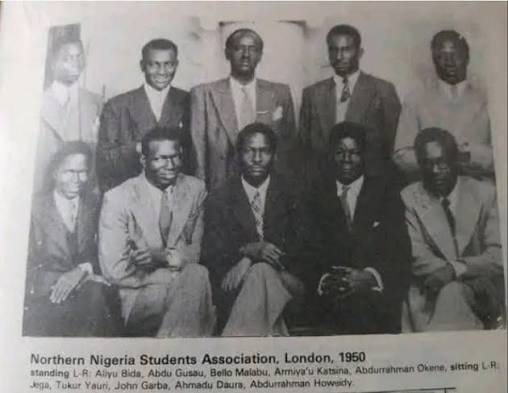
Ten men, standing and seated, gaze out from a black and white photograph captured in London in 1950. Their expressions convey an earnest determination, reflecting a quiet revolution unfolding within Northern Nigeria. This evocative image, alongside notes from diplomat John Mamman Garba’s memoir, offers a window into a profound cultural shift among Northern Nigerians.
These individuals were more than just students or visitors abroad; they were part of a small, influential vanguard. Their journeys to London symbolized the burgeoning aspirations of a region grappling with its identity and its critical role in a nation moving swiftly toward independence. The photograph freezes a moment of intense cultural anticipation.
London: A Crossroads for Northern Nigerians
The names etched into the photograph’s caption—Aliyu Bida, Abdu Gusau, Bello Malabu, Armirya Katsina, Abdurrahman Okenne, Jega, Tukur Yauri, John Garba, Ahmadu Daura, and Abdurrahman Howidey—represent a cross-section of Northern Nigerian society. Their presence in the British capital in 1950 positioned them at a pivotal juncture in Nigeria’s development. The country was on the precipice of significant constitutional changes.
London, for many years, served as a powerful magnet for West African students and professionals. It became a vibrant hub where new ideas about self-determination and nation-building took root. Organisations like the West African Students’ Union (WASU), established in 1925, provided crucial networks, accommodation, and a forum for political discourse. By 1951, about 2,300 West African students were studying in Britain.
For Northern Nigerians, this overseas exposure carried particular weight. Despite deep-seated indigenous intellectual traditions rooted in Islamic scholarship, access to Western-style education had historically lagged behind other regions under colonial administration.
The journey to London was an act of deliberate cultural reorientation, an investment in a future where modern administrative and technical skills would be paramount. It was a conscious step towards bridging cultural gaps. Frederic Buxton Abbega’s journey in the 19th century similarly highlights Nigerians engaging with European cultures, albeit under different circumstances.
Education Beyond Borders: Shaping a Northern Vanguard
The pursuit of Western education by these Northern Nigerians represented a strategic and cultural pivot for the region. It acknowledged the necessity of engaging with the colonial administration’s systems, not to abandon their own heritage, but to equip themselves for a new national reality. British officials had noted the disparity in educational access by the late 1940s, underscoring the urgency.
Colonial Secretary Arthur Creech Jones reported to the House of Commons on March 9, 1949, that roughly 54,000 boys and 17,000 girls received primary and secondary education across Northern Nigeria. He also confirmed an expanded scholarship scheme specifically prioritizing Northern candidates. This official recognition highlighted the pressing need for a trained Northern Nigerian workforce to meet the demands of self-governance.
John Mamman Garba’s trajectory exemplifies this shift. He earned his degree from the London School of Economics in 1950. His later career as a pioneer diplomat, joining the Nigerian Foreign Service in 1957 and eventually serving as Nigeria’s ambassador to the United States, demonstrates how this generation actively constructed Nigeria’s international identity.
These were the individuals who would define what it meant to represent an independent nation on the world stage.
Bridging Worlds: Hausa Scholarship and Comparative Education
Some individuals in the photograph embodied this cultural exchange in uniquely profound ways. Muhammadu Tukur, identified as Tukur Yauri, didn’t solely study; he also taught Hausa at the School of Oriental and African Studies (SOAS) at the University of London during the late 1940s and early 1950s.
His role shows that Nigerians in Britain were both receiving knowledge and actively contributing to the intellectual landscape, sharing their rich linguistic and cultural heritage with the wider world.
Tukur Yauri’s subsequent path, entering Northern Nigerian administration and later becoming Emir of Yauri, further illustrates this complex interplay. His life reflected the unique overlap of Western education, colonial administrative structures, and traditional authority that shaped Northern Nigeria in the years leading to independence. It was a merging of worlds, defining a new kind of leadership for the region.
Another pivotal figure was Abdurrahman Okene, an educationist who pursued advanced study in comparative education at the Institute of Education, University of London. His 1951 work, A Comparative Study of Primary Education in Great Britain and in the Middle Belt of Nigeria, directly engaged with educational disparities and potential solutions for Nigeria.
Okene, like many peers, returned to hold significant positions, helping to develop schools and expand the educational infrastructure needed for emerging regional governments. Aeesha Abdullahi Alhaji hunts Nigeria’s past through poetry, echoing these historical educational quests.
The Craft of Nation-Building: New Skills, New Roles
The training these men received in London translated directly into new professional avenues and, by extension, altered the cultural aspirations for younger Nigerians back home. The colonial government was gradually transferring responsibilities, creating a demand for a professional class that simply didn’t exist in sufficient numbers. This wasn’t just about replacing colonial officers; it was about defining new societal roles and expectations.
Regional ministries expanded, the civil service required more Nigerian officers, and schools desperately needed teachers and administrators. Public works departments demanded engineers and technical staff to build critical infrastructure. Each of these roles represented a tangible shift in what it meant to contribute to society, expanding possibilities beyond traditional or agrarian occupations.
The demand for qualified individuals created a new form of social mobility and purpose.
Consider Abdu Gusau, who pursued technical and engineering education, including training at Woolwich Polytechnic. His career as a prominent engineer and public servant highlights that the drive for independence required not only political leaders but also the technical experts to build the nation’s physical infrastructure.
Roads, public buildings, and water systems needed trained professionals, making engineering a newly esteemed profession and a vital part of the national development narrative.
Weaving Tradition with Modernity: Local Impact
The careers of many individuals captured in the photograph demonstrate how these newly acquired skills integrated into existing social structures. Aliyu, Makaman Bida, served in the Nigerian Legislative Council and became deeply involved in Northern regional government.
He became the Northern Region’s first Minister of Education, later serving as Minister of Education and Social Welfare, and then as Northern Minister of Finance. His trajectory shows how Western education could propel individuals into positions of significant political and administrative power within the evolving regional institutions, marrying traditional influence with modern governance.
Bello Malabu’s work in Adamawa further illustrates this intricate blend. As a schools manager within the Adamawa Native Authority, he stood at the intersection of established emirate systems and the expanding institutions of modern government. He also held the traditional title of Madaki Adamawa, participating actively in Northern public life.
His career highlights the nuanced integration, rather than outright replacement, of traditional roles with new administrative responsibilities. This fusion was critical for the new system to gain local legitimacy and widespread acceptance.
The other named individuals—Jega, Armirya Katsina, Ahmadu Daura, and Abdurrahman Howidey—were also part of this broader circle of Northern Nigerians living, studying, or undergoing professional development in Britain. Their collective presence reflected the gradual expansion of Northern Nigeria’s overseas-educated professional class. These men, whether in government, education, or other sectors, became crucial links between two worlds, shaping a hybrid cultural identity for a new nation.
The Enduring Cultural Legacy of Overseas Education
These Northern Nigerians, upon returning from London, carried more than just certificates; they brought back new perspectives, new ideas about governance, and a redefined sense of national identity. They had observed Britain directly, experienced its institutions, and participated in vibrant discussions about empire and nationalism. This exposure inevitably reshaped their understanding of their place in the world and their vision for an independent Nigeria.
Their experiences abroad, combined with their subsequent leadership roles, helped to forge a hybrid identity for the emerging Nigerian elite. They had to reconcile the deep-seated Islamic and intellectual traditions of Northern Nigeria with the demands of a modern, Western-influenced state. This delicate balancing act became a defining cultural characteristic of leadership in the North, influencing policy, education, and social development for decades to come.
The impact extended far beyond the individuals themselves. Their success stories resonated across the region, inspiring others and fueling a growing desire for education and professional advancement.
This aspiration was not merely economic; it represented a fundamental cultural shift, redefining what success looked like and broadening the horizons for what was possible for a young Nigerian. It underscored the critical idea that self-governance demanded not just political will, but also a skilled, trained human capital.
Nigeria’s cultural divides today sometimes echo the complex integrations and identity negotiations of this foundational era.
More Than Policy: The Human Fabric of Change
The photograph of these ten Northern Nigerians in London captures a profoundly human moment within a period of immense political and cultural transformation. Their lives embody the transition from a colonial past, marked by unequal access to Western education, to a future where Nigerians would assume full responsibility for their own institutions.
The story was never just about constitutional conferences; it was about the tangible, daily work of building a nation, one skilled individual at a time.
The collective journeys of John Mamman Garba, Muhammadu Tukur Yauri, Abdurrahman Okene, Aliyu Makaman Bida, Abdu Gusau, and their colleagues illustrate how education and professional training became central to this transformation. Their experiences in Britain, followed by dedicated service in various capacities, laid foundational stones for the modern Nigerian state. They represented the human fabric upon which a new nation was being woven.
Ultimately, this image offers a poignant reminder that the grand narratives of political independence are always underpinned by individual lives and choices. These men, part of a small but growing circle of overseas-educated professionals, returned home prepared to carry the responsibilities of a new era.
Their photograph remains a powerful testament to the cultural and intellectual preparation that paved the way for Nigeria’s eventual self-rule, reflecting a shift in national consciousness and a determination to shape their own destiny.
