




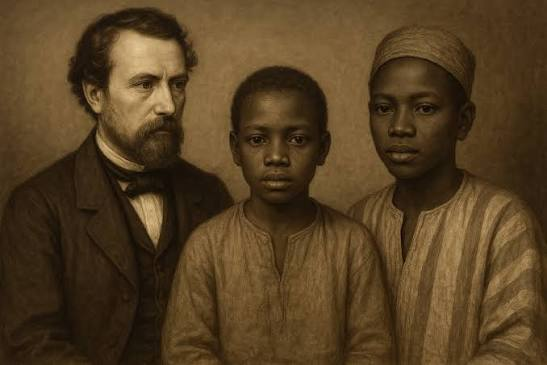
Frederic Buxton Abbega, an enslaved Margi boy from northeastern Nigeria in the mid-19th century, became an honored guest in European royal courts.
His path, marked by profound shifts in fortune, saw him travel across continents with German explorer Heinrich Barth before returning to West Africa to become a formidable political figure in Lokoja.
Frederic Buxton Abbega’s unforeseen path
Born around 1835-1836 in Askira, Abbega’s early life was abruptly upended by slave raids that swept through the region. His subsequent liberation by a European explorer set in motion a series of events that would place him at the intersection of African and European worlds, offering a rare glimpse into the complexities of a rapidly changing era.
Abbega entered the world in the heart of Margi country, an ethnic community rooted in present-day north-eastern Nigeria. His childhood, however, was violently disrupted when he was captured by slave-raiders, a common tragedy in the volatile 1830s. He was then carried far from his home to Kukawa, a bustling political and commercial hub within the powerful Bornu state near Lake Chad.
Kukawa, a nexus of trade and power, also served as a crucial base for European expeditions pushing into the Central Sudan. It was here that fate intervened for Abbega. German geologist Adolf Overweg, part of a British-sponsored expedition that had traversed the Sahara from Tripoli, encountered Abbega and purchased him from slavery, granting him his freedom in 1851.
The turning point at Kukawa
Overweg’s act of liberation marked the decisive turning point in Abbega’s young life. No longer a captive, he found himself attached to the expedition, assisting its members in their scientific pursuits around Lake Chad. But this new chapter was short-lived.
On September 27, 1852, Overweg died at Maduari, near Kukawa, at the age of 30. His sudden demise profoundly impacted the expedition and, critically, redirected Abbega’s own future. Soon after, Abbega, alongside another freed individual named Dorugu, entered the service of Heinrich Barth, Overweg’s colleague and a prominent scholar of African cultures.
Crossing continents: from Sahara sands to European courts
Abbega and Dorugu became integral members of Heinrich Barth’s extensive expedition, which spanned from 1849 to 1855. Their linguistic skills, local knowledge, and practical assistance proved indispensable as Barth meticulously documented the languages, political systems, trade routes, and social life of the regions he traversed, including Bornu, Adamawa, and even Timbuktu.
Such complex political landscapes were constantly evolving, as seen in the decisions made by a politician who shaped Benin’s fate in a similar era.
For three years, Abbega journeyed with Barth through the vast landscapes of Kanem-Bornu and around Lake Chad. This immense trek culminated in their crossing of the formidable Sahara Desert, an arduous journey that eventually led them to Tripoli on the Mediterranean coast. From there, an even more extraordinary leg of their voyage began.
In 1855, Abbega, Dorugu, and Barth departed Tripoli, sailing across the Mediterranean Sea to Marseille, France. Their arrival in Europe marked a dramatic shift from the African landscapes they knew. They then journeyed by train across France to London, England, arriving in September 1855, before continuing their travels to various cities in Germany, including Hamburg, Berlin, and Gotha.
Encounters with Queen Victoria and Kaiser Wilhelm
In Europe, Abbega and Dorugu became figures of intense curiosity, often drawing unwanted attention in public. Despite this, their experiences included remarkable encounters with European royalty. Abbega met Queen Victoria during his stay in England, reportedly receiving a gift of £40 from the monarch herself. He also recounted receiving smaller sums, such as half-a-crown or five shillings, from ladies he met.
His European journey also took him to Germany, where Dorugu’s recollections suggest Barth arranged for Abbega to meet Wilhelm of Prussia. Wilhelm later became King of Prussia and, in 1871, the first German Emperor, Wilhelm I. These encounters with royal figures, along with formal European dinners attended by hundreds, left a lasting impression on the young African traveler, memories he would recount decades later.
While in Europe, Abbega received formal instruction that further bridged his African heritage with European customs. In May 1857, he converted to Christianity and was baptized, adopting the name Frederic Buxton Abbega. This name honored Thomas Fowell Buxton, a prominent British abolitionist, signifying a powerful connection to the anti-slavery movement that had indirectly shaped his freedom.
Return to a transforming Africa: building influence in Lokoja
Frederic Buxton Abbega did not remain in Europe. By 1857, he was on his way back to Africa, traveling by sea. His return marked a new phase of his life, one where his unique experiences—his fluency in local languages, his knowledge of African customs, and his firsthand understanding of European societies—made him exceptionally valuable in the rapidly developing colonial landscape.
Upon his return, Abbega initially served as a catechist for the Church Missionary Society (CMS) among the Nupe people. His skills quickly led to him being dispatched by the CMS to Lokoja, a strategically vital settlement at the confluence of the Niger and Benue rivers.
There, he worked alongside Samuel Ajayi Crowther, the first Black bishop of the Anglican Church, contributing to the burgeoning missionary efforts.
Lokoja was rapidly emerging as a significant center for British missionary, commercial, and political activity. Abbega’s invaluable skillset made him a natural intermediary. He transitioned from mission work, eventually reverting to Islam, and became a prominent interpreter for a growing host of European explorers, British colonial officials, and the powerful Royal Niger Company.
This strategic importance of Lokoja would later become key to broader colonial strategies, including those leading to the 1914 Nigeria amalgamation.
Baikie’s trust and early responsibilities
Abbega’s abilities soon caught the attention of William Balfour Baikie, the Scottish explorer and administrator whose extensive activities on the Niger were instrumental in Lokoja’s development. By the early 1860s, Abbega had earned Baikie’s profound trust, leading to significant responsibilities within the burgeoning settlement.
In a letter dated March 2, 1862, from Bida, Baikie explicitly stated that he had left Abbega “in charge at Lukoja” during his absence. This was no small task; Abbega was supervising construction efforts and overseeing educational initiatives, including teaching three girls to read.
This appointment underscored his remarkable transformation from a former captive to a trusted administrator in a critical emerging center, a testament to his intelligence and adaptability.
His role extended far beyond simple linguistic translation. Interpreters in 19th-century West Africa were often cultural diplomats, mediating between disparate political and social worlds.
Abbega, with his unique personal history spanning enslavement, European travel, and an innate understanding of both African and European customs, was perfectly positioned to excel in this role, navigating the complex interplay of cultures and interests in a rapidly changing West Africa.
The rise of a local power: from intermediary to Sarkin Lokoja
Frederic Buxton Abbega continued to consolidate his influence and standing within Lokoja throughout the latter half of the 19th century. His extensive contacts with missionaries, European traders, and administrators of the Royal Niger Company cemented his position as a pivotal figure. This growing influence eventually translated into formal political power.
In 1896, Abbega ascended to the prestigious position of Sarkin Lokoja, a Hausa title meaning ruler or chief. This appointment officially placed him within the evolving political order as British influence expanded decisively along the Niger River. It was an extraordinary capstone to a life that had begun in bondage.
His tenure as Sarkin, however, was not without interruption. He was removed from office in 1897, only to be restored approximately a year later, demonstrating his enduring local support and indispensable knowledge. His final removal came in 1904, marking the end of his formal political leadership but not his historical significance.
An enduring figure: Abbega’s legacy through Olive Macleod’s eyes
Decades after his return from Europe, Frederic Buxton Abbega’s extraordinary life continued to captivate. In 1910–1911, the Scottish traveler Olive Macleod encountered an elderly Abbega during her expedition through West and Central Africa. Her account, published in 1912 as Chiefs and Cities of Central Africa, included a vivid portrait of the man she referred to as “Chief Abbiga.”
Although his official role as Sarkin Lokoja had concluded, the title remained intrinsically linked to his identity, reflecting his lasting impact on the community. Macleod was particularly struck by his command of English, a skill honed through his European travels and decades of interaction with British officials and missionaries. Abbega’s journey provides context to understanding deeper historical systems of West Africa.
Macleod’s meeting with Abbega served as a poignant bridge between two distinct historical eras. She represented an age of intensifying British colonial administration, meticulously charting territories that were increasingly under foreign control. Abbega, conversely, embodied an earlier world—one of powerful Bornu kingdoms, pioneering Sahara expeditions, the brutal realities of 19th-century slave-raiding, and the initial tentative steps of European engagement in Lokoja.
Frederic Buxton Abbega was far more than a mere companion to European explorers. He was an active African historical actor, whose life illuminated the complex exchanges of people, knowledge, and power between Africa and Europe during a period of monumental transformation.
His journey from enslavement to political leadership stands as a powerful testament to human resilience and adaptability in the face of profound historical currents, inviting us to consider the myriad ways individuals shaped the course of Nigeria’s making.
He embodied a critical transition point, a testament to his adaptability and influence in a world undergoing seismic change.
