




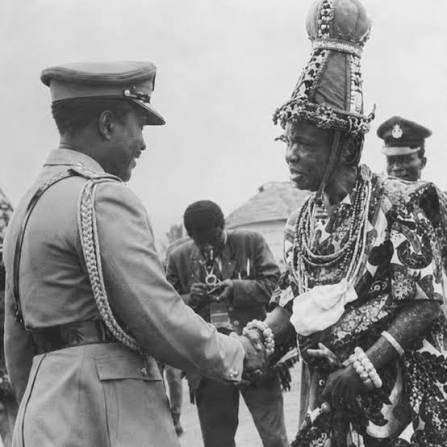
In the bustling streets of Benin City in the early 1950s, a determined politician earned a nickname that echoed his unwavering loyalty: “B2.” Chief Humphrey Omo-Osagie, a man of aristocratic heritage and acute political instinct, was far more than just a loyal deputy; he was a pivotal figure.
His remarkable career journey, spanning colonial government service to a revered traditional chieftaincy, bridged the old world with the new, fundamentally reshaping the political landscape of Benin and paving the way for the Mid-Western Region.
Architect who shaped Benin’s legacy
Omo-Osagie’s life, stretching from his birth in 1896 to his death in 1977, encapsulated Nigeria’s complex evolution from colonial rule to self-governance. He masterfully wove together ancient traditions with modern parliamentary ambition. This unique ability positioned him to make decisions that continue to influence the administrative and cultural fabric of his homeland.
Humphrey Omo-Osagie arrived into the world in Benin City in 1896, a descendant of a distinguished aristocratic family. His lineage was rooted in the prestigious Ezomo family, with his great-grandfather, Iyase N’Ohenmwen, having held a significant traditional title.
His early education began at Government School in Benin City, a crucial step that placed him on a path of colonial learning. This allowed him to proceed to King’s College, Lagos, where he graduated in 1919. King’s College stood as one of the most prominent secondary schools accessible to Africans during the colonial era.
Upon graduation, Omo-Osagie embarked on a career in the colonial Medical Department, serving from 1919 until his retirement in 1945. This extensive period within the British administrative machinery proved invaluable, granting him an intimate understanding of the bureaucratic levers governing colonial Nigeria. He observed firsthand how policy was crafted and implemented, equipping him with an insider’s perspective that would later define his political acumen.
Even during his tenure as a civil servant, Omo-Osagie displayed an early affinity for nationalist politics. He joined Herbert Macaulay’s Nigerian National Democratic Party (NNDP), a foundational political organisation. Later, he also became a member of the Nigerian Youth Movement after its establishment in 1934.
His political awakening included delivering public lectures as early as 1923, guided by the nationalist pioneer Herbert Macaulay himself. This early tutelage honed his skills as a formidable orator and political mobiliser, laying the groundwork for his eventual rise as a prominent leader in his own right.
The Battle for Benin: Otu-Edo and the Rise of ‘B2’
After retiring from government service in 1945, Omo-Osagie plunged into the charged political environment of Benin. The late 1940s and early 1950s were a period defined by intense local rivalries and heated debates. Key issues included taxation, the structure of local government, and the delicate balance of power between traditional institutions and the nascent regional administration.
It was within this crucible that Omo-Osagie became inextricably linked with the Otu-Edo movement, which he founded and led in 1953. This grassroots political organisation centred itself on Benin cultural identity, seeking to protect and promote its unique heritage amidst broader regional shifts. As its President-General, Omo-Osagie quickly emerged as a dominant force within the region.
Otu-Edo positioned itself as the staunch defender of Benin interests and its cherished traditional institutions. The movement gained significant influence in Benin by 1952, operating with the revered Oba Akenzua II as its patron. This alliance proved formidable, consistently delivering majority support in Benin for the National Council of Nigeria and the Cameroons (NCNC), led by Dr. Nnamdi Azikiwe.
Omo-Osagie’s unwavering support for Oba Akenzua II against the then-Iyase, Chief Gaius Obaseki, in the early 1950s cemented his reputation. This loyalty earned him the enduring moniker “B2” – short for “Benin authentic number 2” – a playful jab at Obaseki’s position and a testament to Omo-Osagie’s perceived closeness to the Oba.
His own vehicle plate number was even B-2, suggesting the Oba or governor held the B-1 spot.
His strategic acumen translated into tangible political success. He served in the Western House of Assembly from 1947 to 1954, gaining crucial legislative experience. Following this, he was elected to the Federal House of Representatives in 1954 and re-elected in 1959, demonstrating his growing influence on the national stage.
A Foot in Two Worlds: Federal Service and Traditional Authority
Omo-Osagie’s political trajectory led him to the heart of national governance. He served as Parliamentary Secretary to the Federal Minister of Finance from 1955 to 1959. This was followed by his appointment as Minister of State in the Federal Ministry of Finance, a role he held from 1957 to 1963.
These positions placed him directly alongside some of Nigeria’s most powerful politicians during the late colonial and early independence periods.
During his time in the Finance Ministry, he worked closely with Chief Festus Okotie-Eboh, the Federal Minister of Finance. This relationship was more than professional; they shared a common vision. Okotie-Eboh was a leading advocate for creating a separate region for the peoples of the Benin and Delta provinces, a cause Omo-Osagie championed tirelessly.
Then, in December 1960, shortly after Nigeria gained its independence, Omo-Osagie received a momentous appointment: he became the Iyase of Benin. This placed him in one of the highest and most significant offices within the traditional political hierarchy of the ancient Benin Kingdom.
The Iyase, often described in English as the traditional prime minister of Benin, held major political responsibilities and, in earlier times, important military functions.
The title of Iyase is not hereditary. Instead, the Oba chooses a loyal and capable individual for the role, reflecting trust and recognition of service. Chief Humphrey Omo-Osagie became the 15th Iyase of Benin, serving under Oba Akenzua II. This appointment visibly connected his burgeoning career in modern electoral politics with the deeply rooted traditional authority of the Benin palace.
This dual role underscored his unique ability to bridge seemingly disparate systems. He navigated the formal structures of federal government while simultaneously upholding and operating within the ancient customs and power dynamics of the Benin Kingdom. His career showed how traditional titles and modern political affiliations could coexist, and even strengthen each other, during Nigeria’s transformative years.
The Mid-West Dream: A Region Forged by Sacrifice
The creation of the Mid-Western Region stands as one of the most defining political achievements of Chief Humphrey Omo-Osagie’s career. His commitment to the cause was unwavering, with its roots stretching back well before independence. The campaign rallied communities across the Benin and Delta provinces, advocating for greater self-determination.
As early as May 5, 1956, the Mid-West State Movement was formally established, with Dennis Osadebay at its helm and Omo-Osagie serving as his crucial deputy leader. Working in close collaboration with Oba Akenzua II, Omo-Osagie vigorously resisted political domination from the powerful Western Region. This shared goal forged a strong alliance between traditional rulers and modern politicians.
The constitutional campaign eventually advanced through the federal legislature. The Mid-Western Region Act, 1962, provided the framework for establishing Nigeria’s fourth region. This territory encompassed Benin Province, including the Akoko Edo District in Afenmai Division, and Delta Province, along with Warri Division and the Warri Urban Township area.
The decisive moment arrived with the referendum held on July 13, 1963. Out of 654,130 eligible voters, an overwhelming 579,077 cast their ballots in favour of the new region, while only 7,218 voted against it. This affirmative vote represented an impressive 89.07 percent of those eligible, comfortably exceeding the required constitutional threshold. The new Mid-Western Region officially came into operation in 1963.
But the true measure of Omo-Osagie’s dedication came with a profound personal sacrifice. When the opportunity arose to establish the new region, he was faced with a critical choice: become the Premier of the newly formed Mid-Western Region himself, or ensure that Benin City would be designated as its capital. He chose the latter.
This decision, allowing Dennis Osadebay to become Premier, secured Benin City’s capital status. It is a sacrifice credited with generating over 70% of Benin City’s modern developments, a legacy that endures today.
His political involvement did not end with the region’s creation. He served as Deputy Administrator for Local Government within the All-Party Midwest Interim Administrative Council during the transitional phase.
He also served as a parliamentarian in the regional House of Assembly, influencing the administration of Dennis Osadebay, who became Premier of the Mid-Western region from 1963 to 1966. This highlights how various forces, from parliamentary figures to Nigerian street theatre, contribute to societal shaping.
A Complex Legacy: Owegbe and Enduring Influence
No exploration of Chief Humphrey Omo-Osagie’s political life would be complete without acknowledging the complexities surrounding Owegbe. This ritual society evolved into a politically significant entity, closely tied to the fierce competition that characterised the Otu-Edo movement in Benin. Its activities became so contentious that the Western Nigerian Government moved to prohibit the organisation in 1959.
The controversy persisted even after the Mid-Western Region’s formation. An official commission of inquiry later investigated Owegbe. Its 1966 report, published by the Mid-Western Nigerian Ministry of Internal Affairs and Information, delved into the organisation’s structure, leadership, political influence, and practices. Omo-Osagie held a prominent position within the political framework associated with Owegbe, as well as within Otu-Edo.
The inquiry examined allegations ranging from political pressure and oath-taking to intimidation, painting a vivid picture of the intense struggle for political control in Benin during Nigeria’s First Republic.
The Owegbe controversy thus remains an important, if complex, part of Omo-Osagie’s broader political narrative, highlighting the raw and often turbulent nature of local political mobilisation during that era.
His ability to navigate such contentious currents alongside his formal roles reveals a shrewd political operator, much like the intricate systems found in Igbo apprenticeship system.
Bridging Traditional and Modern Authority
Omo-Osagie’s historical importance stems significantly from the diverse institutions through which he wielded influence. He was a colonial civil servant, an elected regional politician, a member of the Federal House of Representatives, a federal Minister of State, President-General of Otu-Edo, the Iyase of Benin, and a senior member of the Mid-Western government.
These varied roles were deeply interconnected. They illustrate how Nigerian politics during decolonisation seamlessly integrated older forms of authority with newly established electoral institutions. In Benin, allegiance to the monarchy could, for instance, coexist with modern political organisation.
Traditional titles could be held by influential politicians who also occupied legislative seats. Local organisations often aligned with national parties while fiercely preserving their distinct regional agendas. Omo-Osagie exemplified this political fusion more clearly than most.
Enduring Legacy
Chief Humphrey Omo-Osagie emerged as one of the most influential Benin politicians during Nigeria’s transition from colonial rule to independence and the First Republic. Born in Benin City in 1896, he attended Government School and King’s College, Lagos. He dedicated years to the colonial Medical Department before retiring in 1945.
From there, he ascended through the ranks of the Otu-Edo movement and electoral politics, representing Benin at both regional and federal levels. He also served in the Federal Ministry of Finance before becoming the Iyase of Benin in December 1960. His impact on the campaign for the Mid-Western Region was considerable.
As the deputy leader of the Mid-West State Movement, Omo-Osagie was instrumental in the extensive political campaign that led to constitutional legislation and the referendum of July 13, 1963. His later role as Deputy Administrator for Local Government, and his influence in the Mid-Western administration, further cemented his importance within the new region.
His political legacy also includes the Owegbe controversy, reflecting the intense competition prevalent in Benin politics during that era. These multiple dimensions reveal a formidable and complex political figure, whose story offers insights into how deep-rooted cultural values, akin to those found in concepts of Yoruba identity, intertwined with modern political structures.
Omo-Osagie’s career illustrates how monarchy, local identity, electoral politics, national parties, and constitutional federalism became deeply entwined during one of the most transformative periods in Nigerian history.
