



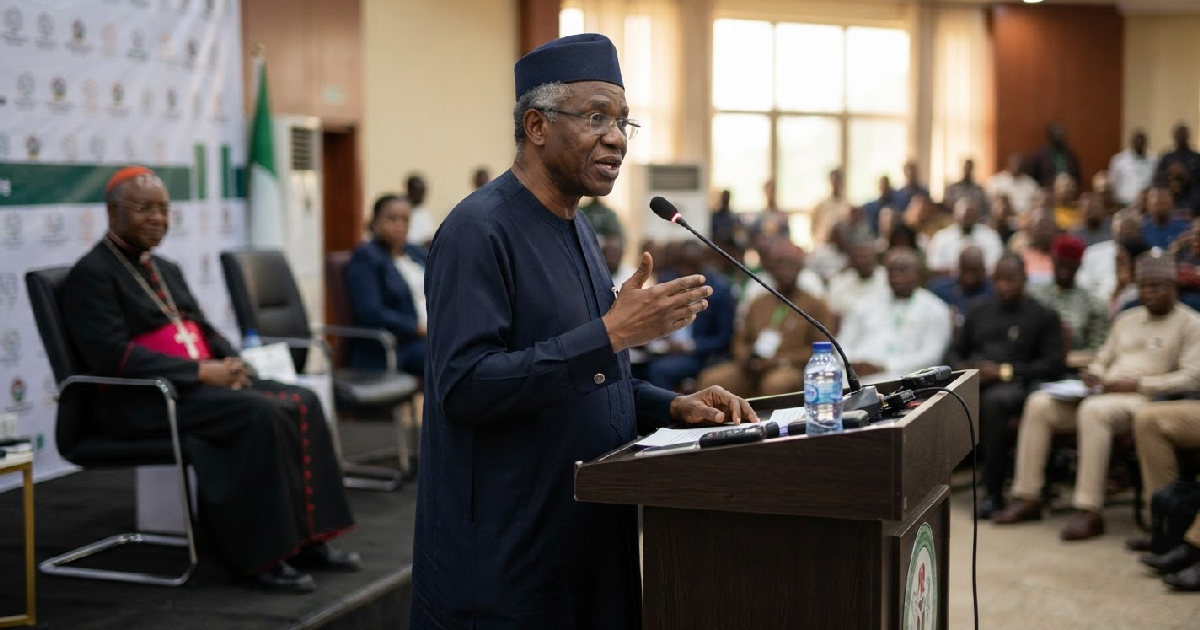
Professor Jibrin Ibrahim, a veteran political scientist and seasoned voice in Nigerian civil society, issued a stark warning.
Ibrahim’s insights build on recent public dialogue, including strong concerns from Archbishop Emeritus of Abuja, John Cardinal Onaiyekan. The Cardinal suggested President Bola Tinubu’s administration aims to win the upcoming elections “by all means,” amid public distress over harsh economic policies.
Cardinal Onaiyekan’s candid warning sparks official backlash
John Cardinal Onaiyekan recently cast a critical light on the current political climate. This followed a private meeting between the Catholic Bishops’ Conference of Nigeria (CBCN) and President Bola Tinubu.
During a subsequent television interview, the Archbishop Emeritus shared his assessment of the administration’s policy direction. He contended that ordinary Nigerians are enduring significant hardship because of the government’s policies.
Cardinal Onaiyekan’s directness on national television quickly drew a sharp retort from the presidency. This official response intensified the debate around the openness of Nigeria’s political discourse.
Presidential aide dismisses concerns as “abuse of privilege”
Temitope Ajayi, the Senior Special Assistant to the President on Media and Publicity, publicly criticized Cardinal Onaiyekan’s remarks. Ajayi stated on Saturday that the Cardinal’s decision to disclose details constituted an “abuse of privilege.”
The presidential aide suggested it was “fundamentally inappropriate” for the Cardinal to offer his personal interpretation of the discussions. This pushback has only deepened concerns about dissent within democratic spaces.
Legislative moves threatening fundamental freedoms
At the heart of Jibrin Ibrahim’s concerns are several legislative proposals currently before Nigeria’s National Assembly. These bills, if enacted, would significantly expand executive control over civic life, according to civil society groups.
They threaten to undermine established rights to freedom of expression, peaceful assembly, association, and media freedom. Critics argue these measures are being considered while Nigeria’s civic space already shrinks, a trend observed since 1999.
The controversial Foreign Aids Bill (SB.1034)
One of the most contentious proposals is the Foreign Aids (Regulation, Transparency and Disclosure) Bill, 2026 (SB.1034). This bill would grant authorities sweeping powers to monitor, regulate, and potentially shut down non-governmental organisations (NGOs).
It also targets civil society groups and private entities receiving foreign assistance. Ostensibly, these powers aim to promote transparency and prevent misuse of funds, but critics view it as a tool to stifle independent advocacy.
Compelling social media platforms to establish physical offices
Another significant legislative effort aims to compel social media platforms to establish physical offices in Nigeria. Failure to comply would result in prohibition from operating in the country.
While framed as regulatory measures, these proposals are widely viewed as increasing governmental leverage over digital platforms. This could limit their ability to facilitate public debate, access to information, and civic participation.
A disturbing pattern of civic space decline
Since President Bola Ahmed Tinubu assumed office in May 2023, authorities have increasingly relied on restrictive laws and politically motivated prosecutions. This pattern includes strategic lawsuits, arbitrary arrests, and judicial harassment targeting journalists and critics.
Jibrin Ibrahim, with over thirty years of active engagement with civil society, views these actions as part of a broader decline. He suggests it marks one of the most serious contractions of civic space since Nigeria embraced democracy in 1999.
Targeting journalists and civil society organisations
Recent examples highlight this concerning trend. The continuing prosecution of activist and publisher Omoyele Sowore stands as a prominent case.
There have also been reprisals against the Socio-Economic Rights and Accountability Project (SERAP) and misuse of the Cybercrimes Act. These actions often target journalists and government critics, underscoring a climate of fear.
International monitoring bodies have also documented this deterioration. The Committee to Protect Journalists (CPJ) reported 91 cases of journalists being harassed or attacked across 13 states and the Federal Capital Territory.
These incidents occurred during the first three years of the current administration, spanning a wide geographical area. They illustrate the pervasive nature of challenges faced by independent media, where speaking truth to power carries increasing risks.
Understanding these historical patterns of governance is crucial for today’s citizens. The evolution of state power and accountability has consistently shaped the national discourse on freedom and control.
Nigeria’s constitutional and international obligations at stake
These legislative proposals raise fundamental questions about Nigeria’s adherence to its own constitution and international human rights treaties. Sections 39 and 40 of the Nigerian Constitution 1999 (as amended) guarantee freedom of expression, peaceful assembly, and association.
Section 22 also affirms the media’s vital role in holding the government accountable. Civil society groups argue the proposed bills directly contradict these foundational principles.
African Charter and International Covenants
Nigeria is also a signatory to the African Charter on Human and Peoples’ Rights, which is incorporated into Nigerian law. This charter protects freedoms of expression, association, assembly, and participation in public affairs.
Furthermore, Nigeria is bound by the International Covenant on Civil and Political Rights (ICCPR), and the International Covenant on Economic, Social and Cultural Rights (ICESCR). These treaties mandate that domestic laws align with international human rights standards.
Any restrictions on these rights must meet strict requirements for legality, legitimate purpose, necessity, and proportionality, as outlined in the ICCPR. Critics assert that the current bills fail to satisfy these internationally recognized standards.
The high stakes for the 2027 general elections
The timing of these legislative efforts is particularly concerning given Nigeria’s preparations for the 2027 general elections. Rather than fostering an open environment for citizens, journalists, and political actors, these measures risk entrenching fear and self-censorship.
Independent advocacy and investigative journalism are not threats to democracy, but rather essential safeguards of constitutional governance. Jibrin Ibrahim and other civil society leaders, like Auwal Rafsanjani, believe these actions indicate that “Nigerian democracy is on trial.”
This atmosphere also impacts the broader economic landscape. While financial initiatives aim to stimulate growth amid public hardship, a shrinking civic space can limit the open debate and critique essential for effective economic policy.
The impact on political participation and dissent
The alleged use of incumbency powers to deregister opposition parties and disrupt politicians further complicates the pre-election period. There are also claims that the Electoral Body, INEC, is acting in a partisan manner.
This concerted effort creates a hostile environment for genuine democratic competition. It raises questions about the integrity of the electoral process itself and the legitimacy of future outcomes.
The experiences of key individuals often illuminate the broader challenges facing a nation. Their stories frequently reflect the intricate interplay of power and tradition in Nigeria’s complex history.
Ultimately, the core question Jibrin Ibrahim’s commentary poses is whether Nigeria is charting a course towards a more restrictive political future. The unfolding debate around these bills and the administration’s response will shape the character of its democracy for years to come.
