




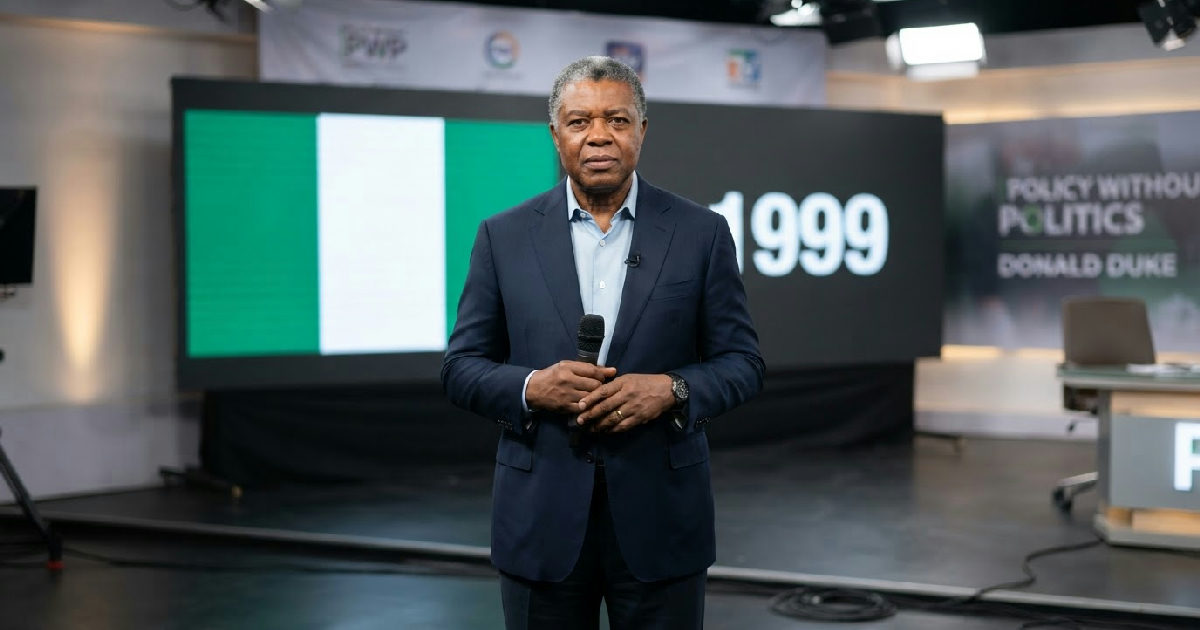
Nigerians were better off in 1999 than they are today, in 2026, despite over two decades of constitutional democracy. That’s the stark assertion from Donald Duke, the presidential candidate for the Peoples Redemption Party (PRP) and former Governor of Cross River State, made during a “Policy Without Politics (PWP)” podcast interview on a Friday.
This claim immediately challenges the very narrative of progress that has defined Nigeria’s post-military era, forcing a question: how could a nation, supposedly maturing in its democratic journey, find its citizens worse off? Such moments in history often redefine perceptions, much like dramatic international incidents have done for Nigeria.
Donald Duke’s Role in 1999 Nigeria
For many Nigerians, the return to civilian rule in 1999 was more than just a political transition. It was a moment laden with immense hope for economic liberation and improved living standards after years of military dictatorships.
The prevailing belief was that democracy, with its inherent transparency and accountability, would naturally usher in an era of prosperity. This vision often painted a picture of steady economic growth, job creation, and a rising quality of life for the average citizen.
But Duke, who also ran as a presidential candidate for the Peoples Redemption Party (PRP), offers a startling counter-narrative. His direct comparison between 1999 and 2026 forces us to confront a potential disconnect between political freedom and economic well-being.
Nigeria’s economic landscape: 1999 in hindsight
Stepping back into 1999, Nigeria was just emerging from a protracted period of military governance, its economy scarred by sanctions, instability, and inconsistent policy. Inflation was high, infrastructure was decaying, and foreign investment was wary.
Yet, in that landscape of challenge, there was a palpable sense of renewed optimism. The naira, while not robust, held a relatively stable exchange rate compared to its future trajectory, and the national debt burden was managed under different terms.
What Nigerians experienced then was an economy on the cusp of re-engagement with the global community. The expectations for democratic dividends included a revitalisation of industries and a focus on long-term growth.
Compared to the decades of governance preceding it, the immediate post-1999 period offered a sense of breaking free from the shackles of isolation and economic mismanagement. This glimmer of hope, however fragile, set a baseline for future comparisons.
The shifting sands of 2026
Fast forward to 2026, and the economic picture painted by many, including Duke, appears considerably bleaker. High unemployment rates persist, creating a large pool of frustrated young people seeking opportunities.
The national currency has faced significant depreciation against major international counterparts, eroding purchasing power and making imports more expensive. This hits ordinary households hard.
Daily life for many Nigerians is now defined by the struggle against escalating costs for basic necessities like food, transport, and housing. These factors collectively contribute to a pervasive sense of economic hardship across various segments of society. Such enduring challenges sometimes echo past periods where national resolve was tested, even in unexpected ways, such as the career of notable figures in law enforcement.
The gap between the soaring aspirations of 1999 and the current economic realities has left many questioning the trajectory of the nation. It highlights how economic policy and its implementation directly affect the lives of millions.
Donald Duke’s perspective: a governor’s view
Donald Duke’s firsthand experience as former Governor of Cross River State offers unique context to his pronouncements. He was at the helm during those initial, hopeful years of renewed democracy, navigating both its challenges and its opportunities.
During his tenure, Duke was known for his focus on tourism and urban development, aiming to transform Cross River State into a prime destination. His insights are not merely theoretical; they are shaped by the practicalities of governance.
He saw up close how national economic policies filtered down to affect ordinary citizens and state finances. This vantage point likely informs his assessment that the economic conditions of the nascent democracy were, in some ways, more favourable than today’s.
His remarks reflect a broader, critical examination by some political leaders regarding the effectiveness of economic management over the past two decades. They underscore a growing public debate about whether democratic structures have delivered tangible economic benefits.
The cost of unfulfilled expectations
Duke’s assertion forces us to confront the heavy cost of unfulfilled expectations in a democracy. When citizens anticipate improved living conditions with political freedom but face sustained economic struggle, it erodes trust in governance.
This disillusionment can foster apathy and cynicism, impacting social cohesion and the nation’s ability to rally around common goals. The sentiment that things were “better before” can become a powerful force in public discourse.
It also raises fundamental questions about how Nigeria defines and measures progress. Is it solely through macroeconomic indicators, or does it require a tangible improvement in the daily lives of its most vulnerable citizens? The answer shapes national priorities.
The ongoing struggle to bridge this gap between expectation and reality remains one of Nigeria’s most significant challenges. Understanding its roots requires acknowledging differing perspectives on historical economic conditions. Examining moments from decades of governance can offer insights into the complex interplay of political decisions and their lasting economic impacts.
A plain insight
Donald Duke’s provocative comparison reveals that the mere presence of democracy does not automatically translate into economic betterment for its people. Sustained, inclusive economic growth requires consistent, effective governance, free from the inertia of past challenges, proving that the struggle for prosperity is a continuous, evolving test, regardless of the political system in place.
