




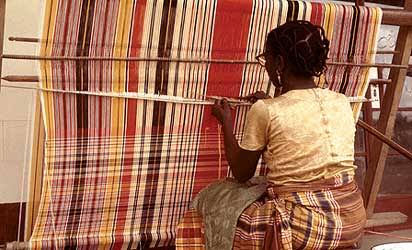
In Nigeria’s Abia State, Akwete weavers are transforming the celebrated handwoven Igbo textile into a global fashion statement, moving beyond traditional ceremonial wrappers.
This transformation isn’t just about aesthetics; it’s a deliberate act of preserving centuries-old knowledge and weaving new economic futures for women in communities like Obohia-Ndoki.
The threads of history: Akwete’s enduring legacy
Artisans and designers are spearheading this resurgence, reimagining the intricate patterns and vivid colours of Akwete for a new generation. They’re crafting everything from structured jackets to coordinated streetwear sets, proving that heritage can not only survive but thrive in the modern era.
The story of Akwete weaving is as old as the communities that create it, rooted deeply in Akwete town within the Ukwa East Local Government Area of Abia State. Evidence suggests the craft flourished as far back as the 19th century, becoming a full-time occupation for many women by the mid to late 1800s.
It was a time when palm oil trade was at its peak, and the demand for high-quality textiles was significant.
One name echoes through this history: Dada Nwakwata, a legendary weaver active in the late 19th century. She’s often credited with revolutionising Akwete, expanding its traditions and pioneering the highly ornamented, intricate weft patterns that define the cloth today. Her innovations cemented Akwete’s reputation for complex designs.
From utility to artistry: evolving techniques
Traditionally, Akwete cloth came to life on wooden or upright frame looms, wielded by women whose skills were passed down through generations. These textiles weren’t just functional; they carried stories and meaning through their symbolic motifs. The vertical broadloom, introduced in 1946, marked another significant step, allowing for larger, seamless cloths and reducing weaving time.
The weaver’s repertoire today boasts well over fifty distinct patterns. Each design, from the geometric precision to the fluid curves, often embodies deep cultural significance, a visual language woven directly into the fabric. The skill involved in these supplementary weft techniques, where additional threads form patterns within the fabric structure, speaks to the immense artistry of the Akwete weaver.
From ceremonial wrapper to contemporary runway
Today, Akwete is undergoing a vibrant reinterpretation. It’s no longer confined to traditional wrappers or ceremonial attire, but is appearing in modern silhouettes that catch the eye and demand attention. Think contemporary balloon trousers, elegant blouses, and sophisticated gowns, all infused with the unique character of handwoven Akwete.
Uchechi Ahunanya, a textile entrepreneur and weaver from Obohia-Ndoki, embodies this transition. Having learned the craft from her mother and grandmother, she now adapts Akwete cloth for a contemporary market. She works with diverse threads and textures, meticulously fulfilling client requests for modern styles while honouring the cloth’s origins.
A moment on the global stage
The appeal of Akwete has even reached international circles. In 2018, former British Prime Minister Theresa May wore an Akwete jacket during her visit to Nigeria, a piece designed by Lagos-based fashion visionary Emmanuel Okoro, whose brand, Emmy Kasbit, is a key player in this cultural fusion. This moment underscored the textile’s potential on the global stage.
But Emmy Kasbit isn’t alone. Designers across Nigeria are recognizing the intrinsic value and unique aesthetic of Akwete. They’re integrating it into collections that fuse traditional craftsmanship with global fashion trends, creating pieces that resonate with both local pride and international appeal. This movement ensures that Akwete is not merely preserved, but actively celebrated and reinterpreted for new audiences.
Economic threads and cultural pride
The shift into modern fashion isn’t purely artistic; it’s a critical pathway to economic empowerment. For women in Akwete communities, weaving has historically been a source of livelihood. This new demand translates directly into increased income, securing a future for both the craft and its practitioners.
A single pair of handwoven silk Akwete can command between ₦150,000 (US$110) and ₦200,000 (US$147), with cotton variants selling for ₦80,000 (US$59) to ₦100,000 (US$73) depending on motif complexity.
Nnodi, an educator focused on the craft, highlights that Akwete is much more than just a textile. It embodies centuries of history, rich aesthetics, traditional technology, community spirit, and collective memory. For him, seeing it gain new prominence is a victory for cultural identity. Nigerian identity has always been intertwined with its artistic expressions, and Akwete is no exception.
Nurturing the next generation of weavers
Attracting younger generations to the labour-intensive craft remains crucial. But there’s hope: Uchechi Ahunanya’s 16-year-old daughter, Divine Ahunanya, is actively learning the weaving tradition. Her involvement symbolizes a continuity that many cultural art forms struggle to maintain, a bridge between the past and the future of Akwete.
The increasing commercial viability, driven by fashion partnerships and direct-to-consumer sales, helps make weaving an attractive profession for young people. This economic incentive reinforces the cultural preservation efforts, demonstrating that tradition can also be a path to prosperity in the modern Nigerian landscape.
Weaving Nigeria’s identity into the world
Akwete’s journey from local art to global fashion phenomenon mirrors a broader appreciation for African textiles worldwide. Historic examples of Akwete textiles are even held by prestigious institutions such as The Metropolitan Museum of Art and the British Museum, underscoring their artistic and cultural value on a global scale. This international recognition validates the intrinsic worth of the craft.
This movement isn’t isolated. It fits within a global trend where indigenous crafts are being revitalized and reinterpreted, often through the lens of contemporary design. Ghana’s Kente cloth, Mali’s Bogolanfini (mudcloth), and Nigeria’s own Adire and Aso-Oke textiles have all seen similar surges in popularity, moving from cultural artifacts to covetable fashion items. These textiles, much like Akwete, are carriers of identity.
For Nigeria, this resurgence of Akwete provides a powerful form of cultural diplomacy. It showcases the nation’s rich artistic heritage and the incredible skill of its artisans. It also poses questions about the balance between authenticity and commercial viability as the craft gains wider exposure.
Cultural broadcasting has played a role in shaping national identity for decades, and now Akwete cloth offers a tangible, wearable form of that identity.
Challenges and the path ahead
Despite the growing enthusiasm, challenges persist. Weavers still face competition from mass-produced fabrics and the high cost of quality raw materials. Ensuring fair compensation and protecting intellectual property as designs gain popularity are also critical for the sustainability of the craft. But the path ahead looks promising, driven by passion and a commitment to heritage.
The story of Akwete weaving today is one of resilience and innovation. It’s about a community using its ancestral craft to define its present and shape its future, proving that the threads of tradition can be rewoven into something new, something beautiful, and something profoundly Nigerian. Musicians too have shaped Nigeria’s cultural narrative, and now Akwete weavers are adding their unique voice.
