




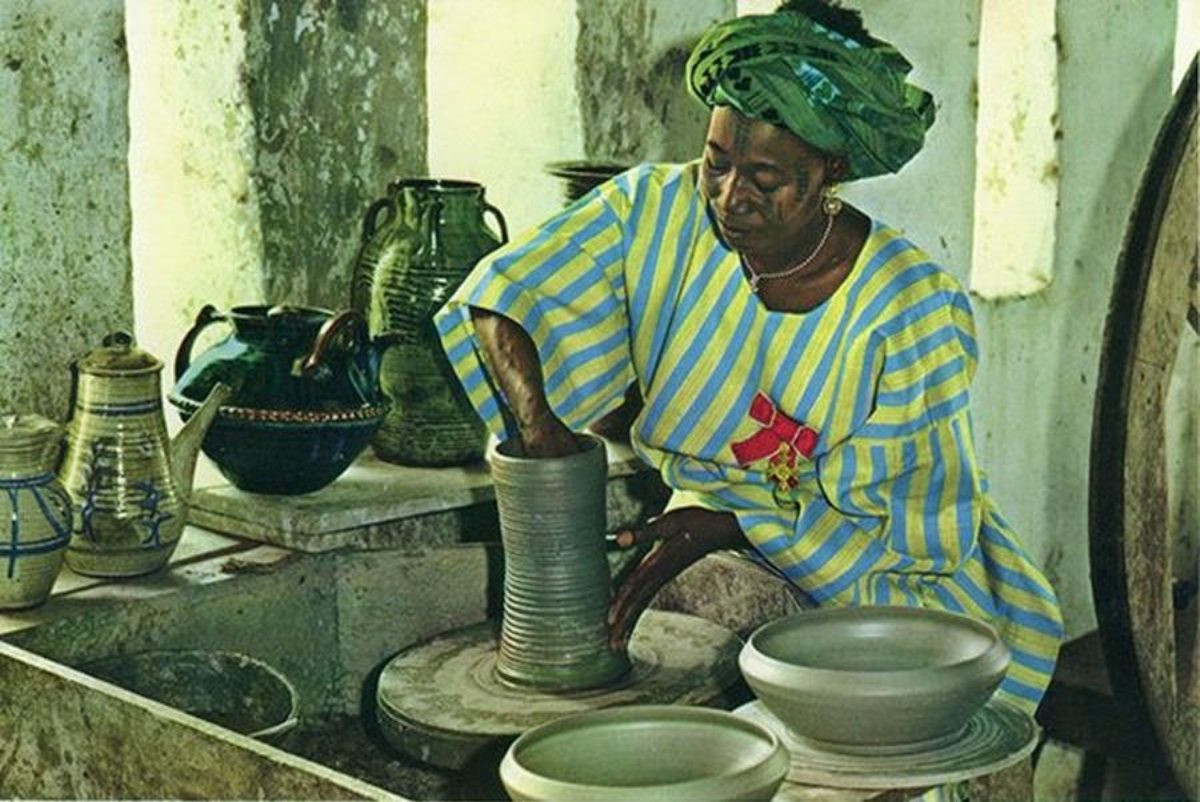
Long before her face graced Nigeria’s ₦20 note, Ladi Kwali sent clay into spheres her childhood could never have imagined.
Her story is more than a simple ascent to fame; it reveals the powerful convergence of two distinct pottery traditions in colonial Nigeria, ultimately forging a unique path for one of the nation’s most celebrated artists.
Ladi Kwali’s clay lessons
Ladi Dosei Kwali was born around 1925 in Kwali, a village within the Gwari region of what was then Northern Nigeria. In her community, pottery wasn’t just a craft; it was a fundamental part of daily life, particularly for women who had honed their skills over generations.
Kwali began her apprenticeship as a child, learning the intricate coiling method from her aunt. This traditional technique involved building vessels gradually, placing long coils of clay one upon another, then joining, shaping, and thinning the walls by hand. It demanded exceptional control and balance, creating forms without the aid of modern machinery.
Her early pots, large water jars and other domestic vessels, were decorated with incised patterns of animals and geometric forms. Lizards, snakes, birds, and fish frequently adorned her work, making these utilitarian objects distinctly hers. These pieces were made not for galleries, but for the practical rhythms of household life.
This traditional practice, where skills pass through generations, reflects the deep heritage of craftsmanship found across Nigeria, evident in the intricate work of Yoruba craftswomen.
It was this profound connection to everyday Nigerian life that made her subsequent transformation into an internationally collected artist so remarkable. Her work showed how deeply embedded traditional knowledge was within the culture.
An Emir’s Palace and a British Potter
The trajectory of Kwali’s life shifted around 1950 when Michael Cardew, a British studio potter, visited the Emir of Abuja. Cardew, an experienced ceramist who had worked in Britain and Ghana, was in Nigeria as part of a colonial government initiative aimed at developing local pottery production.
At the Emir’s palace, Cardew encountered local pottery, noting pieces associated with Ladi Kwali. He immediately recognised a level of skill that was vital to his vision for modernising Nigerian ceramics. This moment is often misconstrued as Cardew “discovering” an unknown village woman.
But the reality was far richer. Kwali was already an accomplished artist, deeply steeped in a hand-building tradition passed down through generations. Cardew didn’t teach her how to make pottery; he offered a new technological system, and she brought an inherent understanding of how to make clay sing.
The Abuja Pottery Training Centre
In 1951, Cardew established the Pottery Training Centre in Abuja, an area now known as Suleja in Niger State. This wasn’t the modern Federal Capital Territory, but a historical settlement. The centre’s purpose was dual: to introduce modern ceramic technology, including the potter’s wheel, glazing, and high-temperature kiln firing, and to foster economic development.
The centre was established partly to introduce modern ceramic technology into Nigerian pottery. Potters were exposed to the wheel, glazing, slips, and high-temperature kiln firing. The programme also had an economic purpose, with traditional pottery adapted for new urban and commercial markets, producing objects for tableware or as decorative pieces, reflecting the colonial administration’s objectives for development.
It was into this environment that Kwali entered. She joined the centre in 1954, stepping onto the wheel for the first time. She began working with glazed stoneware, embracing these technological advancements. However, she made a crucial choice: she didn’t abandon her traditional methods. Instead, she integrated them.
Her unique approach allowed her to construct large vessels using the coiling method she had perfected, then adorn them with traditional Gwari imagery, before firing them using the centre’s modern kilns and glazes. It was a potent fusion, where Gwari forms met modern ceramic possibilities.
Crafting a New Nigerian Aesthetic
Kwali’s work became instantly recognisable for its distinctive synthesis. Her pieces were covered with animals – lizards, snakes, birds, fish, scorpions – often incised directly into the clay. A 1957 water jar, now in the Fitzwilliam Museum at the University of Cambridge, exemplifies this blend, showcasing hand-coiling, incised decoration, slip, and transparent glaze.
Crucially, this particular water jar was created as an exhibition piece for European collectors, rather than for domestic use. This shift highlighted how traditional Nigerian pottery was acquiring a new purpose within the international art market.
Her art started reaching audiences beyond Nigeria by the late 1950s, with exhibitions at London’s Berkeley Galleries in 1958 and 1962. Her pots entered prestigious international collections, including the Victoria and Albert Museum and the British Museum.
Kwali’s international recognition also led to extensive travel. In 1962, she toured Britain with Cardew, demonstrating her hand-building techniques to captivated audiences. She showed how a vessel could rise from coils of clay without a wheel, challenging prevailing assumptions about ceramic knowledge.
She later travelled to the United States in 1972 with Cardew, participating in demonstrations there as well. The American tour was connected to a broader effort to bring African craftsmen to American audiences and encourage cultural exchange.
Her work showed that sophistication wasn’t exclusive to Western methods; it existed vibrantly within traditional Nigerian practices.
A Legacy of National Recognition
Kwali’s growing international stature eventually garnered significant official recognition at home and abroad. In 1963, she received the Member of the Order of the British Empire (MBE). Later, in 1977, Ahmadu Bello University awarded her an honorary doctorate.
The Nigerian state also honored her profound contributions. She earned the Nigerian National Merit Award, which recognises outstanding national achievement, and in 1981, she was made an Officer of the Order of the Niger. Kwali, whose education came solely through her craft, had become one of Nigeria’s most revered cultural icons.
Her most familiar symbol, for millions of Nigerians, came in 2007, when her portrait appeared on the redesigned polymer ₦20 note. The Central Bank of Nigeria highlighted her pottery as a key cultural feature on the currency.
This transformed her from a celebrated artist into a ubiquitous figure, visible to anyone handling the note, making her face more widely known than her actual ceramic works.
Her international presence as an artist showcased the depth of Nigerian knowledge abroad, a dynamic also seen in how Northern Nigerians in London have maintained their cultural identity.
The institution that fostered her unique artistic journey, the Abuja Pottery Training Centre, was ultimately renamed the Ladi Kwali Pottery Centre. This tribute acknowledged that she was far more than a student there; she was a foundational force who shaped its historical significance, demonstrating the enduring impact of individual talent on institutional identity.
Insight: How State Policy Shapes Cultural Legacy and Economic Value
Ladi Kwali died in Minna on August 12, 1984, at approximately 59 years old. By then, her work had travelled across continents, finding homes in some of the world’s most important collections. Her career, shaped in part by her collaboration with Michael Cardew, demonstrated a complex exchange of knowledge.
The story of Ladi Kwali, and particularly the Abuja Pottery Training Centre, offers a clear insight into the complex interplay between colonial development policy, cultural preservation, and national identity. The decision by colonial administration to establish the centre was not purely artistic; it was an economic policy aimed at adapting traditional crafts for new markets.
Kwali’s ability to thrive within this system, blending Gwari tradition with modern techniques, demonstrated how state-backed institutions could inadvertently create platforms for indigenous knowledge to gain international prominence.
Later, the Nigerian state, through awards and currency, formally integrated her legacy into the national narrative, showcasing how governmental recognition elevates specific cultural expressions to symbols of collective identity. This demonstrates how institutional frameworks, even those initiated by colonial powers, can shape and define the economic and cultural value of tradition in a changing world.
