




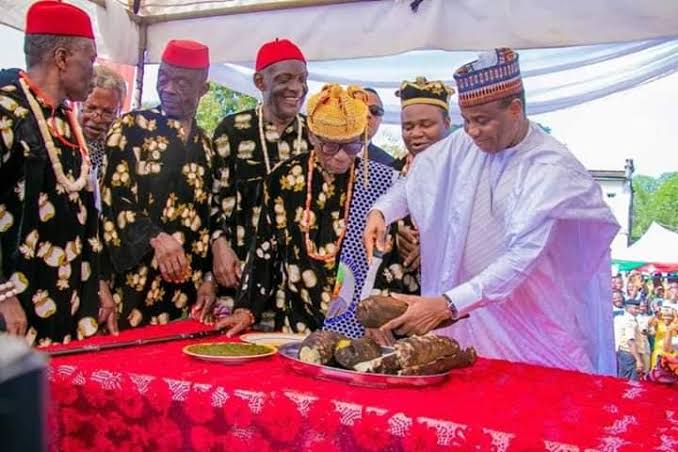
On August 15th, the grounds of Oke Ovoro Secondary School in Uvuru, Mbaise, were filled not just with people, but with a palpable sense of history. This was the scene of the 2026 Iriji Mbaise festival, an annual explosion of colour, music, and community spirit, all centered on a single, revered crop: the yam.
As dancers moved to the rhythm of traditional instruments and families shared in the bounty of the harvest, former Imo State Governor, Rt. Hon. Emeka Ihedioha, a son of Mbaise, spoke to the heart of the gathering.
Where Yam Binds Inside the king of crops and soul
He urged the communities to protect this heritage, a poignant reminder that this celebration is more than a party; it’s a living link to a past that must be carefully carried into the future.
To understand the Iriji Mbaise festival, one must first understand the yam. In Igbo culture, the yam is not merely food. It is the undisputed ‘king of crops’, a symbol of wealth, a testament to hard work, and a spiritual link between the community, the earth goddess (Ala), and the ancestors who walked the land before.
The cultivation of yams is a demanding, labour-intensive process, and a bountiful harvest has long been the measure of a man’s worth and a community’s prosperity. This deep respect is enshrined in tradition. It’s considered taboo to eat the newly harvested yam before it has been formally celebrated and offered in thanksgiving. This act elevates the crop from simple sustenance to a sacred communion.
This is the core purpose of Iriji Mbaise. It’s a moment for the community to collectively give thanks for a successful harvest, reinforcing the bonds that tie them together.
The ceremony is traditionally led by the ‘Ndi Ezeji’ (literally, ‘kings of yam’), a respected brotherhood of successful farmers who have earned their titles through skill and dedication. They make the first offerings, ensuring the ancestors are honoured before the community partakes.
The deep connection between agriculture and identity is not unique to the Mbaise. Across Nigeria, farming traditions have shaped communities for centuries, as seen in historic events like the Abakaliki Agricultural Show at the dawn of independence, which showcased the nation’s reliance on the land.
From Ahianjoku’s shrine to a modern celebration
While the festival feels timeless, its modern form is a story of adaptation. The Iriji Mbaise we see today evolved from an older, pre-colonial tradition: the Ahianjoku festival. This ancient rite was dedicated specifically to Ahiajoku, the Igbo deity of yams, seeking its blessing for a plentiful harvest.
The mid-20th century marked a significant turning point. With the widespread adoption of Christianity in the region, many communities sought to reconcile their new faith with their ancestral traditions. Research points to the year 1946 as a pivotal period in the development of the contemporary, Christianized version of the festival.
It retained the core elements of thanksgiving and community but framed them within a new religious context.
This synthesis is what makes the festival so powerful. It didn’t erase the past; it built upon it. Today, the sounds of Christian hymns might mingle with the beat of the Ogbongelenge drums.
The vibrant, traditional dances—like the Abigbo, Agbacha Ekurunwa, and Alija—are performed with the same energy as they have been for generations, telling stories of the harvest, of history, and of the community itself.
This ability to adapt while preserving a core identity is a recurring theme in Nigerian history. It mirrors the way communities like the Anioma launched a thirty-year Ekumeku resistance against colonial forces, fighting to maintain their autonomy and cultural integrity in the face of overwhelming change.
Mbaise: the five towns that become one
The name ‘Mbaise’ itself tells a story of unity. It’s a portmanteau derived from the five founding clans of the region: Agbaja, Ahiara, Ekwereazu, Ezi na Ihite, and Oke Uvuru. Covering three Local Government Areas—Aboh Mbaise, Ahiazu Mbaise, and Ezinihitte Mbaise—the region is one of the most densely populated in West Africa, with a population exceeding 600,000 in the 2006 census.
The Iriji Mbaise festival is the moment each year when these five towns, and their descendants scattered across the globe, truly become one. It is a homecoming. Sons and daughters of Mbaise travel from across Nigeria and beyond, drawn back to their roots by the promise of reunion and the taste of new yam.
This annual pilgrimage underscores the festival’s role in reinforcing a collective identity.
At the 2026 event, the leadership of the cultural organisation Ezurueze, led by Surveyor Joe Ogbonna Anosike, earned praise for maintaining this unity despite the inherent challenges of organising such a large-scale event. It’s a testament to the community’s shared commitment to a tradition that transcends individual or clan differences.
This deep cultural broadcasting has historical precedent, echoing how early media, like Sir Bernard Bourdillon’s wired broadcasts, helped to shape and transmit a shared sense of identity across a vast and diverse nation.
A delicate balance between heritage and progress
The call from former governor Emeka Ihedioha at the festival was not just a political speech; it was an articulation of the central challenge facing Iriji Mbaise and countless other Nigerian cultural traditions. How do you preserve the past while embracing the future? How does a festival rooted in agriculture stay relevant to a generation more familiar with smartphones than with yam mounds?
The presence of a diverse array of dignitaries at the 2026 festival highlighted this intersection of the traditional and the modern. Alongside traditional rulers were prominent political figures like Senator Ezenwa Onyewuchi and Rt. Hon. Emeka Chinedu Martins.
The corporate world was represented by figures such as Chief Stanley Amuchie, an Executive Director at Fidelity Bank Plc, and the military by Major General O. A. Fadairo, GOC of the 82 Division.
Their attendance signifies that the festival is not a relic. It is a major event on the socio-political calendar of Imo State, a platform for connection and a powerful statement of regional pride. It demonstrates that cultural heritage and modern life are not mutually exclusive. Instead, culture provides the foundation upon which progress can be built, giving development a unique and meaningful local identity.
This is the delicate balance Ihedioha spoke of. It’s about passing traditions to younger generations not as rigid, unchangeable rules, but as a source of strength and wisdom. It’s about valuing history, not as something to be confined to a museum, but as a living, breathing force that shapes the present and informs the future.
What the future holds for the new yam
The survival of the Iriji Mbaise festival depends on its ability to continue answering a fundamental human need: the need to belong. In an increasingly globalised world, rituals that connect us to a specific place, a specific history, and a specific community become more important, not less.
The festival serves as a powerful anchor for the Mbaise diaspora. For those living far from home, it’s a tangible link to their identity, a way to introduce their own children to the language, food, and values of their ancestors. The celebration is not just about thanking the gods for the yam; it’s about thanking the past for the gift of the present.
Ultimately, the future of the new yam rests in the hands of the next generation. It will be their responsibility to find new ways to tell the old stories, to infuse the ancient rhythms with new meaning, and to ensure that the bonds of community, forged over centuries of shared harvests, remain strong.
The yam itself offers the perfect metaphor. It is a root, buried in the soil of Mbaise, that provides sustenance and life. The Iriji festival is the act of unearthing that root each year, not only to feast, but to remember where the truest source of strength has always been found.
