




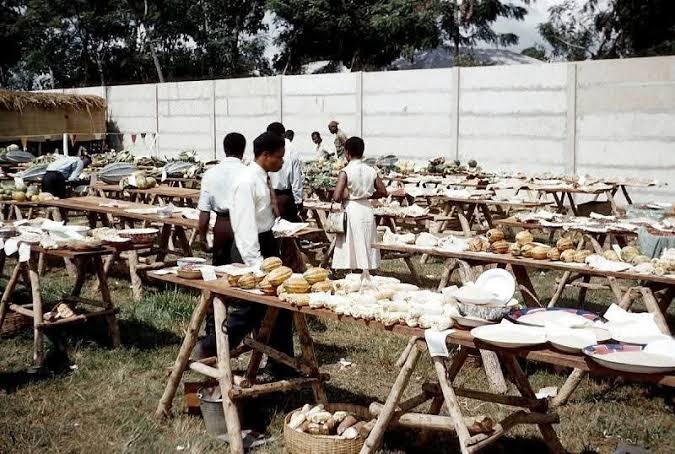
In Nigeria’s Eastern Region, as the nation stood on the cusp of independence, the Abakaliki Agricultural Show of 1960 offered a snapshot of a society in transition.
His photographic archives, now held at the Smithsonian Institution’s Eliot Elisofon Photographic Archives, provide an invaluable record. The Abakaliki Agricultural Show, held around Nigeria’s Independence Day on October 1, 1960, highlighted agriculture’s foundational role in the local economy and society, showcasing both enduring traditions and burgeoning commercial shifts.
Farming and commerce at the 1960 Abakaliki Agricultural Show
Abakaliki in 1960 served as an important administrative and commercial hub within Nigeria’s Eastern Region. The modern state of Ebonyi did not yet exist, but Abakaliki was already a focal point for the surrounding agricultural districts. Ebonyi State was created in 1996 from parts of Enugu and Abia states, with Abakaliki becoming its capital.
Simon Ottenberg, whose extensive work included his book Farmers and Townspeople in a Changing Nigeria: Abakaliki during Colonial Times, 1905–1960, knew this area intimately. His photographs, taken between June and December 1960, place the agricultural show firmly within the extraordinary months leading up to and immediately following independence.
The images he collected depict vast fields, dedicated farmers, and landscapes deeply intertwined with the land. Yam, cocoyam, and cassava formed the bedrock of this farming system, each carrying distinct economic and social meanings that shaped daily life.
Beyond subsistence, agriculture was rapidly commercialising. Produce not only fed households but also supplied local markets. Crops like cassava and the increasingly prominent rice were entering wider trading networks, connecting rural producers with distant consumers across the country.
Yam’s enduring cultural weight
Across much of Igbo society, yam held a significance far beyond mere sustenance, carrying strong associations with achievement, masculinity, wealth, and social standing. It was a cultural marker of profound importance.
Historian Chima J. Korieh noted yam cultivation was central to the agricultural ethos of many Igbo communities. Preparing the yam mounds, planting seed yams, and carefully staking the vines were primarily male tasks, reinforcing gender roles within farming.
Successful yam production could significantly enhance a man’s standing in the community. The crop also played a crucial role in various rituals and ceremonial aspects of life, underscoring its unique position in the agricultural landscape around Abakaliki.
Despite yam’s strong male identification, women and children played substantial roles in the household agricultural economy. Women were crucial in clearing land, weeding fields, tending to crops, and participating actively in a range of farming activities alongside men.
Some communities saw women assist with yam production itself, even as society maintained yam as primarily a man’s crop. This division of labor showed an intricate network of gendered responsibilities, all while relying heavily on cooperation within families and communities.
Cassava and women’s economic power
Cocoyam and cassava, in contrast, were more closely associated with women’s agricultural production across many Igbo communities. Cassava, in particular, gained increasing importance due to several distinct advantages it offered over yam.
It could remain in the soil until needed, providing a reliable buffer for household food security. Furthermore, cassava could be processed into marketable products like gari, offering a pathway to cash income for women.
Its commercial importance grew considerably during the colonial period, as demand for processed gari expanded in urban centres and distant markets. This transformation made cassava a vital commercial crop, augmenting its role as a household food source.
Women were cultivators, processors, traders, and essential suppliers of food to growing towns. The cassava economy offered many women new opportunities to generate income while continuing their indispensable roles in ensuring household food production.
So, while yam maintained its exceptional cultural prestige, especially linked to male identity, cassava became increasingly central to women’s farming, supporting household food security and driving commercial activity.
The rise of rice cultivation in Abakaliki
Perhaps the most transformative development within Abakaliki’s agricultural economy by 1960 was the explosive growth of rice production. While yam, cassava, and cocoyam remained fundamental staples, rice was rapidly becoming one of the district’s most commercially significant crops.
Rice production in Abakaliki was significant by 1960. The “Abakaliki brand of rice” was renowned across Nigeria and beyond, transported to major cities like Enugu, Afikpo, Umuahia, Aba, Port Harcourt, Calabar, Onitsha, Benin, Lagos, Ibadan, and even Ghana. By 1959, approximately 20,000 acres were dedicated to rice cultivation.
The growth of milling reflected the development of a substantial processing and trading economy around locally produced rice. This transformation continued after independence.
By 1959, approximately 95 rice mills were operating in Abakaliki. This growth in cultivation, processing, and trade showed how rapidly the local agricultural economy was changing, demonstrating a countryside renowned for traditional crops now also a thriving commercial rice industry.
The success also benefited from deliberate interventions. In 1960, Dr. Akanu Ibiam, then Governor of the Eastern Region, famously directed Norwegian Missionaries to Ikwo. Their mission was to assist rural farmers in mastering modern agricultural techniques, leading to the establishment of the Norwegian Church Agriculture Project (NORCAP).
Agricultural development in a new nation
The Abakaliki Agricultural Show in 1960 occurred during a period of burgeoning agricultural development programs across Eastern Nigeria. The 1950s had already seen government authorities place a greater emphasis on agricultural extension and rural development.
Following the constitutional reforms of 1954, regional governments gained increased responsibilities for economic planning. Throughout the 1950s, government authorities placed a greater emphasis on agricultural extension and rural development, fostering progress across the Eastern Region.
Agricultural extension services also expanded significantly. Demonstrations, practical school farms, field days, and agricultural shows like the one in Abakaliki became crucial tools. They introduced farmers to new techniques and improved methods of production, aiming to boost overall output.
Agricultural education and training in the region was also further developed throughout the 1950s. The Abakaliki Agricultural Show 1960 therefore sat squarely within this broader wave of public interest in farming, productivity, and rural development.
It brought farmers, their produce, and new agricultural ideas into public view. These events sparked conversations among rural communities, traders, and officials about productivity, land use, technology, and market access.
A glimpse into changing rural lives
Rural Eastern Nigeria in the decades leading up to independence was far from an isolated subsistence economy. Farmers had long engaged in exchange and local markets, but colonial economic changes dramatically increased the geographical reach of agricultural commerce.
Produce moved freely between rural communities and rapidly growing towns. Road and rail networks expanded, allowing crops and processed foods to reach consumers much farther away. Cassava products traveled northward, and Abakaliki rice entered wide-ranging trading networks.
Even palm produce, long central to the regional economy, saw its reach grow. Alongside these developments, agricultural processing equipment became increasingly common, changing traditional labor patterns.
These shifts also brought new demands for labor within rural households. Education, opportunities for wage employment, and internal migration offered younger generations alternatives to full-time farming, leading to concerns among government planners about rural-to-urban movement.
Agricultural officials actively encouraged educated young men to view farming as a worthwhile and modern occupation. But women remained indispensable to food production and marketing.
Their labor sustained household agriculture and contributed substantially to the commercial movement of crops such as cassava and other foodstuffs. The rural economy was truly transforming, shaped by commercialisation, education, migration, government intervention, and changing opportunities for both men and women.
This era also brought shifts in governance and tradition across other parts of the newly independent nation, as documented in accounts of Onitsha Ndichie authority.
Legacy of a fading era
Simon Ottenberg’s Abakaliki photographs capture an especially critical moment. 1960 marked the decisive transition from British colonial rule to full Nigerian independence. On October 1, 1960, Nigeria became a sovereign nation, ending decades of formal foreign administration.
While independence didn’t instantly overhaul the daily routines of farming households, it fundamentally shifted political authority. Responsibility for national development, including agricultural progress, increasingly passed into Nigerian hands, signaling a new era of self-determination.
In Eastern Nigeria, agricultural development remained a cornerstone of regional economic planning. Political leaders championed ambitious programs designed to expand production, introduce improved crop varieties, encourage mechanization, and strengthen agricultural extension services.
The agricultural show Ottenberg photographed thus stands symbolically at the boundary between two distinct political eras. Behind its public display lay generations of accumulated farming knowledge and established local systems of production.
Ahead, however, stretched a future filled with ambitious development programs, the promise of expanding commercial agriculture, and profound political changes that would continue to reshape Eastern Nigeria throughout the 1960s and beyond.
Ottenberg’s work preserves a unique record of a countryside poised on the brink. It shows traditional farming practices meeting the powerful currents of expanding markets, new technologies, and shifting institutional frameworks, all as Nigeria stepped into its independent future.
