



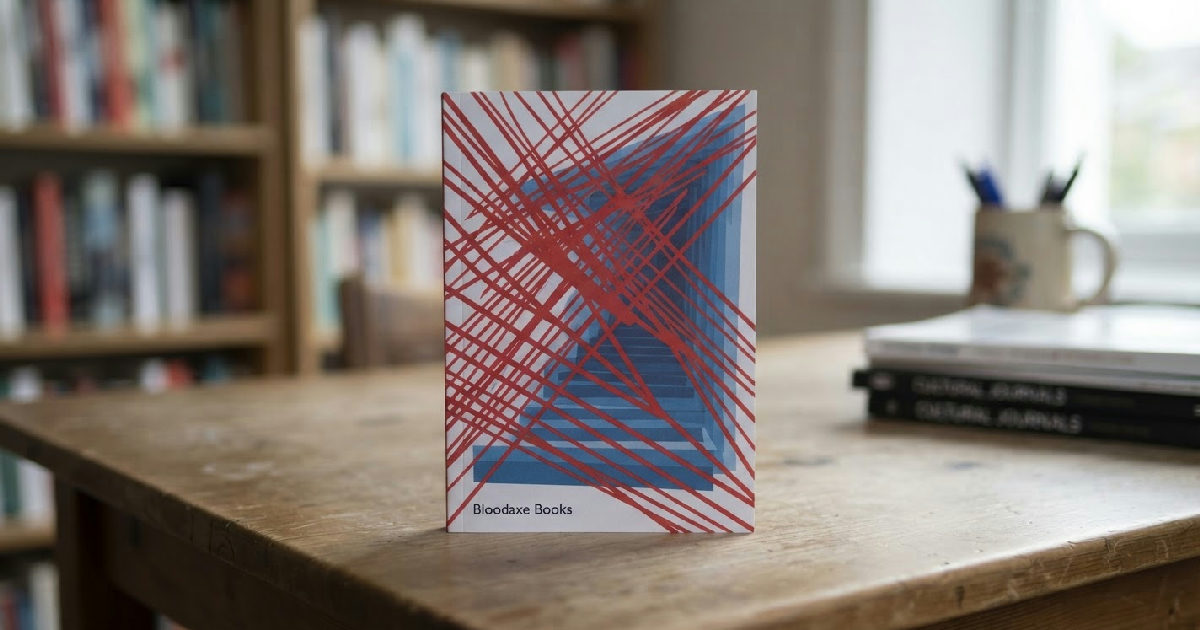
The cover of Versus Versus: 100 Poems by Deaf, Disabled & Neurodivergent Poets immediately pulls you in, embodying a powerful Disability and the Grammar of Presence. A restless red against a receding blue, lines that pulsed with a rhythm you could almost hear. This wasn’t just a design; it was a feeling. It suggested movement, a refusal of stillness.
This striking visual introduction perfectly sets the stage for the works within. The anthology, published by Bloodaxe Books, gathers 100 voices from Deaf, Disabled, and Neurodivergent writers globally. It creates a powerful new “grammar of presence,” as analyst Iheoma Uzomba articulates in her July 9, 2026, Open Country Mag article.
Understanding Disability and the Grammar of Presence
Uzomba’s piece, “Disability and the Grammar of Presence in Versus Versus,” unpacks how these poems challenge the long-held silence and misrepresentation surrounding disability. It asserts that the experiences of those outside ableist norms are not a lack, but a distinct and potent form of expression. Through this collection, the body reclaims its voice, shaping a language all its own.
For too long, the discourse around disability has been “bent out of shape.” It often veers towards pathos, towards pseudo-inspiration, or into the clinical realm of pathology and misdiagnosis. This historical framing has cast disability into what Frantz Fanon termed “the zone of nonbeing.” It renders individuals both hypervisible and invisible, reduced to their perceived “illness.”
The Versus Versus anthology actively resists this dehumanising tradition. It moves against the grain of what poetry is often expected to do. These poems refuse decorum; they speak away from the margin, insisting on their place at the centre of human experience. This shift signals a profound novelty in the literary landscape.
The very title, “versus versus,” as explained by anthology editor Racheal Boast, suggests a fascinating paradox. It implies that in this “duplicity,” one thing cancels the other, leading not to opposition, but to “being together in concurrence.” It’s about making room for what society has othered, challenging established views and inviting new perspectives on human experience.
The Poetic Body and its New Grammar
The “grammar of presence” that Uzomba highlights is a radical redefinition of language itself. It shows how bodies often deemed “dysfunctional” can speak in ways that defy conventional understanding. The collection challenges the notion that sight is confined to the eyes, or speech to the mouth.
Khando Langri’s “Medicine mantra for the road” opens with a guiding invitation: “go lightly (like this)/ to the frayed edges of place.” It offers a “mantra for the journey,” transforming silence into “a parable.” Here, silence is not absence or lack; it becomes a modality of language, repeatedly turned into something wondrous.
Consider Torrin Greathouse’s “Essay Fragment: Medical Modality of Disability.” The word “disability” appears struck through, erased on the page. The poem describes the disabled body as “closest to machine/ in its dysfunction” or “a weight on society.” Yet, through this very act of striking through, the poem weaponises silence. It turns the systemic silencing of disabled voices into a potent form of grammar.
In Jen Campbell’s “First Thing, I Am a Forest,” the poet explores the tension between inner and outer seeing. “When I wake up and I cannot see, I reach,” she writes. This reaching, positioned at the line’s threshold, signifies potential. It extends beyond the visible, into a realm not dependent on physical sight.
Even with “webs stuck to my eyelids,” the speaker finds a way to “wear/ a rain jacket in an attempt to escape/ this weathering.” The body resists normative function.
John Lee Clarke’s “At the Holiday Gas Station” further illustrates this re-distribution of senses. His speakers “see/ With our hands,” and fingers are depicted as “walking.” Similarly, Linda Hogan’s “When the Body” speaks of the body’s capacity to “speak from the hands.”
These poems make “other grammars” possible, demonstrating how the body itself becomes a site of linguistic innovation and resistance. This re-imagining of sensory experience offers a fresh perspective on human expression, prompting us to reconsider what it means to perceive and communicate. Such artistic explorations contribute to a broader understanding of shifting Nigerian identity.
Confronting the ‘Ugly Laws’ and Reclaiming Beauty
The “illness” in Versus Versus often takes the form of being “out of place” with ableist norms. To be anything other than “normal” means navigating a world that often labels, stares, and effaces. Tito Rajarshi Mukhopadhyay’s “Misfit” captures this, describing the repeated stares of passersby who brand him with that very word.
Lateef McLeod’s “I Am Too Pretty for Some Ugly Laws” confronts the systemic erasure imposed by policy. He writes about being “scrubbed / off the public pavement,” effectively made invisible by discriminatory practices. The poem directly references historical “Ugly Laws.”
These statutes once declared “any person who is/ diseased, maimed, mutilated,/ or in any way deformed” to be “an unsightly or disgusting object.” Such individuals were deemed “improper” for public spaces.
But McLeod’s work, like much of the anthology, refuses to accept these categorisations. He reclaims beauty, overwriting policy by asserting that the laws themselves are the disfigured ones. The poet’s defiance insists on his own inherent worth, subverting the very terms of judgment.
This powerful assertion challenges the notion that beauty is a mere currency in consumerist culture, tied to specific physical attributes. It reclaims the individual narrative, much as a careful analysis of a politician’s dual life can alter public perception.
Andy Jackson’s “Song not for you” employs irony and humour to reject patronising attitudes. The speaker mimics the voice of someone who finds them “inspiring” just for performing daily tasks. “Fantastic to see you getting out,” the imagined voice says, suggesting a presumption of pity.
The poem asserts agency, declaring that the speaker’s life is “not for you” — not an inspirational poster for others’ comfort.
Resistance also takes the form of improvisation, as seen in Jack Mapanje’s “Skipping Without Ropes.” Despite life dealing a hand “without ropes,” the speaker chooses to “skip without your rope.” He forges hope in deprivation, turning enforced stillness into motion.
The skipping becomes a symbolic movement through the “silly rules” and “filthy walls” of ableist society. The strength found in such personal reclamation speaks volumes about resilience.
African Voices in the Global Discourse
The anthology features a rich diversity of voices across eras and experiences. This includes historical figures like Abdullah al-Baradouni and Paul Celan, alongside contemporaries such as Ada Limón and Ilya Kaminsky. Crucially, Versus Versus also prominently features African poets. Kwame Dawes, Chisom Okafor, JK Anowe, Jack Mapanje, Sarah Lubala, and Iyanuoluwa Adenle contribute significantly to this collection.
Their inclusion challenges the old trope that African poets are solely representatives of socio-political struggle. Instead, their voices enter a vital discourse. This conversation, still thin across the continent, addresses the malaise of memory and bodily unrest. It’s a dialogue that deepens the anthology’s overall impact, offering uniquely African perspectives on universal human experiences.
These insights often touch upon the complexities of memory and the profound experience of grief, themes resonant across creative forms.
JK Anowe’s “a musical malady” offers a fever dream of recollection. The head “sings of a departure of all reasoning,” with a song lodged inside every word, waiting to fracture. Memory here becomes a sickness, an appetite that resists containment. The speaker fills a book with the word “remember,” paradoxically highlighting how fragile the act itself is. This act dissolves quickly into longing.
Images of goats returning to their young, a mother’s daydream, and a father’s “dust-feet at the thresh-/old” extend this scattering of memory. The poem culminates in a brutal vision: a grand piano in a field, a finger nailed to its single key, blood dripping as the only source of sound.
Here, music plays out as violence, and memory returns as pain. The discomfiture of this imagery reverberates long after reading.
Chisom Okafor’s “In another life, I am twenty-two, gifted and curious” explores the split self. One figure dreams of escape, waiting at the sea’s far end. The other remains trapped in the body, seeking to understand “the exquisite mathematics of drowning.” This internal division reflects a profound struggle with identity and circumstance.
Sarah Lubala’s “6 Errant Thoughts on Being a Refugee” compresses memory to what the body cannot shed. Home shrinks to “a narrow bed,” encapsulating the profound loss and confinement of displacement. Jack Mapanje, again, shows improvisation against lack in “Skipping Without Ropes.” He moves his body with nothing but “forged hope” against the strictures of ableist decree.
Beyond the Anthology: A Shifting Cultural Landscape
The Versus Versus anthology, through the lens of Iheoma Uzomba’s analysis, illuminates a larger cultural disquiet. It highlights that to live in bodies deemed “misfit,” “displaced,” or “impaired” is to live with an unrest that is both intimate and deeply historical. This unrest manifests as memories scattered across continents, generations, individual bodies, and diverse climates.
By refusing to contain this unrest, these poets reveal the possibility of entirely new grammars. They offer modalities through which Deaf, Disabled, and Neurodivergent individuals can speak back to the world. They claim their rightful places, not as exceptions or objects of pity, but as integral participants in the human story.
The anthology is more than a collection of poems; it is a manifesto for re-imagining how we perceive, understand, and articulate identity. It asks us to listen differently, to see beyond superficial appearances, and to recognise the inherent power in every form of human expression.
