



Decree No. 4 of 1984, enacted on July 4, 1984, criminalized the publication of reports deemed false by the government.
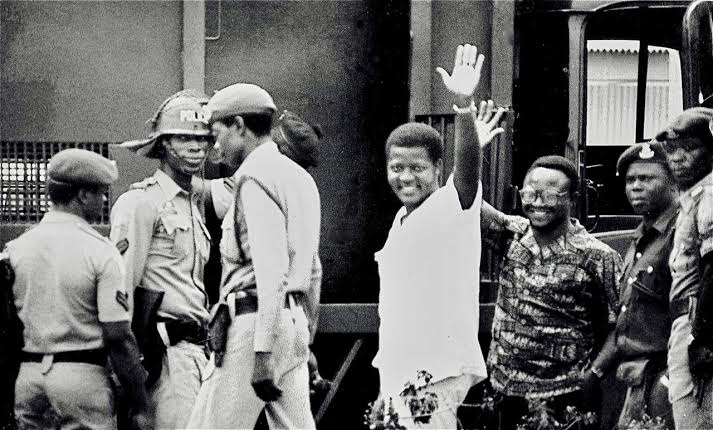
The air in the special tribunal hall was thick with tension as Tunde Thompson, a senior diplomatic correspondent for The Guardian, and Nduka Irabor, an assistant news editor, stood before a panel chaired by a High Court judge and military officers. Their alleged crime under Decree No. 4 of 1984 was publishing reports deemed false by the government.
4 of 1984: publishing reports that the military government deemed capable of bringing public officers into ridicule or disrepute.
The decree’s draconian reach
This date, a year to the day The Guardian began daily publication, marked a seismic shift for Nigeria’s fledgling press. The judgment delivered that day, sentencing both journalists to a year in prison, didn’t just punish individuals; it sent a chilling message through every newsroom across the country.
The Public Officers (Protection Against False Accusation) Decree 1984, swiftly became known as Decree No. 4. It was promulgated on March 29, 1984, by the military regime of Major General Muhammadu Buhari, which had seized power on December 31, 1983, ending the Second Republic.
The decree made it an offence to publish any message, rumour, report, or statement deemed false in a material particular. But its reach extended far beyond factual inaccuracies. It also criminalised reports that brought, or were calculated to bring, the Federal Military Government, a state government, or any public officer into ridicule or disrepute.
This specific wording was critical. It meant that even accurate reporting could fall foul of the law if it embarrassed officialdom. The intent was clear: to stifle press freedom and muzzle any criticism of the new military administration, which had positioned itself as a corrective force against corruption and indiscipline.
Individuals convicted under the decree faced prison sentences of up to two years. Corporate bodies, like media houses, faced significant fines, with Guardian Newspapers Limited being fined ₦50,000 in the landmark case. The government also gained the power to shut down media organizations and proscribe newspapers, effectively revoking their licenses.
A military tribunal, no appeals
Perhaps most alarming for Nigeria’s legal landscape was the mechanism for enforcing Decree No. 4. Offenses were tried before a special military tribunal, bypassing the established judicial system. These tribunals comprised a High Court judge but crucially included military officers.
Crucially, there was no right to appeal their decisions through the ordinary court system. This provision stripped defendants of fundamental legal protections, concentrating immense power in the hands of the state and making the tribunal’s verdict final.
For journalists, this meant politically sensitive publications were now subject to a military legal structure. It was a clear demonstration of how directly the government intended to regulate reporting concerning public officials and its own actions.
The Guardian’s disputed reports
The confrontation between the Buhari government and The Guardian stemmed from three specific publications in March and April 1984. On March 31, the newspaper reported on the proposed closure of 11 Nigerian foreign missions. The very next day, April 1, it detailed that eight military officers were under consideration for ambassadorial appointments.
A third report, published on April 8, concerned retired Major-General Ibrahim Haruna and Major-General Haldu Hannaniya. It suggested that Haruna would replace Hannaniya as Nigeria’s High Commissioner to the United Kingdom. These reports, while about diplomatic matters, exposed sensitive internal government discussions.
The government disputed elements of these reports, particularly the third. Retired General Haldu Hannaniya later confirmed that The Guardian’s story about reshuffling ambassadorial lists was, in fact, true, causing embarrassment within the regime. This admission underscored the decree’s broad application, targeting truth that caused discomfort.
Thompson and Irabor were arrested in February 1984 and held for weeks before their trial began on June 4, 1984. Their defence was led by the distinguished Chief Rotimi Williams. The prosecution relied heavily on testimony from figures like George Dove-Edwin, Permanent Secretary in the Ministry of External Affairs, whose statements partially corroborated some of the disputed reporting.
Dove-Edwin confirmed that ten of the eleven foreign missions were indeed under consideration for closure, with only Buea in Cameroon being an exception. He also verified that eight military officers were being considered for ambassadorial roles. Such detailed reports revealed internal deliberations that the government preferred to keep private.
Despite these partial confirmations, the tribunal acquitted the journalists on the first two counts. However, the third report, regarding Major-General Ibrahim Haruna and Major-General Haldu Hannaniya, proved their undoing. The tribunal concluded this assertion was “false in every material particular.” It was on this count that they, and Guardian Newspapers Limited, were convicted.
Birthday jail shocker
The judgment on July 4, 1984, was a stark reminder of the new reality facing Nigerian journalists. Both Thompson and Irabor were sentenced to one year in prison, while Guardian Newspapers Limited received a ₦50,000 fine. The timing was particularly poignant for the newspaper, coinciding with its first anniversary of daily publication.
The Guardian captured the national mood the following day with its front-page headline: “Our Birthday Jail Shocker!” By then, Thompson and Irabor had already endured weeks of pre-trial detention. Their imprisonment quickly became a powerful symbol of the fraught relationship between Nigerian journalism and military authority.
Their case became a touchstone, highlighting the dual responsibilities of journalism and the limits of state power. While journalists have an obligation to verify sensitive information, Decree No. 4 went much further. It criminalized reporting that simply brought government into “ridicule or disrepute,” even if factually accurate.
The Nigerian Union of Journalists vigorously opposed the decree. This period fostered an atmosphere of self-censorship in newsrooms. Investigative journalism slowed, and the public’s right to know was significantly curtailed. By the time the Buhari regime was overthrown in August 1985, a commentator in The Concord newspaper described the local press as being in a “comatose condition.”
The end of Decree No. 4, but not the pressure
The Buhari government was toppled in another military coup on August 27, 1985. Major-General Ibrahim Babangida emerged as the new Head of State, and one of his first acts was to repeal Decree No. 4. He also ordered the release of those still detained under its provisions.
Thompson and Irabor had actually been released months earlier, on March 3, 1985, having spent almost eleven months in custody when counting their pre-trial detention. Their release predated Babangida’s coup by nearly six months.
But the repeal of Decree No. 4 did not end the conflict between Nigerian governments and the press. Subsequent military regimes continued to detain reporters, close down media houses, and impose various restrictions. The challenge of balancing authority with open reporting persisted.
Today, Nigeria operates under a constitutional democratic system, fundamentally different from the military rule of 1984. Yet, the broader tension between government authority and journalism continues. Debates over laws dealing with false publication, defamation, cybercrime, and national security still rage.
In July 2026, journalist Stanley Ugagbe of Secret Reporters and publisher Tega Oghenedoro faced charges in a Federal High Court in Abuja. These proceedings arose from published allegations concerning a public official, leading to Ugagbe’s remand at Kuje Custodial Centre while his bail application was adjourned. The principled stands of individuals against state power remain a constant thread.
The circumstances are different, with constitutional courts and elected institutions offering protections absent in 1984. Nevertheless, the ongoing use of criminal proceedings in disputes involving journalistic publications shows why the history of Decree No. 4 remains relevant. It constantly asks: where do we draw the line between protecting individuals from false allegations and safeguarding the press’s ability to scrutinise public power?
