




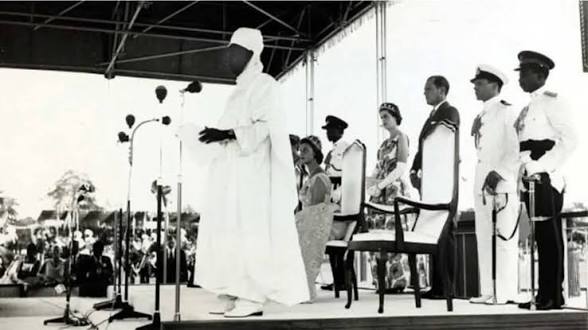
In the final weeks of 1959, a palpable sense of anticipation hung over Nigeria’s federal capital. The air in Lagos was thick not just with the dry dust of the harmattan but with the promise of a new era. The federal election held on December 12, 1959, was the final, decisive act before the curtain fell on British colonial rule.
This contest was set to produce Nigeria’s 1959 Cabinet, the team of politicians who would inherit the machinery of a state they had yet to fully control. The outcome was a complex affair, reflecting the sprawling, diverse nation it sought to unite. It laid bare the regional fault lines that would define Nigerian politics for the next decades.
The alliance formed before the Last Colonial Election
No single party secured an outright majority in the federal election. The results necessitated a coalition between the conservative, northern-dominated Northern People’s Congress (NPC) and the National Council of Nigeria and the Cameroons (NCNC). This unlikely alliance was the foundation of Nigeria’s first independent government.
Sir Abubakar Tafawa Balewa of the NPC continued in his role as Prime Minister, having already led the government since 1957. He was charged with holding together a cabinet of rivals and steering the final, delicate steps towards sovereignty. Independence was set for just ten months later, on October 1, 1960.
Dr. Nnamdi Azikiwe, leader of the NCNC, secured his appointment as Governor-General when Nigeria achieved independence. The third major party, the Action Group (AG) led by Chief Obafemi Awolowo, became the official Leader of the Opposition in the federal parliament.
Prime Minister Balewa’s task was immense. He had to manage a Council of Ministers representing distinct political leaderships and interests from three powerful regions. These were the men tasked not just with governance, but with the monumental project of nation-building.
Ministerial posts in the new federal administration
Within Balewa’s cabinet, a group of ministers took charge of portfolios critical to the functioning of a modern, independent state. Their work in these early years laid the groundwork for the institutions that govern Nigeria today. The transition required establishing national authority and legal frameworks.
The careers of men like Shehu Shagari, Alhaji Yusuff Maitama Sule, and Dr. Taslim Olawale Elias demonstrate the calibre of leadership and the scale of the challenge. These figures were charged with constructing the institutional pillars to support the new state. Their ministries were the engine rooms turning political compromises into tangible reality.
These appointments were the first moves in asserting Nigerian control over what had previously been colonial administration. They had to create a new legal system, plan an independent economy, and assert Nigeria’s place on the world stage. They needed to achieve all this while managing deep-seated tensions within their own ranks.
Shehu Shagari and the economic blueprint
Long before he became Nigeria’s first executive president in 1979, Shehu Usman Aliyu Shagari was a key player in the First Republic. In the early federal government, parliamentary records identify him as the Minister of Economic Development. This was a vital role, placing him at the heart of planning for a post-colonial economy.
Shagari’s position concerned the machinery of planning and national development. It tasked him with preparing the Nigerian government to assume full control over its economy and administration. For the first time, Nigerians were in charge of charting their own economic course, free from British priorities.
His movement between ministries reflected the changing structure of the federal government. By the 1962 to 1963 parliamentary session, Shagari had shifted to serving as Minister of Internal Affairs. This portfolio was previously held by Usman Sarki, illustrating the constant shuffling of roles in the early years.
Maitama Sule and strategic resources
Alhaji Yusuff Maitama Sule, a prominent member of the Northern People’s Congress, was entrusted with the Ministry of Mines and Power. This ministry occupied an important place in a developing country seeking to expand electricity generation and infrastructure. It was also critical for the utilisation of Nigeria’s mineral resources.
Maitama Sule’s appointment brought a key figure from the northern political establishment into the federal administration during the transition to sovereignty. His service here formed an early chapter in a much longer distinguished career as a diplomat. He later served as Nigeria’s Ambassador to the United Nations in 1981.
Taslim Olawale Elias and the legal foundation
No transition from colonial rule to independence is possible without a profound legal transformation. The man charged with overseeing this for Nigeria was Taslim Olawale Elias, commonly identified as T. O. Elias. He was an important lawyer and constitutional scholar even before independence.
Elias participated in the constitutional processes that helped prepare Nigeria for sovereignty. He entered federal ministerial office after independence in 1960, becoming Attorney-General of the Federation and Minister of Justice. His appointment placed him at the centre of the legal development of the new state.
His office was responsible for establishing judicial institutions and ensuring the new constitution was a living framework for governance. Elias’s work provided the legal bedrock for the First Republic. His later career saw him become Chief Justice of Nigeria.
Constitution and the evolution of the First Republic
The period between the 1959 election and the 1966 military coup was one of rapid constitutional change. For the first three years after independence, Nigeria remained a constitutional monarchy. Queen Elizabeth II was the Head of State, represented by Governor-General Nnamdi Azikiwe.
On October 1, 1963, Nigeria took its next major step, transforming into a republic within the Commonwealth. Azikiwe’s title changed from Governor-General to President, while Sir Abubakar Tafawa Balewa continued as Prime Minister. This constant constitutional evolution meant ministerial roles and responsibilities were frequently shuffled.
This fluidity was a sign of a government adapting to new realities and the complex task of establishing infrastructure for the new state. Usumanu Maitambari, another northern politician, illustrates this pattern. He served as a Member of Parliament and later occupied ministerial positions, including Minister of State.
The Westminster-style parliamentary system closely connected the executive with Parliament. Under the 1960 Constitution, most ministers were expected to hold membership in either the Senate or the House of Representatives. These political distinctions were significant as Balewa reorganised his administration in the early 1960s.
The political structures that endured
The 1959 election and the cabinet it produced were the crucible of independent Nigeria. This moment locked in place the political structures that defined the nation’s political life. The coalition government, born of necessity and compromise, was a fragile vessel for the aspirations of a new nation.
The deep ideological and regional divisions between the coalition partners were never resolved, only managed by Sir Tafawa Balewa. The Northern People’s Congress emerged as the largest party in the federal legislature, winning 134 of the 312 seats. This dominance gave the northern bloc immense influence in the formation of the federal government.
The issue of regionalism, and the power dynamic between Lagos and the regional capitals, was a defining feature of the era. Sir Ahmadu Bello chose to remain Premier of the Northern Region while delegating federal leadership to Balewa. This decision spoke volumes about where the real centre of power lay.
The intense political struggles show that the transition was not limited to the ceremony of October 1, 1960. It was a continuing institutional process stretching from the final colonial elections through independence. The unresolved issues of Nigeria’s internal borders created an environment of perpetual political struggle.
For six brief years, these men governed a parliamentary democracy that was boisterous, flawed, and full of promise. The military coup of January 15, 1966, brought that constitutional order to a sudden, violent end. Yet, the questions they faced have not disappeared.
How does a nation of such diversity share power effectively? How are its vast resources to be managed for the benefit of all citizens? The story of the 1959 cabinet is the origin story of the central challenges Nigeria continues to confront today.
