




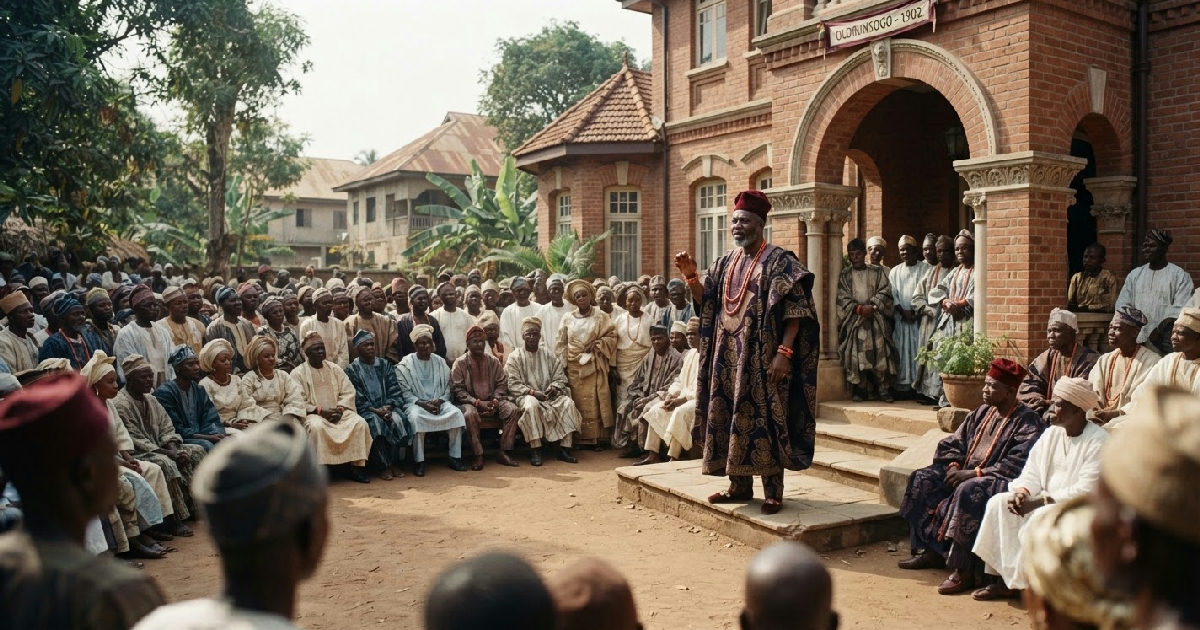
In 1902, Balogun Bello Odueyungbo Kuku stood before a large gathering at his magnificent new residence in Ijebu-Ode. The house, named Olorunsogo, or “God is Wonderful,” was the first brick house of its kind in the town, commissioned between 1897 and 1900. As guests from Lagos, Ibadan, and beyond looked on, Kuku, one of the most powerful men in Ijebuland, publicly declared himself a Muslim.
It was a moment that perfectly captured the man. Kuku was a survivor, a merchant, a military veteran, and a politician who navigated the profound social shifts of the late 19th century. His life, spanning from his birth in 1845 to his death in November 1907, tells the story of how modern Ijebuland was forged from a warrior state into a colonial territory.
The making of merchant prince Balogun Kuku
Kuku’s story begins with loss, which gave him his defining alias. Born Odueyungbo in 1845, his mother, Detimoku, died shortly after his birth, earning him the name “Kuku,” meaning “Survivor.” He grew up in the Mobasoro Quarters of Ijebu-Ode in a world defined by both commerce and constant conflict, and he quickly learned to master both.
From a young age, he plunged into the world of long-distance trade. He participated in trading caravans that journeyed across Yorubaland, travelling to bustling commercial hubs including Ondo, Apomu, Ketu, Ilorin, and the growing port of Lagos. He initially started his trading business in Ibadan before returning to Ijebu-Ode.
His commercial networks dealt in essential commodities like kola nuts, textiles, palm oil, and firearms, the latter making him a significant arms dealer. This trade supplied weapons to militarily dominant cities like Ibadan, securing powerful partnerships across Yorubaland and giving Ijebu forces access to modern weaponry.
By around 1890, Kuku had accumulated substantial wealth and was regarded as one of the wealthiest men in Ijebuland. His immense fortune provided more than personal comfort; it bought dependants, clients, and political connections, strengthening his military and social standing.
His commercial success was so significant that it became inseparable from his political influence. He was considered “the barometer and unit of measurement of success and indeed the heart of Ijebu economy,” demonstrating that his power radiated from his independent financial empire.
Kuku’s rise through the military hierarchy
While his wealth grew, Balogun Kuku also climbed the military ladder. He lived during the era of the great Yoruba wars, a time when military prowess was the ultimate currency of power. He rose through the ranks to become the Seriki, one of the highest military positions beneath the paramount Balogun Onofowokan.
This position placed him firmly within Ijebuland’s warrior establishment. The 19th century saw near-constant conflicts, including the widespread Ekiti Parapo, or Kiriji, War, where Ijebu forces participated in the complicated regional struggles. The need for strong regional defense was vital against such powerful forces as those that struggled to repel Dahomey assault at Abeokuta years earlier.
His defining military moment came around 1890 during the Ogunsegun War, an internal conflict sparked by a dispute with Ijebu-Igbo. Awujale Tunwashe and Balogun Onofowokan turned to Kuku for assistance, and he led Ijebu-Ode forces to victory. He also defended the sacred city of Ile-Ife at the behest of the Ooni, successfully repelling Ijesha incursions.
These victories proved he was more than just a rich merchant. He was a capable military strategist who consistently defended the Awujale’s throne, quelling insurrections from rival Ijebu communities and ensuring its supremacy. His military rank, wealth, and connections cemented him as a central figure in Ijebu public life.
Navigating the 1892 British conquest
The year 1892 marked a devastating turning point for Ijebuland’s traditional elite. After years of tension over trade routes, British forces invaded and conquered the kingdom in the Imagbon War. This campaign fundamentally shattered the independent military order that had defined power for centuries.
Kuku did not command the Ijebu forces in the main confrontation. Instead, his most critical role came immediately after the defeat, where he acted as a key truce broker. His “exposition, experience and maturity” were credited with performing a diplomatic job in the feud and resolving the immediate conflict between the British and the Ijebu political establishment.
This transition highlights Kuku’s unique genius for adaptation. His traditional authority as a Seriki was quickly translated into relevance within the new colonial system, which relied on indigenous chiefs for administration. He was not just a warrior, but a master negotiator whose assets became more valuable than ever.
The British conquest greatly reduced the independent military function of the Balogun office, forcing leaders to adapt to a system where influence depended on negotiation and commercial power. This imposition of colonial administration on traditional authority would later lead to broader resistance movements, such as when farmers challenged colonial tax policies in other parts of Yorubaland.
Around 1899, the ageing Balogun Onofowokan relinquished the paramount Balogun office to Kuku. Kuku’s accession came at a time when the Balogun could no longer function principally as the commander of an independent military establishment. Instead, the role became one centered on administration, political councils, and managing relations with the colonial authorities.
The patron of faith and the Ojude Oba festival
Balogun Kuku’s public declaration of Islam in 1902 was a defining moment that broadened his sphere of influence. While Islam had already established a presence in Ijebu-Ode, Kuku’s patronage gave it unprecedented visibility and prestige, contributing to its entrenchment in the town.
The celebrated moment took place at the opening of his new Olorunsogo residence, which included a mosque as part of the compound. An early account records that approximately 300 people declared for Islam during the event, with other traditions placing the total number of associated converts at over 600.
Kuku’s public identification with Islam gave the religion immediate social standing. His conversion is also reported to have been influenced by a desire to protect his large household from Christian missionaries, who were insisting on monogamy at the time.
Perhaps his most visible legacy today is the Ojude Oba festival, which he is widely credited with originating around 1896. This annual event honors the Awujale and has evolved into one of the most famous cultural celebrations in southwestern Nigeria, often equated with the Brazilian Carnival.
Kuku played an important part in transforming an older observance into the ceremony known as Ita Oba, which later became Ojude Oba. His participation strengthened the connection between the Balogun institution, Muslim Eid celebrations, and annual royal homage to the Awujale.
Today, the festival is a powerful expression of Ijebu collective identity where Christians, Muslims, and traditional adherents participate. The equestrian displays, featuring descendants of warrior families, serve to preserve the ceremonial memory of the nineteenth-century military aristocracy from which Kuku emerged.
A legacy cast in brick and memory
When Balogun Bello Odueyungbo Kuku died on November 13, 1907, he left behind far more than just a title and commercial fortune. He left a transformed Ijebuland, shaped by his wealth, his political ingenuity, and his religious patronage. His legacy is written into the modern identity of his people.
His architectural vision, Olorunsogo House, still stands as a testament to his ambition. The “modern mansion” was built in Portuguese style by Arc. Balthazar Reis & Co., designed and decorated by Brazilians. At the time, its grandeur was said to rival European estates and surpass any royal palace in Yorubaland.
The endurance of the Ojude Oba festival is another powerful reminder of his influence. The celebration survived the death of Oba Sikiru Kayode Adetona in July 2025, one of Nigeria’s longest-reigning traditional rulers. The festival held in May 2026, the first following Adetona’s death, demonstrated its evolution into an essential institution of Ijebu identity.
Balogun Kuku’s life was a bridge between two worlds: the independent Yoruba kingdoms of the 19th century and the emerging colonial reality. The political systems he helped shape laid the foundation for the future, including the eventual road to Independence decades later.
He turned wealth into political power, military prestige into administrative authority, and personal faith into a public movement. More than a century after his death, his influence remains undeniable, reminding us how individual ambition can reshape institutions across epochs.
