




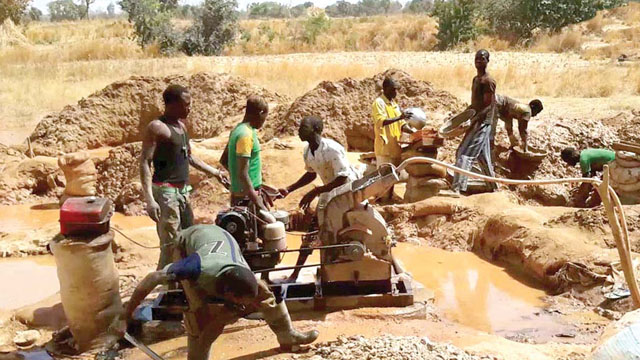
Today, the landscape of the Jos is dotted with over 4,000 ponds. Their still waters reflect the big Nigerian sky, looking like natural lakes carved into the rolling hills. But these pools are not natural. They are the open wounds of a system designed for one purpose: to pull wealth from the ground for an empire on the other side of the world, no matter the cost.
These ponds, and the mountainous heaps of excavated earth beside them, are the most visible legacy of the Plateau tin mining industry. It’s a system that transformed the region into a global powerhouse for tin and columbite, built cities, and established transport networks. But it also took land, broke bodies, and left behind an environmental debt that Nigerians are still paying more than sixty years after independence.
The colonial system’s violent birth
While the people of the Nok culture had worked tin for centuries, the system that would permanently scar the Plateau began with a British discovery in 1902. Colonel Laws, a British officer, identified vast deposits of cassiterite, the primary ore of tin, in the region’s rivers. By 1907, large-scale commercial extraction was fully underway, driven by Britain’s need for a mineral crucial for its industrial and military machines.
This wasn’t a partnership; it was a conquest for resources. The primary motivation for the British subjugation of the Plateau’s people was to gain control of its immense mineral wealth, including tin and columbite. Tin was essential for producing everything from airplanes and tanks to radio sets. The Plateau wasn’t just a source of revenue; it was a strategic asset for the British Empire, especially during the World Wars.
The scale of the operation was immense. Prospecting teams, backed by soldiers, moved through the valleys, and the town of Jos grew from a modest settlement into a bustling hub of the new industry. By 1929, the annual value of tin production was estimated at a staggering £2 million sterling, nearly half of which was repatriated directly to Britain. At its peak, Jos was the sixth-largest producer of tin in the world.
The infrastructure needed to move the tin from the isolated plateau to the ports was vast. This system relied on new technology and a massive workforce, creating a complex machine that connected the heart of northern Nigeria to global capitalism. For efficient transport of minerals, the industry became tightly coupled with rail connections and power generation across the region, a network whose expansion of rail forged Nigeria’s economic backbone.
Mechanics of resource extraction and control
The colonial mining system rested on three pillars: the appropriation of land, the mobilisation of labour, and the application of industrial technology. Each came at a profound human cost and systematically dismantled the existing social and economic structures of the Plateau’s indigenous communities. The physical landscape of the Plateau still bears the evidence of this mechanisation, visible in the huge mounds of displaced material and excavated ground.
Taking the land
To mine the tin, the British first had to control the land. This was accomplished through a series of legal instruments, like the Land Proclamation Acts of 1904 and 1910 and the Mineral Act of 1903. These laws effectively transferred control of the land and its resources to the colonial state, which then leased the rights to mining companies. At the height of the industry, an estimated 90% of the Jos’s land was controlled by colonial mining interests.
For the indigenous population, who were primarily farmers, the impact was catastrophic. Huge tracts of fertile agricultural land were alienated, stripped of topsoil, and dug up, leaving behind a barren moonscape of pits and tailings. This dispossession led to widespread food insecurity and shattered the agricultural foundation of the local economy, forcing many into the very mining industry that had taken their land.
Mobilising the workers
The **colonial mining** enterprises required an enormous workforce. To meet this demand, the colonial administration encouraged migration from across Northern Nigeria and beyond, including Hausa, Igbo, and Yoruba workers. This created a new, multi-ethnic social dynamic in the mining camps. Hausa traders were often hired as supervisors, placed in a position of authority over local labourers through the British system of indirect rule.
During the Second World War, when tin was declared a strategic mineral for the Allied effort, the demand for labour reached a fever pitch. The colonial state resorted to forced labour, compelling men from the Plateau and other Northern Provinces to work in the mines. At its peak in 1943, the officially counted workforce reached nearly 75,000 men.
This period of forced labour remains a dark chapter in the social history of the mines. It was a system of exploitation that fueled resentment and demonstrated how deeply colonial economic imperatives reached into the lives of ordinary Nigerians. Historian William M. Freund documented the development of this vast migrant labour force between 1903 and 1945, noting how colonial taxation and expanding cash needs drove workers to the Plateau.
The enduring environmental legacy of Jos Plateau tin mining
The wealth generated by the Jos Plateau was immense, but it flowed overwhelmingly in one direction. The system was designed for extraction, not for sustainable development. While major firms like Amalgamated Tin Mines of Nigeria posted huge profits, the social and environmental legacy was borne by the local population and left as a debt for future generations.
The colonial policy of “divide and rule” had lasting consequences. By empowering Hausa and Fulani leaders in the mines through the Emir of Bauchi, the British created a social hierarchy that placed indigenous groups at the bottom. These policies are now seen by many historians as a root cause of the modern conflicts between “indigene” and “settler” groups that have plagued Jos for decades.
A poisoned landscape
The most enduring legacy is written into the land itself, particularly the more than 4,000 abandoned mining pits and ponds. These are not just scars on the landscape; they are environmental hazards. For decades, they have been known as death traps, with dozens of people drowning in their depths. Now, scientific research confirms a more insidious danger: radioactivity and toxic contamination.
A 2026 study examining radiological impacts found dangerously elevated levels of radioactive elements in the soil and mine tailings. Researchers reported uranium-238 activities reaching as high as 3,000 becquerels per kilogram and thorium-232 levels up to 6,400 Bq/kg. These materials expose local communities to heightened radiation risks through direct contact, contaminated dust, and the food chain.
This confirmed what many had long suspected. In 2012, then-Minister of Health, Professor Onyebuchi Chukwu, publicly linked a rise in cancer cases in Plateau State to radioactive waste from the decades of tin mining. Another study in 2022 found elevated concentrations of other toxic elements in pond water, soil, and food crops, posing significant health risks to communities living near the abandoned mines in Bokkos Local Government Area.
A toxic inheritance and the rise of artisanal miners
The decline of large-scale industrial mining, accelerated by the discovery of oil in the mid-1950s, did not end the story. Instead, it created a new and equally perilous chapter. The infrastructure of the colonial system was left to rust, but the minerals left behind in the waste dumps and abandoned pits created a new economy for artisanal miners.
Today, thousands of people, often young men, risk their lives scavenging in these old workings. Armed with little more than shovels and their bare hands, they enter unstable pits in search of the remnants of tin and columbite left by the industrial giants. Collapses are frequent and often fatal. A May 2026 report from the News Agency of Nigeria documented numerous deaths, including one incident the previous year where a pit collapse buried more than 20 people.
The Nigerian government is now confronting this deep-rooted problem. On March 4, 2025, the Federal Government announced a project to create a Geographic Information System (GIS) database to map and characterise all abandoned mine sites. This is intended to support environmental assessment and future planning for reclamation.
In Plateau State, Governor Caleb Mutfwang temporarily suspended all mining activities in early 2025 to screen and license operators, an attempt to bring order to a chaotic and dangerous industry. By May 23, 2025, 159 operators, including holders of mining licences and small-scale mining leases, had been cleared to resume activity. Mining remained restricted for those who had not been cleared.
These regulatory efforts address a challenge that stems directly from the colonial era. They remind us that even as Nigeria approached independence, inheriting structures it did not build remained the central problem of Nigeria’s cabinet transition. The authorities are dealing not only with the physical remnants of an earlier industry but also with land that continues to attract miners because commercially recoverable minerals remain.
The landscape photographed near Vom Road in January 1958, marked by its pools and heaps of spoil, stands at a revealing moment in Nigerian history. The country was approaching independence, but the Plateau already bore the unmistakable physical imprint of a mining economy built over the preceding decades. It’s a testament that the cost of extracting resources is often paid generations after the boom has ended, and that some debts can never truly be settled.
