




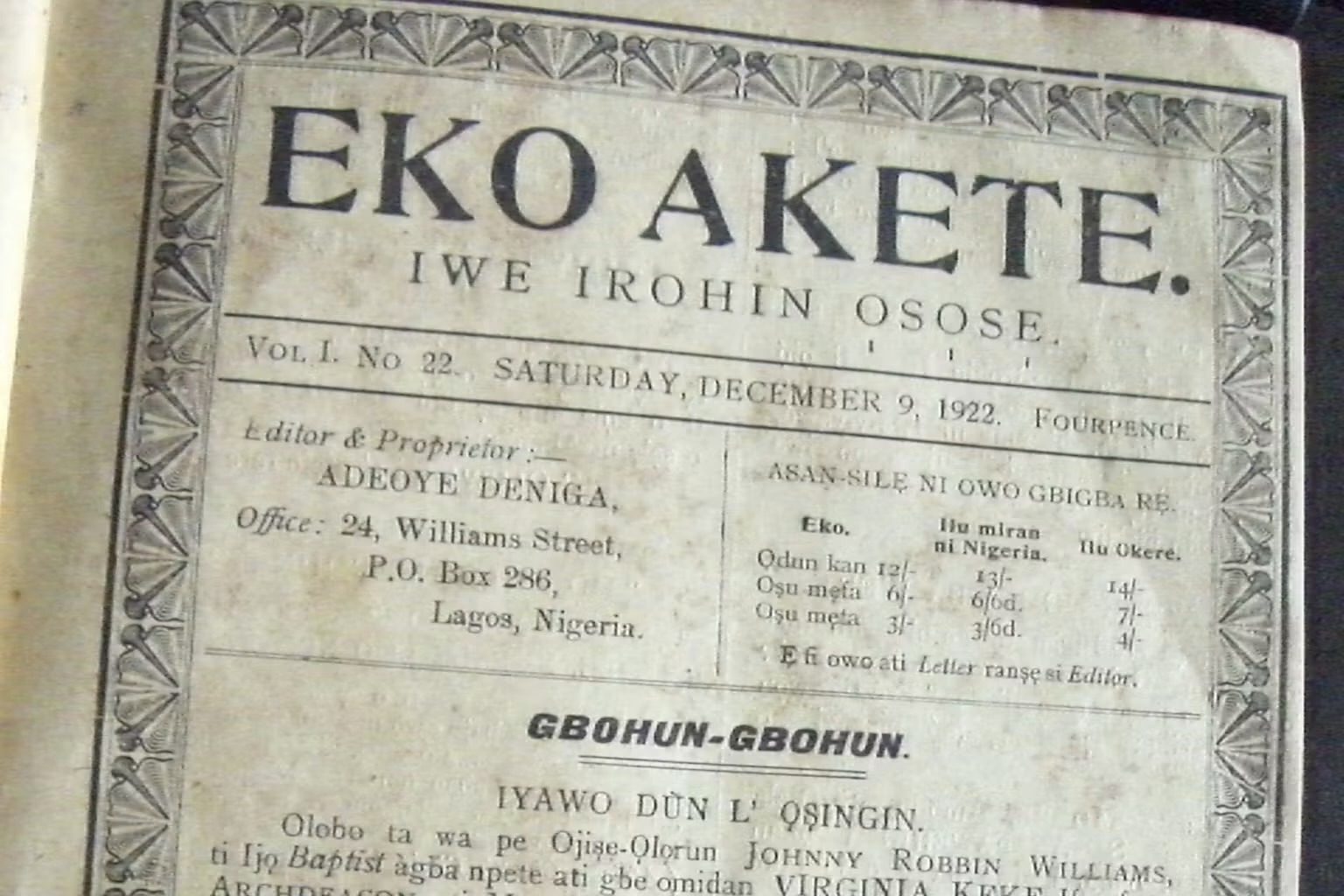
The first edition of Eko Akete hit the bustling streets of Lagos in July 1922. This weekly newspaper, written entirely in Yoruba, marked a pivotal moment in Nigeria’s cultural awakening under colonial rule and the burgeoning Yoruba print culture in Lagos.
Led by indigenous journalists like Adeoye Deniga, these publications were not just news outlets; they were defiant assertions of linguistic identity and vital platforms for public discourse.
The birth of Yoruba-language newspapers
This burgeoning Yoruba print culture of the 1920s reshaped how Lagosians connected with their heritage and with each other. It laid the groundwork for a rich tradition of creative writing and fostered an early sense of nationalist awareness that transcended the British colonial administration’s linguistic impositions.
By the 1920s, Lagos had transformed into a dynamic, heterogeneous town. Diverse groups converged there, creating an eclectic atmosphere even as English-language newspapers largely dominated the colonial press. Yet, a palpable demand for news and commentary in indigenous languages began to grow.
This era saw a generation of Yoruba intellectuals recognise the urgent need for self-representation. They understood that controlling their narratives and communicating in their mother tongue was critical for cultural preservation. Print media offered a powerful, accessible avenue to achieve this.
Adeoye Deniga’s pioneering editorial vision
Adeoye Deniga stands out as a central figure in this cultural movement. As editor of Eko Akete, he wasn’t just a writer; he was a translator, commentator, and cultural mediator. Deniga skillfully blended Western journalistic practices with deeply rooted indigenous knowledge systems, crafting a unique voice for his readers.
Eko Akete was a consistent source of information, arriving weekly to thousands of Yoruba-speaking households. Surviving copies of the paper, including its inaugural issue from July 15, 1922, are invaluable historical artifacts. They vividly demonstrate how Nigerians actively used the press for cultural assertion and community building.
Bridging Western journalism with local expression
Indigenous journalists of this period, exemplified by Deniga, faced a unique challenge. They had to adopt the mechanics of print journalism while ensuring the content resonated with local sensibilities and oral traditions. This meant translating complex ideas and current events into language that was both accurate and culturally appropriate.
Their efforts helped democratise access to information, extending beyond the English-speaking elite. It ensured that public opinion could be shaped and shared across a broader swathe of society, giving a voice to those often overlooked by the colonial mainstream.
"Segilola" captivates colonial Lagos
Another landmark moment arrived with the serialization of “The Life History of Me, Segilola” in the weekly newspaper Akede Eko. Published between 1929 and 1930, this groundbreaking narrative is widely considered Nigeria’s first Yoruba novel. I.B. Thomas, Akede Eko’s editor-proprietor, penned the work himself.
The story unfolded as a series of letters purportedly from an aging prostitute named Segilola. It chronicled her life from youthful flirtation through gold-digging to “full blown harlotry.” Thomas masterfully intertwined moral warnings with “gleeful memories of her irresistible sexuality,” creating a sensation among Lagos readers.
A city gripped by a fictional life
The impact of “Segilola” was immediate and profound. Many readers genuinely believed the protagonist was a real person, writing in to offer advice or even financial support. One reader famously sent 10 shillings to help Segilola, illustrating the story’s powerful grip on the public imagination.
The novel sparked widespread commentary on what many perceived as the increasing moral laxity of Lagos life. Discussions about the “culpable frivolity and greed” of the city’s women filled conversations. Its success cemented a tradition of creative writing in Yoruba, which would become one of Africa’s richest and most diverse.
“The Life History of Me, Segilola” was so popular that I.B. Thomas republished it as a book immediately after its serialization concluded in March 1930. The following year, an abridged English translation was also serialised, extending its reach even further.
Print as a tool for cultural identity
These Yoruba-language publications did more than just report news or entertain. They became essential tools for cultural preservation in the face of British colonial dominance. While English was imposed as Nigeria’s official language, the indigenous press offered a vital counter-narrative.
It provided a space for Yoruba intellectuals to articulate their worldview, celebrate their traditions, and critique colonial policies. This active assertion of linguistic and cultural identity was a quiet but powerful act of resistance. It reminded people that their heritage remained vibrant and relevant.
Shaping early nationalist awareness
The consistent appearance of Yoruba-language newspapers also played a subtle but crucial role in fostering early nationalist sentiments. By creating a shared linguistic and cultural space, these publications helped forge a collective identity among their readers. This sense of shared experience was a foundational element for broader anti-colonial movements.
People who might otherwise have felt isolated found common ground in the pages of Eko Akete or Akede Eko. They read about their concerns, their triumphs, and their cultural expressions, building a collective consciousness that would eventually fuel the push for independence.
Lagos: A crucible of modern Nigerian culture
Lagos itself, as the epicentre of this print revolution, was undergoing rapid transformation. After becoming the capital of the Colony and Southern Protectorate in 1906, and later the main location of the first capital of United Nigeria after 1914, it became a hub of development. Significant buildings like the Supreme Court and the Old Secretariat rose on Lagos Island.
This burgeoning urban centre provided fertile ground for intellectual and cultural growth. The city’s diverse population, a melting pot of peoples and ideas, created a receptive audience for the indigenous press. Many people were moving to the city for opportunity, creating an urgent need for local news and stories.
Even the establishment of entities like the Lagos Executive Development Board in 1931, following the bubonic plague of the late 1920s, shaped the city’s landscape. These infrastructural developments, while practical, also inadvertently facilitated the spread of ideas through print. A growing, connected populace meant more readers for Yoruba newspapers.
What the Yoruba press tells us today
The legacy of this early Yoruba print culture is undeniable. It demonstrates that long before political independence, there was a fierce battle for cultural and linguistic autonomy being fought on the pages of weekly newspapers. These publications weren’t just chronicling history; they were actively shaping it.
They show us the resilience and ingenuity of Nigerian pioneers who carved out spaces for indigenous expression, even under colonial constraints. It’s a reminder that culture and language are often the first battlegrounds in the fight for self-determination, and that the pen can indeed be a mighty weapon. Understanding this period offers a deeper insight into the forces that shaped modern Lagos.
The stories, commentaries, and novels published during this era reflect the complexities of Nigerian life in the 1920s. They capture the anxieties of urbanisation, the clash of traditions, and the burgeoning desire for a distinct national identity. The vibrant literary landscape they created continues to influence Nigerian literature and media today. Many figures from this period embody the spirit of Nigerian resilience.
These pioneers didn’t just publish newspapers; they published a vision for a literate, self-aware Nigerian society. And in doing so, they left an indelible mark on the nation’s cultural soul.
