



When the name Kirikiri echoes through Lagos, it conjures an almost singular image: the formidable maximum-security prison. Yet, this bustling district in Apapa is far more than just its correctional facilities; it is a vibrant Kirikiri community with a deep history, a thriving economy, and a resilience that constantly pushes back against its monolithic reputation.
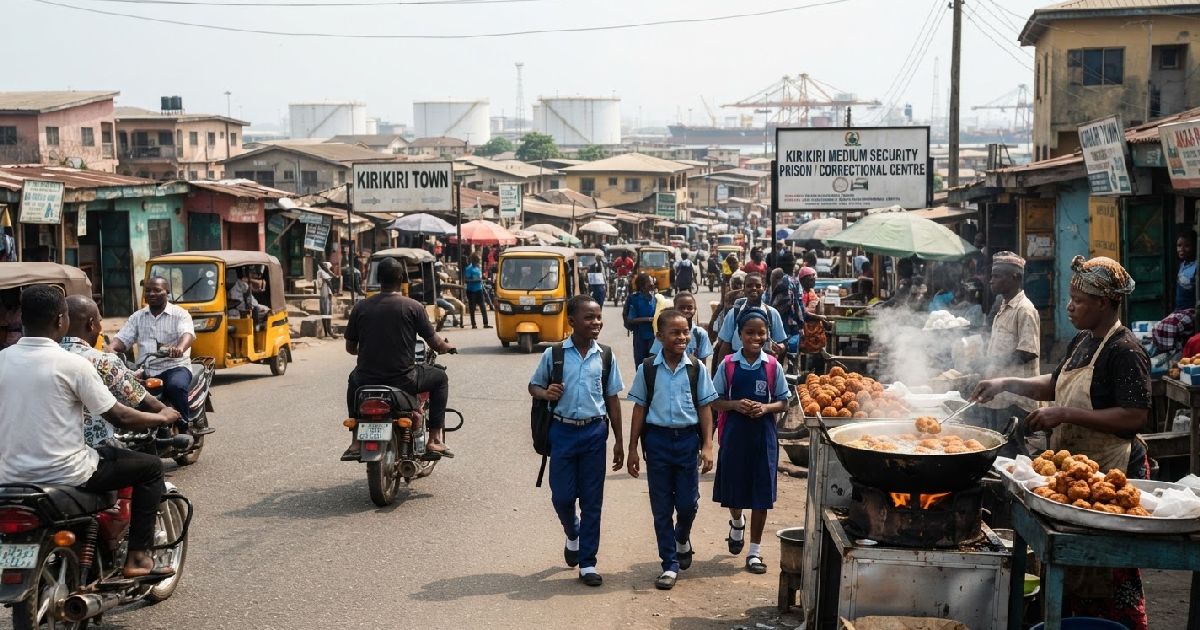
Scores of commercial motorcycles navigate its narrow roads before dawn, school children in crisp uniforms dodge traffic, and the aroma of freshly fried akara fills the air. This daily pulse of life unfolds alongside a concerted effort by various organisations to bring rehabilitation and welfare initiatives to those incarcerated within the famous walls, painting a complex picture of a place often misunderstood.
Kirikiri’s deep-rooted history before the bars
Long before the Kirikiri Maximum Prison became a national landmark in 1955, the area was sustained by its strategic location along the Lagos waterways. Its creeks and lagoon provided a livelihood for generations of fishing communities. James Oyinkro, a long-time resident, recalls a time when the town was primarily a fishing village, where he went fishing with his parents.
He also remembers a small airstrip in the area, a vital link for European engineers involved in constructing the Tin-Can Island Port. This maritime heritage has remained a constant, with fishermen still repairing nets along the waterfront and barges ferrying goods, connecting Kirikiri’s economy to the broader Lagos shipping industry.
High Chief Babatunde Babalola Shabi, the 66-year-old Baale of Kirikiri town, arrived in the late 1970s. He witnessed the community’s transformation from a sparsely populated settlement dotted with cashew trees into one of Lagos’ busiest working-class neighbourhoods. He often points to the busy streets, challenging outsiders to see beyond the prison gates and recognise the living community that surrounds them.
A thriving economic engine for Lagos
Beyond its residential streets, Kirikiri operates as a critical industrial hub for Lagos. Industrial estates house manufacturing companies, warehouses, and logistics firms that service the nearby Apapa Port and Tin Can Island. Ibrahim Musa, a machine operator at one of the numerous tank farms, highlights Kirikiri’s significant role in Nigeria’s petroleum distribution network.
These facilities handle vast quantities of petroleum products, which thousands of trucks distribute across Nigeria daily. Emmanuel Okafor, a welder in the warders’ quarters, points to hundreds of artisans – mechanics, electricians, carpenters, painters, and welders – whose workshops train apprentices and contribute substantially to Lagos’s informal economy.
Alhaja Rukayat Bello, a market leader, estimates that thousands earn their living directly or indirectly through the bustling Kirikiri market, which attracts customers from across Lagos and often opens before dawn.
The prevalence of these industries has earned Kirikiri a new, unofficial moniker: “Tank Farm Village.” While this has brought jobs and commercial activity, creating bustling corridors for roadside vendors and spare parts dealers, it comes with a steep price. Residents contend with severe traffic congestion, air pollution, deteriorating roads, and the ever-present fear of an industrial accident, all while trying to preserve their unique identity.
Initiatives transforming lives within the walls
While the Kirikiri community grapples with its external image and new industrial challenges, significant efforts are underway to foster rehabilitation and welfare within the correctional facilities themselves. These initiatives, driven by various non-governmental organisations, government bodies, and academic institutions, represent another “other side” of Kirikiri that often goes unnoticed.
On August 7, 2026, the University of Lagos (UNILAG) Faculty of Creative Arts, Department of Music and Sound Production, in partnership with the Centre for Legal Support and Inmate Rehabilitation (CELSIR) led by Barrister Joke Aladesanmi, launched the “Voices Beyond Walls” music therapy program. This initiative, spearheaded by Dr.
Florence Nweke, an Associate Professor at UNILAG, uses music to provide hope, emotional release, and foster social interaction among inmates.
Educational opportunities are also expanding. On February 11, 2026, the Nigeria Customs Service (NCS) Lighter Terminal Command in Apapa commissioned a new four-classroom block, a well-equipped library, and an ICT centre within the facilities.
This builds on programmes like the National Open University of Nigeria (NOUN), which allows inmates like Collins Aragba to pursue university degrees from behind bars, as he has been doing since at least March 27, 2018.
Welfare programs address essential needs. The Blossom Flow Foundation, led by Convener Mrs. Joan Faluyi, conducted a menstrual hygiene and literacy program for female inmates on April 12, 2024. They partnered with Multimodal Transport Technologies Ltd and Offshore Dimensions, alongside change-maker Mrs. Ofi Valentina Amiebi-Uchegbu, to tackle period poverty and improve living conditions.
Similarly, the Core Need Oasis Foundation International (CNOFI) regularly conducts “Mission to Kirikiri Prisons,” providing encouragement, essential supplies, and spiritual support to inmates. In October 2021, the Senate Committee on Interior significantly increased the daily food ration for prisoners from 450 naira to 1000 naira, addressing a long-standing welfare concern.
Legal aid is another critical component of these “beyond prison walls” efforts. On January 18, 2024, the JAALS Foundation partnered with the Women in Prison Support Initiative (WIPSI) and FIDA to provide legal assistance through a clinic. WIPSI, focused on preventive, corrective, and rehabilitative services for imprisoned women, actively supports these efforts.
A project by GlobalGiving is also working to provide legal aid for 51 poor inmates.
The Lagos State Government has also stepped up efforts for prison decongestion. On March 13, 2025, Mr. Lawal Pedro, SAN, the Lagos State Attorney General and Commissioner for Justice, visited the Kirikiri Maximum Security Custodial Centre to explore initiatives like plea bargaining, restorative justice, and community service.
Governor Babajide Sanwo-Olu has also approved the provision of two coaster buses to ease inmate transportation to courts, a practical step to speed up legal processes.
Confronting the stereotypes and new realities
Despite the vibrant life and the progressive initiatives, the shadow of its correctional facilities still looms large over Kirikiri. Residents, from professionals to young chiefs, often carry the burden of this stereotype.
Ifeanyi Okoli, one of the area’s youngest chiefs, recounted how classmates once laughed at him for living in Kirikiri, asking if he greeted prisoners daily. He only managed to convince them when they visited and saw a typical Lagos neighbourhood.
High Chief Shabi also expresses his disappointment that outsiders seldom look beyond the prison gates, affecting his children who are professionals. He sees the “prison” label as an unfair oversimplification. Community leaders like Chief Adebayo of the Community Development Association believe that changing public perception requires sustained storytelling, rejecting the assumption that everyone in Kirikiri is connected to the prison.
But the community now faces a dual identity crisis. The “Tank Farm Village” moniker, while reflecting economic reality, also brings new challenges. The constant roar of diesel engines, the perpetual smell of petrol, and the fear of catastrophic accidents are part of daily life. Children must weave through parked tankers on their way to school.
This new reality, while bringing jobs, also introduces significant environmental and safety concerns for residents.
Kirikiri’s enduring spirit and contested future
As evening descends on Kirikiri, calls to prayer mingle with church bells, and roadside restaurants fill with customers discussing daily life. It is an ordinary Lagos evening, yet the people of Kirikiri know their ordinary struggles to compete with the extraordinary images its name evokes.
Behind the towering prison walls and beneath the shadow of industrial tank farms lies a community nurturing dreams, educating children, building businesses, and sustaining vital industries.
The ongoing efforts within the correctional facilities to rehabilitate inmates and the community’s own battle against a reductive narrative both highlight a place caught between its past, its present, and its aspirations. High Chief Shabi notes that some tank farm owners have begun rehabilitating roads and drainage, a small but significant step.
The struggle to preserve Kirikiri’s intrinsic identity, beyond the labels imposed upon it, remains a powerful, ongoing narrative, illustrating the complex forces that shape Nigeria’s urban landscapes.
