




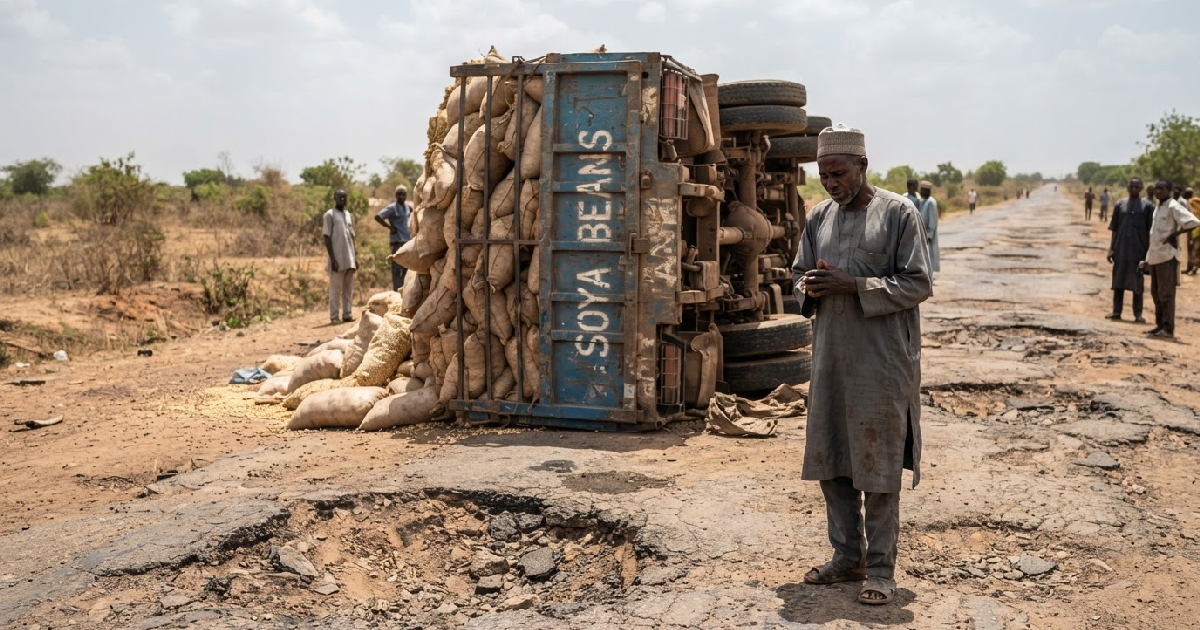
Along the Bida-Lapai road in Niger State, where a 70-kilometer stretch has devolved into a cratered nightmare, Muhammed Sani recently spent three grueling days attempting to cover less than 40 kilometers.
His truck, laden with soya beans destined for Ibadan, eventually overturned, a stark illustration of the perils now commonplace on what was once a critical link between Nigeria’s northern food baskets and southern markets.
The Bida-Lapai road economic artery chokes on neglect
This isn’t just an inconvenience; it’s a systemic breakdown, one that forces countless truck drivers, traders, and communities into a daily gamble with their livelihoods and lives.
For years, this strategic economic corridor, part of the larger 124.8-kilometer Lambata-Lapai-Bida road project, has steadily disintegrated. Its decay highlights a pattern of infrastructure neglect that has profound consequences for the movement of goods, the cost of doing business, and ultimately, the prices of basic commodities across the country.
But now, amidst the mounting frustration, a potential path to rehabilitation is emerging, spearheaded by private sector intervention.
The Bida-Lapai road serves as an essential conduit, ferrying thousands of heavy-duty trucks daily between Lagos’s seaports and the markets of northern Nigeria. It also facilitates the southward flow of agricultural produce and livestock, underpinning a significant portion of the nation’s internal trade.
But years of chronic neglect have left this highway riddled with deep potholes, shattered asphalt, and hazardous stretches that transform routine journeys into arduous, multi-day ordeals.
Transport operators speak of frequent vehicle breakdowns, exponentially prolonged travel times, and escalating transport costs. The road has become a site of repeated accidents involving heavy trucks, incidents that routinely claim lives and destroy property. Abdurahman Umar Gimba, a member of the National Truck Drivers Associations, laments that every journey carries significant risks for those transporting goods across the country.
Drivers take matters into their own hands
The situation has grown so dire that transport unions have taken drastic measures to protect their members and the communities along the route. Abdurahman Umar Gimba recounted how a taskforce committee, supported by the police area commander, now controls the movement of heavy trucks in and out of Bida town.
They restrict movement, releasing only 50 to 60 trucks at a time, a desperate attempt to manage the chaos and reduce casualties.
“Just recently, trucks killed three commercial motorcycle riders; that’s why we are here to control them,” Gimba explained, highlighting the immediate human cost.
“If we fail to do it, there will be more casualties as the accidents caused by the bad road condition are too much.” It’s a testament to the road’s condition that drivers must act as de facto traffic controllers and emergency road crews.
Indeed, drivers haven’t just managed traffic; they’ve also pooled their resources to undertake emergency repairs. Usman Jaba, a truck driver and member of the GDN Truck Drivers Association, revealed that operators have collectively spent nothing less than N20 million in the last six months filling dangerous potholes and making temporary fixes.
It’s a burden they’ve willingly taken on, simply to keep the road passable and protect their livelihoods.
“Our decision was not about taking over government’s responsibility but protecting lives, preventing accidents and reducing the huge financial losses caused by the road’s worsening condition,” Jaba stated. This collective action, while providing short-term relief, starkly exposes the systemic failure of adequate infrastructure maintenance. Building vital infrastructure often relies on a coherent state-led plan, not citizen philanthropy.
A history of broken promises and delayed action
The Bida-Lapai road’s current state isn’t a sudden collapse but the result of years, reportedly over eight or nine, of chronic neglect. While construction for its rehabilitation supposedly began in 2018, the road has only worsened, prompting continuous outcry from users.
The federal government has, in previous years, acknowledged the strategic importance of the Lambata–Lapai–Bida road and assured users that rehabilitation efforts would continue under various funding programs.
However, these assurances have brought little relief on the ground. Usman Jaba recalled hearing in February that the federal government had approved the road’s rehabilitation, yet six months later, no discernible improvement had occurred. This cycle of promises and inaction has eroded public trust and left thousands of commuters in limbo, facing escalating risks and costs.
Security risks and economic strangulation
The road’s deterioration extends beyond mere inconvenience; it has profound security implications. The Bida-Lapai road became an alternate route for heavy trucks heading to or from Kano, Kaduna, and Borno axes after the Kaduna-Birnin Gwari road became unsafe due to banditry. This forces drivers to travel an additional 120 kilometers or more, increasing exposure and transit times.
Usman Jaba argues that a well-maintained Kaduna-Birnin Gwari road would deny bandits the opportunity to operate, suggesting the poor state of roads directly fuels insecurity. This unintended consequence highlights how infrastructure failures create a cascading effect across various facets of national life, intertwining with issues of safety and governance.
The economic ramifications are equally severe, with frequent breakdowns increasing vehicle maintenance costs for tyres, suspension systems, and steering components, which wear out much faster than expected.
Muhammed Bashir, another transporter, notes that these increased operational costs are inevitably passed on to consumers, driving up the prices of goods across the country. Traders face significant delays, while passengers endure longer travel times, higher fares, and increased fuel consumption.
The lost income, damaged goods, and delayed deliveries contribute to a stagnant economy, impacting everyone from farmers to urban consumers. Boosting local businesses requires a dependable transport network to get goods to market efficiently.
The hidden environmental and human toll
Beyond the immediate financial and logistical burdens, the crumbling Bida-Lapai road poses a growing environmental hazard to communities living along its path. The frequent accidents involving trucks carrying industrial chemicals have led to uncontrolled spills onto farmlands, drainage channels, and residential areas.
Isa Alhaji Sani Dankwarai, a local resident, described a recent incident where a chemical spill, whose contents remained unknown, burned down trees and grasses, seeping deep into underground water sources.
“Some children were hospitalised a day after the incident because they drank from one of the wells,” Dankwarai recounted, painting a grim picture of direct human impact. Farmers worry about reduced crop yields and endangered livestock due to contaminated soil and water.
The slow response to these hazardous material accidents means overturned trucks sometimes remain at crash sites for days without proper containment, allowing toxic substances to spread further, particularly during the rainy season.
This escalating environmental and health crisis underscores the multifaceted costs of neglected infrastructure. It’s a direct assault on the well-being of the communities who rely on these vital transport links for their very survival.
Until permanent repairs are implemented, these communities will continue to live under the shadow of chemical contamination and the constant threat of accidents. This highlights the critical intersection of infrastructure, public health, and environmental policy, demanding a coordinated governmental response that has been conspicuously absent.
Dangote’s intervention: A new chapter for the road?
Amidst the despair and self-funded repairs, a significant development offers a glimmer of hope. The Dangote Group has confirmed preparations to commence construction on three major roads in Niger State, including the crucial Bida–Lambata section, which encompasses the beleaguered Bida-Lapai stretch. This monumental undertaking falls under the federal government’s Road Infrastructure Tax Credit Scheme, an initiative designed to incentivize private sector participation in infrastructure development.
Tony Chiejina, the company’s spokesman, confirmed the plans, stating that technical assessments and project planning are currently underway to ensure all requirements are met before contractors are mobilized. The project covers a combined length of approximately 410 kilometers, encompassing the Mokwa–Bida, Bida–Lambata, and Mokwa–Tegina roads.
Contractors are expected on site between now and the end of the third quarter of this year, with the construction work projected to take 30 months from its official commencement date. Attracting major investment like this is crucial for national development, but consistent follow-through remains key.
What this road tells us about nation building
The saga of the Bida-Lapai road is more than just a story of a dilapidated highway; it’s a narrative deeply woven into the fabric of Nigeria’s development.
It illustrates the recurring challenge of maintaining critical national assets, the immense pressure placed on ordinary citizens when the state falters, and the eventual reliance on private enterprise to bridge significant infrastructure gaps.
For decades, the nation has grappled with the question of how to fund and sustain its expansive road network, a question often answered with stop-gap measures and delayed projects.
The willingness of truck drivers to collectively contribute millions of naira for temporary fixes, alongside the eventual large-scale intervention by the Dangote Group, paints a complex picture. It reflects both the resilience of Nigerians to overcome systemic failures and the deep-seated issues within the institutional frameworks responsible for infrastructure.
As work eventually begins on these vital routes, the Bida-Lapai road stands as a stark reminder: is Nigeria’s path to development destined to be paved by crisis and corporate philanthropy, or can a more proactive, sustainable public policy emerge?
