




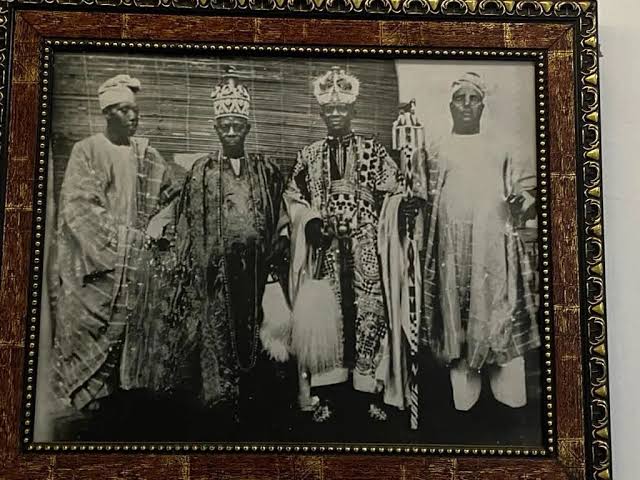
In November 1954, Oba Timothy Oloyede Fadina, Olagoroye II, was far from the royal palace as supporters rallied for his return in Ota.
His story, however, didn’t end with his removal from the throne. A decade later, the influential Drum magazine would capture him in Lagos, earning a living through motor-car sales. This profound transformation from a revered monarch to a private citizen navigating the burgeoning commercial life of Lagos paints a vivid picture of adaptation and resilience during a period of immense change in Nigeria.
The contested path to the Olota stool
Born on November 6, 1900, Timothy Oloyede Fadina’s journey to the Olota stool was anything but straightforward. His path intersected with the complex traditional and colonial administrative systems of the era.
In 1936, the Ogboni Cult recognized his growing influence, installing him as “Oloregun.” His leadership potential was further acknowledged in 1942 when he was appointed the Otta Native Authority Treasurer.
The succession battle of 1947
The Olota position becoming vacant in 1947 ignited a fierce succession struggle. Prince Timothy Fadina emerged as a prominent candidate for the throne.
He was crowned Olota of Ota in 1949, though some sources indicate 1948 as a possible date for his enthronement. His candidature followed deliberations involving Ota chiefs, kingmakers, and representatives of the Ijemo Royal House.
But the path to the throne was fraught with legal challenges. Chief Timothy Talabi Dada also vied for the stool, pushing the dispute into the colonial judicial system. His formal installation faced delays as the succession dispute entered the colonial judicial system.
This episode highlights the intricate interplay between age-old customs and the relatively new colonial legal framework. Ultimately, Fadina secured the throne and began his reign in 1949.
He belonged to the Ijemo-Isolosi Ruling House, and his royal title, Olagoroye II, linked him to an earlier holder of that name, rooting his authority in Ota’s deep history.
Royalty in a changing Nigeria: Oba Fadina’s brief reign
Oba Timothy Oloyede Fadina ascended the throne at a pivotal moment. The late 1940s and early 1950s were a time of rapid political evolution across Nigeria, with constitutional reforms broadening participation and political parties gaining significant traction.
Newspapers became vital platforms for public discourse. Traditional rulers, while still central to their communities, increasingly found themselves operating within a wider structure that included colonial officers, emerging regional governments, and the courts.
A monarch of charisma and foresight
Oba Fadina quickly distinguished himself. He was widely regarded as the most popular, articulate, wealthy, and enlightened figure in Ota, making him a compelling choice for the Olota position.
Contemporaries described him as a wisdom-filled and forward-looking leader. Some media men of the era even hailed him as the ‘mighty Olota of Ota,’ a testament to his commanding presence and influence.
He was also renowned for his charisma and keen sense of style, often rumored to be one of the best-dressed Obas in Yorubaland. His impact stretched beyond Ota, as evidenced by his hosting of the Awori Oba First Summit in 1950, a significant gathering of regional kings.
This gathering itself speaks volumes about his influence and ambition. It was a clear demonstration of his vision for unifying Awori leadership.
The crisis of 1954 and the abrupt end of a reign
The year 1954 proved decisive for Oba Fadina. His reign, marked by a rise in local political tensions, culminated in a dramatic downfall that underscored the fragility of traditional authority under colonial scrutiny.
Oba Fadina became entangled in legal proceedings which ultimately led to his dethronement. The reasons behind his removal were complex and widely reported.
Allegations and political maneuvers surrounding dethronement
Allegations of unremitted taxes played a role, with some speculating he was becoming “bigger than the powers that be.” Political reasons, including his reported opposition to taxation by the government during the Awolowo regime, were frequently cited.
A meeting he hosted with Awori kings was reportedly used by opponents to allege he was planning something sinister. Some claimed he aimed to strengthen himself against authorities or halt tax remittances.
There were also rumors of a conspiracy involving his half-brother and Oba Timothy Dada, who would eventually succeed him. He was said to have been charged to court and later removed from office, an action many described as political due to his cold relationship with the Western Regional government.
Whatever the precise combination of factors, Oba Fadina’s short five-year reign came to an abrupt, politically charged end on May 11, 1954. He was sent into exile on this date, with some accounts suggesting he was deposed while on a trip to Oba Ademola Adetokunbo in Abeokuta.
From Ota palace to Lagos streets: Fadina’s new life
Deposed and exiled on May 11, 1954, Oba Timothy Oloyede Fadina found himself navigating a radically different reality. His royal authority was stripped away, yet his story took an unexpected turn, revealing a man capable of profound adaptation.
He relocated to Lagos, then a rapidly expanding city and the commercial heart of newly independent Nigeria. Here, the former Olota shed the trappings of royalty and embraced a new, remarkably ordinary profession.
A king becomes a salesman
By March 1964, a decade after his dethronement, Fadina was living as a private citizen. He had transitioned into running a car dealership and earning income through vehicle sales on commission.
The influential Drum magazine, known for its vivid documentation of African politics, society, and urban culture, immortalized this transformation. Their photographic assignment of March 2, 1964, bore the memorable caption: “A king puts himself on commission.”
The image, preserved in the Drum Social Histories archive, captured more than just a former monarch in a new role. It presented a compelling portrait of societal change, illustrating how status, authority, and personal circumstances could dramatically shift in 20th-century Nigeria.
Fadina’s ability to adapt, moving from the ceremonial responsibilities of the Olota’s palace to the bustling commercial life of Lagos, underscores his remarkable character. He lived as a tenant for a time in Apapa Road, Ebute Metta, before moving to Lagos Island.
He even built a three-story building in Sango, almost opposite Ota Travellers Inn, demonstrating his continued participation in the economic fabric of the nation. This resilience reveals that the loss of royal office didn’t signify the end of his active engagement with life.
Meanwhile, the succession in Ota remained contentious. His successor, Oba Timothy Talabi Dada, reportedly faced challenges to his legitimacy, with many in Ota viewing him as a politically imposed king.
The divisions surrounding Fadina’s departure and the subsequent installation of Dada lingered, speaking to the depth of feeling many had for the deposed Olota.
A living legacy: Honoring Oba Fadina today
Decades after his reign and subsequent life in Lagos, Oba Timothy Oloyede Fadina’s legacy continues to resonate. His long life, which ended on August 23, 1993, at the age of 93, is now being honored through concrete community development initiatives in Ota.
This enduring recognition reflects a renewed appreciation for his impact on Ota history and the broader narrative of traditional leadership.
The Oba Timothy Fadina Foundation’s initiative
On May 8, 2026, a significant announcement was made regarding the establishment of a 40-Bed Oba Timothy Oloyede Fadina Primary Health Care Center in Ota. This center is designed to strengthen community wellness and support accessible medical tourism in Ogun State.
The project was facilitated by His Royal Majesty, Professor Adeyemi AbdulKabir Obalanlege, the current Olota of Ota Kingdom. Funding and execution came from the Presidency through the Office of the Senior Special Assistant to the President on Sustainable Development Goals (SSAP-SDGs), under Princess Adejoke Orelope-Adefulire.
Prince Adetunji Fadina, President of the Association of Tourism Practitioners of Nigeria (ATPN) and Chairman of the Oba Timothy Fadina Foundation, described the health center as “a living legacy that connects history with humanity.”
This initiative represents more than just a medical facility; it symbolizes a re-evaluation of Oba Fadina’s contributions and struggles. It’s a way for the community to acknowledge the long-term impact of its leaders, even those whose reigns ended under contentious circumstances.
The health center serves as a tangible link between Ota’s past and its future, ensuring that the name of Oba Timothy Oloyede Fadina, once embroiled in political turmoil, is now synonymous with progress and well-being for his people.
The broader story of Nigeria’s development is often seen in such local efforts, where communities build on their past to forge new futures, much like the story of Kirikiri and its evolving identity.
His life story, marked by power, political upheaval, and personal resilience, remains a compelling chapter in Nigeria’s journey. It reminds us how traditional institutions navigated the currents of colonial rule and the early years of independence, and how individual figures adapted to profound changes.
Oba Fadina’s experience reflects the constant interplay between tradition and modernity, a dynamic that continues to shape Nigerian society. It leaves us with a question: what does it mean for a leader, and a people, to continually redefine their place in a rapidly evolving world?
