




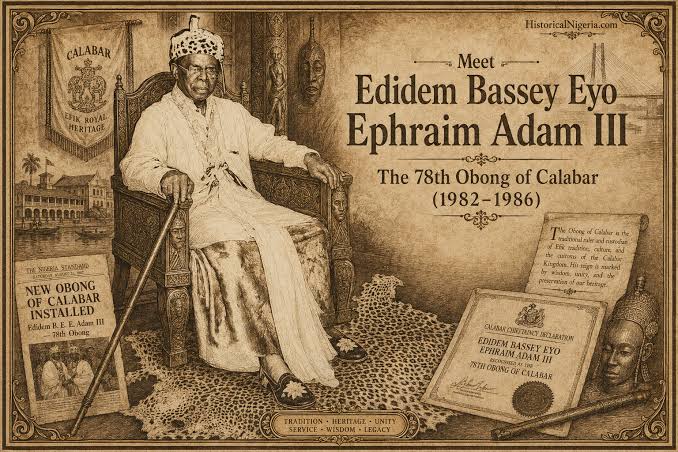
Edidem Bassey Eyo Ephraim Adam III was coronated the 78th Obong of Calabar and Paramount Ruler of the Efiks on Saturday, November 27, 1982, at Duke Town Presbyterian Church.
This elaborate ceremony, while a public spectacle, marked the culmination of a much longer, multifaceted royal transition for a man whose life had already spanned pioneering engineering and deeply rooted traditional leadership. He would reign until his death on December 14, 1986.
Edidem Bassey Eyo Ephraim Adam III’s royal upbringing
Bassey Eyo Ephraim Adam, born on December 25, 1904, was already an established figure within both the modern professional world and the intricate Efik traditional political structure. His journey to the throne was characterized by a contested succession and multiple stages of traditional installation and governmental recognition, painting a vivid picture of how Nigeria’s traditional institutions adapted in the late 20th century.
Edidem Bassey Eyo Ephraim Adam III entered the world with deep roots in Calabar’s royal lineage. His paternal side connected him to the Etim Efiom royal house, while his maternal lineage traced back to the Duke royal house. This dual heritage positioned him uniquely within the Efik aristocracy from birth.
His father, Etubom Eyo Ephraim Adam, also known as Eyo Efiom Ededem, had served as head of the Etim Efiom royal house from 1906 to 1911. His mother, Princess Eyoanwan Eyo Edem, further strengthened his ties to Calabar’s traditional nobility and the Efut Nobility, through her mother Inima Okon from the Odionka Ebuka royal house in Efut Abua.
Education played a significant role in shaping the young Bassey Eyo Ephraim Adam. He attended the Church of Scotland Mission School in Ikot Efio Enang at Akpabuyo before transferring to Duke Town School. His academic pursuits led him to pass the Preliminary Cambridge examination in 1922, a notable achievement for his era.
He continued his studies at the Normal College at Hope Waddell Training Institution from 1922 to 1924. Later, he proceeded to King’s College, Lagos, between 1924 and 1925, where he completed his secondary education and successfully passed the London University Matriculation Examination. This early exposure to rigorous education laid the groundwork for a distinguished career.
From engineering pioneer to traditional authority
Before his ascendance to the Obongship, Bassey Eyo Ephraim Adam established himself as a pioneering electrical engineer in Nigeria. His professional journey began in the Public Works Department, where he served with distinction across various parts of the country. This experience not only honed his technical skills but also broadened his understanding of Nigeria’s diverse regions.
After his public service, he ventured into entrepreneurship, founding Adam Engineering Brothers. This civil engineering and electrical contracting company became a notable success, particularly in Jos, where he was based. His work as a respected contractor allowed him to build extensive networks across Northern Nigeria, connecting him with influential figures beyond his traditional Efik homeland.
Championing minority rights
Beyond his engineering feats, Bassey Eyo Ephraim Adam was a vocal advocate for political recognition and autonomy for minority ethnic groups in Eastern Nigeria. In the 1950s, he actively supported the Calabar-Ogoja-Rivers (COR) State Movement. He wasn’t just a passive supporter; he mobilized support, organized activities, and provided crucial financial assistance to the cause.
His home became a bustling hub for political organization, uniting people from the old Calabar province under a common objective. This deep involvement in the COR State Movement, which championed political recognition for minority ethnic groups, showcased his commitment to justice and self-determination.
His journey continued with further training abroad, including stints in Sierra Leone and the UK. He attended the Engineering School of the Public Works Department in Lagos and later the Bournemouth School of Engineering in England. This international exposure further cemented his professional credentials and his status as a pioneering electrical engineer.
He eventually obtained a Diploma of the Institute of Service Engineers in Kent and became an Associate of the institute. His achievements were later recognized with a fellowship from the Nigerian Institute of Management. These academic and professional milestones highlight a man dedicated to excellence in both technical and managerial fields, a rare blend for traditional leaders of his time.
The contested path to the Obongship
The death of Edidem Esien Ekpe Oku V on January 14, 1982, set in motion a complex and often contentious process to determine the next Obong of Calabar.
Bassey Eyo Ephraim Adam, already an Etubom of Etim Efiom house since 1979 and a member of the Etuboms’ Traditional Council, was no outsider to this intricate system. His standing within his royal house and the wider council proved critical.
The succession was not a simple matter of hereditary transfer but a tightly contested battle. Among the principal contenders was Etubom Cobham Eneyo Boco, his maternal first cousin, as noted by historian Orok-Orok Effiom Duke. This rivalry underscored the deep-seated complexities of Efik royal succession, where lineage, qualification, seniority, and customary procedures all played a role.
Disagreements within the traditional establishment escalated, eventually leading to litigation. Several members of the traditional council found themselves aligned with opposing camps as the struggle unfolded. Ultimately, Bassey Eyo Ephraim Adam emerged as the successful candidate, navigating a political landscape fraught with alliances and rivalries.
Layers of legitimacy: Selection, installation, and state recognition
Edidem Bassey Eyo Ephraim Adam III’s ascent to the throne was a carefully structured sequence of events, each adding a layer of legitimacy to his Obongship. Orok-Orok Effiom Duke records that the Etuboms’ Traditional Council formally selected Bassey Adam on November 8, 1982, marking the pivotal decision in his favor.
Following this selection, he was publicly proclaimed Obong-elect on November 9, 1982. These developments cemented his position at the heart of the succession process, setting the stage for the formal ceremonies to follow. It demonstrated that his journey was well underway months before the public coronation.
A crucial traditional installation took place on February 9, 1982, at the Obong’s Palace in Calabar. Here, Bassey Eyo Ephraim Adam underwent traditional crowning at Efe Asabo, an essential element that deeply embedded his authority within indigenous Efik political and ceremonial traditions. This ritual established his spiritual and customary claim to the throne, predating any Christian ceremonies.
Another decisive step occurred on March 15, 1982, when the Cross River State Government formally recognized him as Obong of Calabar. He received the staff of office and official certificates of recognition, integrating his traditional authority within the administrative structure of modern Nigeria. This state recognition reflected the broader relationship between traditional rulership and the nation’s administrative structure.
By March 1982, Bassey Adam had thus passed through both the intricate traditional installation and formal state recognition processes. These stages established his uncontested position months before the Christian coronation ceremony, highlighting the layered nature of Efik kingship where ancient customs coexisted with modern governmental structures. His authority was fully formed, awaiting only its public celebration.
The coronation: A public affirmation of Efik kingship
The grand coronation on Saturday, November 27, 1982, at Duke Town Presbyterian Church was the public crescendo of Bassey Eyo Ephraim Adam III’s accession. It concluded a week-long series of activities that began on November 22, drawing the community into a shared celebration. The official program meticulously outlined a royal procession, prayers, hymns, and the formal crowning itself.
This ceremony wasn’t just spectacle; it was a deeply symbolic event that fused Efik tradition with Christian elements. The choice of Duke Town Presbyterian Church was particularly resonant, given its historical significance as a hub of Christian missionary activity in Calabar since the 19th century.
Christianity had long become intertwined with the public life of many Efik families, making the church a natural venue for such a momentous occasion.
The coronation programme included the monarch’s oath, genealogical information, and historical material concerning the institution of the Obongship. This blend of ancient and modern, indigenous and Christian, underscored the unique character of 20th-century Efik kingship. Royal insignia and traditional political authority were present alongside Christian clergy and worship, demonstrating a profound adaptation rather than abandonment of heritage.
The ceremony served to present the Obong before a broad public audience, affirming his legitimacy in the eyes of both traditionalists and those influenced by colonial and post-colonial structures. It exemplified how longstanding African traditional institutions could adapt their public expressions without compromising their indigenous foundations.
Leading through national tumult
Edidem Bassey Eyo Ephraim Adam III’s brief reign, spanning just four years from 1982 to 1986, coincided with one of Nigeria’s most turbulent political periods. He assumed the throne during the Second Republic under President Shehu Shagari. This democratic interlude, however, was short-lived.
In December 1983, Nigeria experienced another military rule, which brought Major General Muhammadu Buhari to power. Just two years later, in August 1985, General Ibrahim Babangida seized control, marking yet another seismic shift in national leadership.
These rapid transitions from civilian rule to military regimes formed the broader, volatile background against which Bassey Adam carried out his duties as a prominent traditional ruler in Cross River State.
During this era, traditional rulers maintained a crucial role as intermediaries between local communities, customary institutions, and the state government. They participated actively in public ceremonies, community affairs, and engagements with government officials. Their authority, rooted in culture and tradition, provided a sense of continuity and stability amidst political upheaval, despite the shifts in national leadership.
As President of the Calabar Municipality Traditional Council, Bassey Adam championed peace, unity, development, and modernization. He undertook extensive tours across Cross River State, actively promoting harmony among communities. He also supported significant development initiatives within Akpabuyo, demonstrating a forward-looking approach to his traditional duties. His reign, though short, was marked by a commitment to both traditional values and the progress of his people.
Legacy of a layered reign
Bassey Eyo Ephraim Adam III remained Obong until his death on December 14, 1986. His passing concluded a reign that, despite its brevity, left a distinctive mark on modern Efik royal history due to its elaborate and layered accession process. His journey to the Obongship brought together various institutions, each contributing a unique dimension to his public authority.
His accession involved the intricate politics of his royal house, the consensus-building within the Etuboms’ Traditional Council, the customary selection rituals, a profound indigenous installation, formal state recognition, and finally, a Christian coronation.
Each stage carried its own meaning: traditional processes connected him to Efik political institutions, government recognition placed him within the state’s administrative framework, and the church ceremony offered a visible Christian expression of his kingship.
This layered character of traditional rulership in modern Calabar, as exemplified by Bassey Adam’s reign, highlights a crucial aspect of Nigerian history: the dynamic interplay between ancient customs and contemporary governance. His story explains why the events of November 27, 1982, shouldn’t be viewed in isolation. Instead, they represent a singular, powerful example of continuity and adaptation within the Efik monarchy.
The Obongship institution endured beyond Bassey Adam’s death, testifying to its inherent resilience. But his specific place in that history remains defined by the complex sequence of events that elevated him from a respected figure within the Etim Efiom House to the revered throne of the Efik kingdom, an enduring symbol of a culture’s ability to evolve without losing its essence.
The enduring significance of his accession
The story of Edidem Bassey Eyo Ephraim Adam III offers a profound window into the evolution of traditional rulership in 20th-century Nigeria. His accession was not a simple handover of power; it was a carefully negotiated process that reflected the socio-political realities of his time. It illustrated how traditional authority, far from being static, could fluidly integrate state administrative structures and adopted religious practices.
His background as a technically trained engineer and a political activist in the COR State Movement provided him with a unique perspective. He understood the demands of modernity and the aspirations of his people for self-determination. This blend of traditional legitimacy and contemporary acumen made him an effective leader during a challenging period for Nigeria, marked by frequent shifts in national power.
The elaborate nature of his coronation, with its blend of Efik customary rites and Christian worship, was more than just pageantry. It served as a powerful public statement about the legitimacy and adaptability of the Obongship. It showed the world that Efik kingship could honor its ancient foundations while openly embracing new cultural and religious dimensions that had become integral to the community.
Ultimately, Edidem Bassey Eyo Ephraim Adam III’s reign, though brief, provides essential insights into the enduring power of traditional institutions in a rapidly changing nation. His life asks us to consider how leadership, especially in culturally rich societies like Nigeria, continuously redefines itself through a dialogue between the past and the present.
It leaves us with a question: what does it mean to lead a people when history, tradition, and modernity all make their separate demands?
