




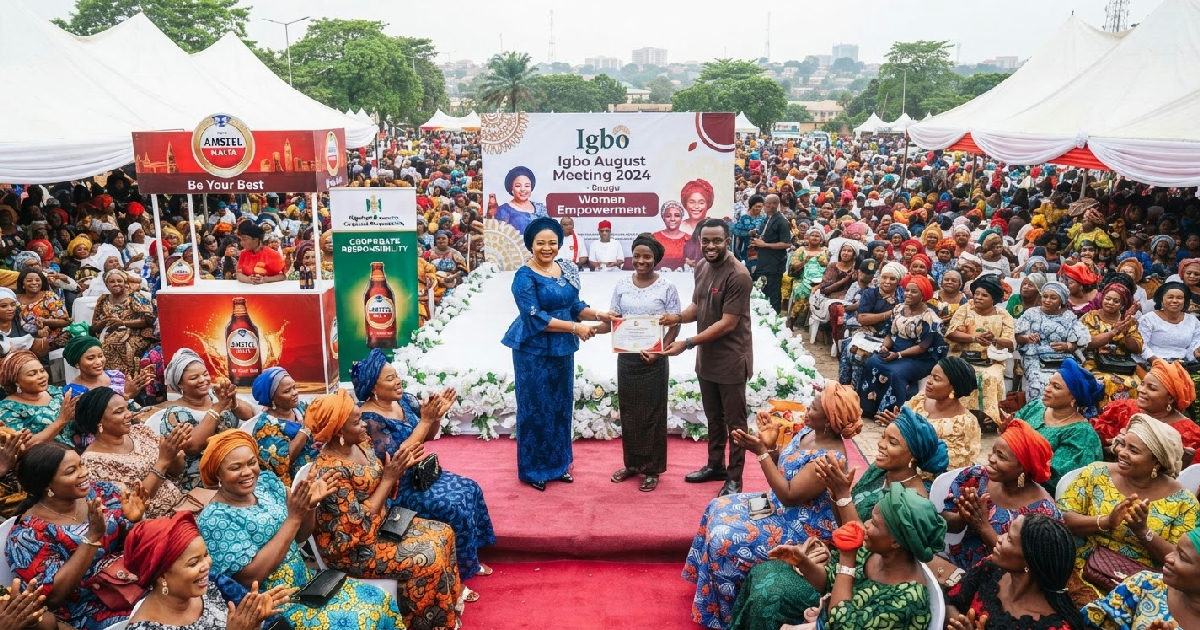
On August 8, 2026, thousands of Igbo women gathered at Okpara Square in Enugu State for the annual August Meeting. First Lady of Enugu State, Mrs. Nkechinyere Mbah, welcomed local and diaspora delegates to deliberate on community development. Premium brand Amstel Malta partnered with the state government to award business grants.
Led by Senior Brand Manager Francis Obiajulu, the brand aligned with the state to support women entrepreneurs. The collaboration seeks to celebrate cultural homecoming while driving economic progress in the region.
The historic rise of a grassroots parliament
This annual gathering remains one of the most powerful self-governing female institutions in West Africa. Much like other Southeast traditions such as the Iriji Mbaise cultural festival, the meeting serves as an anchor for community development and social cohesion. It represents a seasonal pause where women reclaim their voices.
For three generations, this mid-year assembly has dictated the developmental pace of rural communities. Women return from Lagos, London, and Abuja to sit with their village peers. They debate everything from clean water projects to local disputes, shaping the physical infrastructure of their ancestral homes.
The roots of this gathering stretch back to the mid-20th century. During the late colonial era, Christian women groups began organizing regional assemblies to coordinate community development. Over the decades, these modest meetings evolved into a formidable social engine.
Historically, rural development in southeastern Nigeria relied heavily on communal effort. The national government often felt distant, and municipal funding was scarce. In this vacuum, married women stepped forward, organizing themselves to build maternity wards, civic halls, and village markets.
This unique structure operates without central command. Each town union has its own autonomous branch, governed by strict democratic principles. The decisions made during these sessions carry the weight of local law, respected by traditional rulers and community chiefs alike.
The gathering has earned the nickname “Women’s Christmas” across the region. It is a rare space where women exercise absolute legislative power over community welfare. The celebration has also evolved into an informal exhibition of textile artistry.
Economic empowerment at Okpara Square
Inside the vast grounds of Okpara Square in Independence Layout, the cultural movement reached its peak. Thousands of women dressed in uniform wrappers transformed the venue into a sea of blue and gold. The atmosphere crackled with song, dance, and collective purpose.
The Enugu State government used the occasion to address critical socio-economic challenges facing women. Hon. Ngozi Enyi, the Commissioner for Children, Gender Affairs and Social Development, emphasized the need for structural support. She noted that rural commerce depends almost entirely on the resilience of women.
First Lady Mrs. Nkechinyere Mbah spoke passionately about the economic vulnerabilities of micro-retailers. She argued that true independence begins with financial inclusion. Her administration’s collaboration with corporate allies aimed to provide sustainable solutions rather than temporary relief.
Direct funding for grassroots enterprises
To translate this rhetoric into action, the government introduced a targeted business support initiative. Amstel Malta backed this program by providing critical financial resources directly to local traders. They sought to strengthen small and medium-sized businesses run by women in the state.
Two outstanding women entrepreneurs from different senatorial zones received business grants during the ceremony. These direct cash injections aim to scale up local operations, from food processing to retail trade. The selection process prioritized businesses with high community impact.
This focused economic intervention represents a shift in how corporate entities engage with local culture. The classic model of corporate sponsorship often ended with branding and free product distribution. Now, the emphasis has moved toward wealth creation and sustainable development.
Cultural alignment and corporate strategy
The involvement of corporate brands in local celebrations is not new, but the depth of engagement is changing. Joy Egolum, the Corporate Affairs Manager, East, for Nigerian Breweries Plc, explained the company’s philosophy during the event. She stated that the brand must win with its communities.
“This is such an auspicious occasion, with a very important demographic of our consumer and customer base,” Egolum said. She emphasized that the company believes in partnering with consumers and local communities. When an event matters to the local community, it becomes a priority for the manufacturer.
The parent company has a history of regional investment. Decades ago, the Nigerian Brewery Limited opens second brewery in Aba to serve the growing markets of the East. This physical presence laid the foundation for deep-seated cultural ties that persist today.
This corporate involvement also reflects a wider shift in Nigerian advertising. Brands are moving away from generic nationwide campaigns to focus on deeply localized experiences. By engaging with regional traditions, they establish a more authentic connection with consumers.
Amstel Malta’s current messaging centers on individual excellence and perseverance. Senior Brand Manager Francis Obiajulu highlighted this connection during his remarks at the venue. He explained that the core campaign is built on the belief that everyone can strive for excellence.
“At the heart of Amstel Malta’s Be Your Best campaign is the belief that everyone has the potential to strive for excellence,” Obiajulu remarked. He added that this philosophy reflects the natural resilience found among Nigerian consumers. The brand sought to mirror that endurance.
How the Igbo August Meeting drives modern homecoming
The contemporary gathering is a complex blend of ancient values and modern aspirations. In the past, the event sometimes faced criticism for competitive displays of wealth. Critics argued that the pressure to wear expensive jewelry and fabrics excluded poorer women from participating.
To solve this, town unions introduced uniform fabrics, often sourced from local textile centers. This decision democratized the meeting and leveled the social playing field. Today, the fashion aspect is celebrated collectively, showing how Akwete weavers transform traditional patterns into modern cultural statements.
Meanwhile, the diaspora has digitized this homecoming. Women in London, Houston, and Toronto who cannot travel home now join the deliberations via video link. This hybrid format allows global resources to flow directly into local development funds.
These funds are systematically deployed to build infrastructure. In many rural communities, the local maternity ward or secondary school was built by the women’s association. The state government recognizes that these women often accomplish what municipal budgets cannot cover.
Ultimately, the success of the gathering lies in its ability to adapt. While preserving its core values of community stewardship, it has embraced new technologies and economic models. This flexibility ensures that the institution remains highly relevant to younger generations.
The 2026 edition in Enugu demonstrated that cultural heritage can coexist with economic empowerment. By combining traditional assembly with business funding, the event provided a sustainable blueprint. It proved that culture is not just a relic of the past, but an active economic driver.
As the crowds dispersed from Okpara Square, the immediate benefits were clear. The grants awarded will help sustain two local households, while the broader deliberations will shape communal policies for the next year. The event successfully bridged the gap between heritage and progress.
