




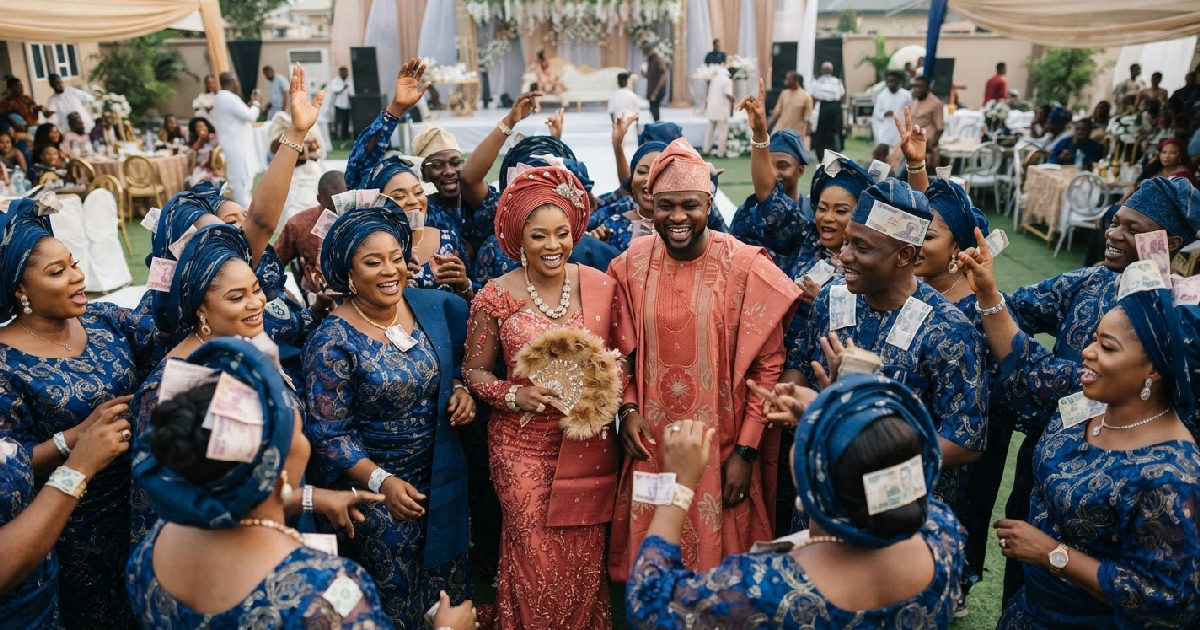
At a Lagos wedding, a vibrant sea of coordinated fabrics once signaled unwavering solidarity. But today, that visual display of unity, known as Asoebi culture in Nigeria, finds itself at a financial crossroads.
A new report from Trust TV News, published on August 8, 2026, casts a stark light on how spiraling costs are reshaping this cherished tradition, challenging its very essence for guests and hosts across the nation and in the diaspora.
The growing financial burden of celebrating unity
This isn’t merely a story about changing fashion trends. It’s about the profound impact of Nigeria’s economic realities—rampant inflation, the depreciating value of the Naira, and rising market prices—on a cultural practice deeply embedded in social celebrations. For many, the joy of participation is now overshadowed by financial strain, prompting difficult questions about Asoebi’s future.
The cost of belonging to an Asoebi group has escalated dramatically. Where once it was an affordable gesture of support, it has now become a significant expenditure. Guests are now confronting price tags that were once unimaginable for a single outfit.
Consider the figures: some Asoebi sets, particularly those featuring high-quality lace or George fabrics, can now demand anywhere from $500 to $1,000 per person. This often excludes the critical additional expenses of tailoring, specific accessories, and professional styling, pushing the total cost even higher.
Dorcas Yakubu, a Trust TV News reporter, has highlighted this dilemma, questioning whether Asoebi is undergoing a natural evolution or if it’s simply bending under immense economic pressure. Her reporting underscores the anxiety felt by many who wish to uphold the tradition.
The strain is evident far beyond the individual attendee. Fabric traders, once thriving on bulk purchases, now report a “significant” drop in patronage. Some lament that they can “stay one week and not sell,” a stark contrast to previous years when customers bought “a lot of yards” without hesitation.
Asoebi’s ancient roots and unifying threads
The story of Asoebi, or Aṣọ-Ẹbí, begins with the Yoruba people of southwestern Nigeria. The term itself translates simply to “family cloth,” a clear indicator of its original purpose: to visibly signify unity and kinship during important family events.
Its earliest forms in the early 1900s saw families purchasing or even weaving a single, distinctive fabric to wear during milestone celebrations. Economic historian Ayodele Olukoju notes that the practice truly gained prominence during the economic boom of the 1920s, fueled by increased palm oil prices.
By the 1950s, Asoebi had begun to expand beyond immediate family circles. Women’s organizations, known as “egbes,” adopted the tradition, using matching attire to signify close friendships and, often, a shared sense of affluence. This marked a pivotal moment in its transition from a private family affair to a broader social institution.
The mid-1960s to the late 1970s saw another shift, with imported fabrics like lace and George becoming fashionable choices for Asoebi. This introduced a new layer of sophistication and variety, cementing its status as a dynamic and integral part of Nigerian fashion.
Today, its reach extends far beyond the Yoruba, embraced by various ethnic groups across Nigeria and finding a strong presence within the Nigerian diaspora in countries like Sierra Leone and Cameroon.
The commerce behind the culture: An intricate ecosystem
Beyond its deep cultural resonance, Asoebi underpins a vast and intricate commercial ecosystem that drives a significant portion of Nigeria’s fashion industry. This network stretches from bustling fabric markets and skilled tailors to high-end fashion designers, makeup artists, photographers, and even logistics companies facilitating its reach.
This ecosystem isn’t confined to Nigeria’s borders either. A substantial diaspora supply chain ensures fabrics and finished garments move seamlessly between Nigeria and communities in the UK, US, and Canada. This global reach highlights its economic clout.
For celebrants, Asoebi has also become a practical mechanism for event funding. They often incorporate a markup on the fabric price, sometimes ranging from 20% to over 50% of the original cost, using these funds to help cover the expenses of their elaborate events.
But this economic model is not without its internal struggles and inequities. A 2019 analysis from Stears revealed a stark gender disparity in these financial obligations. Women typically faced the brunt of Asoebi expenses, often paying around ₦25,000 for five yards of fabric for a single affluent wedding. Men, conversely, could satisfy the requirement by purchasing a matching cap for roughly ₦2,500.
Udo Maryanne Okonjo, author of “The Asoebi Economy: Culture, commerce, and the hidden cost to women’s wealth,” has critically examined this imbalance. She states unequivocally that “Women bear 90% of the financial, emotional, and logistical pressure of Asoebi culture.” Okonjo argues that this reflects a deeper societal expectation for women to uphold and visually represent collective displays, often at considerable personal cost.
Okonjo doesn’t mince words about the evolving nature of the tradition either. She quotes a top Lagos designer who observed, “Asoebi is no longer a culture. It’s now commerce, class, and politics.” This sentiment underscores a growing concern that the tradition’s unifying spirit is being eclipsed by its financial implications.
She also added a personal perspective, saying, “But I do not love pressure disguised as tradition. Or segregation packaged as culture. Or the quiet financial strain many women carry alone. And Asoebi must evolve with us.” Her words resonate with many who feel trapped between cultural expectation and economic reality.
Broader economic shifts impact many Nigerian enterprises, including those aided by institutions that fuel business growth.
Adapting to austerity: Reshaping the tradition
Faced with these escalating costs, both hosts and guests are making significant adaptations. Many are actively seeking more affordable fabric alternatives, moving away from expensive imported laces to more accessible local options. This shift is a direct response to the financial squeeze, impacting the choices available to celebrants.
The pressure is changing how people participate in events. Some guests, unable to afford the stipulated Asoebi, are opting out of purchasing the fabric entirely, instead attending events in other suitable attire. This subtle rebellion highlights the financial burden now associated with demonstrating solidarity.
Even with these pressures, the core value of unity remains important to many. Mrs. Kemi Babalola, who wore a chosen dress code at a presidential inauguration, explained her decision as “a sign of solidarity for the new president and the vice president.” This shows the continued desire to express collective support.
Dealing with national economic realities, whether in fashion or healthcare, often requires significant adaptation, as seen in efforts to reduce Nigeria’s medical tourism bill.
Similarly, Mr. Idris Abdullahi, an All Progressives Congress (APC) member, noted that “using uniform for any event adds colour,” acknowledging the aesthetic and communal benefits. This tension between tradition and economic feasibility is playing out in countless decisions across the country.
Social media platforms like Instagram, particularly accounts like “Aso Ebi Bella” with over three million followers, continue to play a vital role. These platforms act as a “distributed directory,” connecting users with tailors, photographers, makeup artists, and hairstylists. This digital infrastructure facilitates the culture’s continuity, even as its financial parameters shift.
What happens next for Asoebi culture in Nigeria?
The Asoebi culture, a vibrant historical thread in Nigeria’s social tapestry, stands at a critical juncture. Its evolution, once driven by expanding social circles and changing fashion tastes, is now being dictated by the harsh realities of economic hardship. Will it continue to adapt, finding new forms that balance tradition with affordability, or will the financial demands fundamentally alter its role?
The question isn’t whether Asoebi will disappear, but rather how it will redefine itself in an era where the cost of collective identity has become a luxury for many. The choices made by individual families, fabric traders, and event planners today will undoubtedly shape this iconic Nigerian fashion tradition for generations to come.
This period of change in Nigerian social life echoes other moments of national transformation, including episodes of societal upheaval.
