




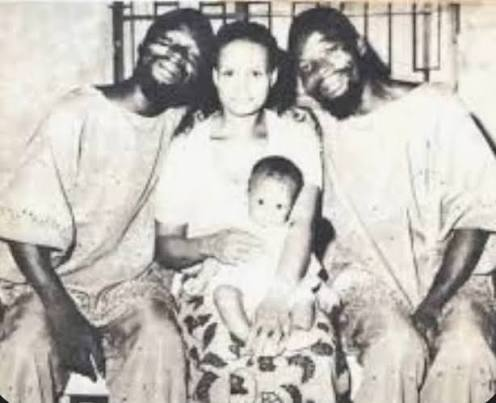
In the intricate landscape of Nigerian family life, the story of Kehinde and Taiwo Ogundipe, and Patricia Adewuyi, stands as a potent symbol of unconventional love and shared identity. These identical twin brothers, the Ogundipe Twins, from Ekiti, alongside Patricia, their singular wife, forged a household that defied prevailing social norms and ignited national fascination.
Their union became a living question mark, challenging long-held assumptions about marriage, individuality, and the spiritual bonds of twinhood within Yoruba culture.
The Enduring Bond of Yoruba Twinhood for the Ogundipe Twins
Their story, unfolding in the bustling Lagos of the 1970s, plunged deep into the heart of what it means to be Nigerian, to be Yoruba, and to define one’s own family. It was a narrative shaped by personal conviction, ancient traditions, and the rapidly changing urban environment.
The Ogundipes’ domestic arrangement was a radical expression of their belief in the profound unity between them, pushing the boundaries of societal acceptance in a nation where marital structures were already diverse but rarely stretched this far.
For centuries, twinhood has held a uniquely profound and often sacred place within Yoruba society. Known as ìbejì, twins are not merely siblings born at the same time; they represent a dual soul, a spiritual connection deeply woven into the fabric of identity and cosmology.
The traditional names Taiwo and Kehinde themselves reflect this spiritual hierarchy: Taiwo, the first to emerge, is believed to be sent forth to inspect the world, while Kehinde is often regarded as the elder, the one who sent Taiwo ahead.
This spiritual significance has fostered elaborate social, religious, and artistic traditions. From the revered òrìṣà ìbejì tradition to the intricately carved ère ìbejì figures representing deceased twins, Yoruba culture imbues twinhood with immense power and protection.
Taiwo Olaleye-Oruene and other scholars have meticulously documented how these beliefs evolved, transforming what was once fear in some communities into reverence. This rich heritage underlines the deep wellspring from which the Ogundipe brothers drew their personal philosophy.
The Ogundipe twins, Kehinde and Taiwo, saw their bond as an extension of this powerful spiritual connection. They believed their shared existence transcended ordinary human relationships, extending into every facet of their lives, including marriage. Their arrangement was a deeply personal interpretation, rooted in a conviction that “God made us to be together in everything we do.”
A Love Story Forged in Lagos
Patricia Adewuyi, a 24-year-old woman at the time, encountered the Ogundipe twins in December 1976 at a lively palm-wine bar in Ijesha Tedo, Lagos. Her initial relationship blossomed with Kehinde Ogundipe, leading to a marriage proposal which she accepted. Her British-born mother reportedly gave her blessing to this union. But what began as a conventional engagement soon navigated a profoundly unconventional path.
Patricia later discovered the full scope of the twins’ vision: she was expected to be a wife to both brothers. This revelation, initially shocking, eventually led to her acceptance and embrace of the arrangement. In subsequent interviews, both Patricia Adewuyi and her mother affirmed her happiness within this unique household.
Their story was not simply about a singular choice, but about the adaptation, compromise, and mutual understanding forged within their shared lives.
The family soon welcomed a son, Noah, who became an integral part of their narrative. Questions about biological paternity were, to the twins, irrelevant; Noah belonged equally to both, a testament to their concept of shared parenthood. This arrangement, while deeply personal, would soon become a national talking point, forcing Nigerians to confront a rare deviation from established marital norms.
When Private Lives Became Public: The 1978 Drum Magazine Feature
In February 1978, the story of Kehinde, Taiwo, and Patricia exploded onto the national consciousness when the Nigerian edition of Drum magazine published a feature under the striking cover line: “Twins Who Share One Wife.” The accompanying photograph, depicting the two brothers, Patricia, and baby Noah, instantly immortalized their household.
Drum, a publication renowned across Africa for its bold style and vivid photography, had found a human-interest story unlike any other.
The magazine, originally founded in South Africa, had expanded its reach across the continent, becoming a crucial chronicler of rapidly changing African societies from 1951 to 1986. It masterfully blended politics with popular culture, sport, celebrity, crime, and intimate human stories.
The Ogundipe twins’ narrative perfectly fit Drum‘s tradition of presenting extraordinary personalities and unconventional lives, capturing a moment when personal choices intersected with societal curiosity. This exposure propelled a private family decision into a widespread cultural conversation about marriage and identity.
The enduring power of that 1978 feature continues to fascinate, decades later. The image and the story it tells serve as a window into an era of Nigerian journalism that celebrated the unusual, forcing readers to examine the boundaries of love, family, and what constitutes an acceptable union.
It highlighted how popular media could transform individual experiences into national dialogues, shaping perceptions and sparking debates that resonated across communities.
Beyond Polygyny: Nigerian Marriage Norms Challenged
The Ogundipe twins’ marriage stood in stark contrast to prevailing Nigerian marital customs. Nigeria is a nation rich in diverse family structures, where polygyny — one man having multiple wives — is common, culturally accepted, religiously sanctioned in many regions, and legally recognized under customary and Sharia law.
However, polyandry — one woman having multiple husbands — is largely illegal, condemned, and unrecognized across the country.
Their union was not without precedent in their personal lives; the twins had reportedly been married to a woman named Rosaline from Benin City before Patricia, though that marriage was short-lived.
Patricia herself later attempted to introduce her sister, Pauline, to Taiwo, perhaps seeking to align their arrangement more closely with conventional polygynous structures, but the twins rejected the idea. This insistence on their singular shared wife underlined their unique interpretation of twin unity.
While anthropological research notes forms of multiple marriage among some Nigerian peoples, such as the Irigwe of the Plateau region, where women could have relationships with more than one husband, these systems exist within distinct cultural and historical contexts separate from Yoruba traditions.
The Ogundipe marriage was thus an exceptional personal arrangement rather than a reflection of a widespread Nigerian practice. Its uniqueness sparked considerable debate, unsettling religious leaders and prompting legal scholars to question its validity in the eyes of the law.
This tension between personal choice and public perception highlights the complex interplay of tradition and modernity in Nigerian society.
1970s Nigeria: A Society in Flux
The context in which the Ogundipe twins’ story emerged was a Nigeria undergoing rapid and profound transformation. The 1970s was a decade of rebuilding after the Nigerian Civil War, fuelled by the burgeoning oil wealth that accelerated urbanization and reshaped cities like Lagos.
This period saw mass migration, bringing together people from diverse ethnic and cultural backgrounds into sprawling urban centers. Such shifts often challenged traditional structures and gave rise to new forms of social expression.
Popular culture was equally dynamic, with Nigerian music, television, magazines, and cinema reflecting evolving ideas about relationships, gender roles, and family life. It was a time of questioning, of redefinition, where traditional values met the realities of modern urban living. The Ogundipe household, in its radical unconventionality, became a stark representation of this societal flux.
Their appearance in Drum magazine captured not only Nigeria’s major political and economic shifts, but also the deeply personal stories unfolding amidst its rapidly changing cities. It demonstrated how individuals navigated modernity while holding onto deeply personal interpretations of cultural heritage.
The controversy and fascination surrounding their marriage underscored a broader societal conversation about personal freedom, cultural identity, and the ever-evolving definition of family in a nation on the move.
The Unwritten Chapters: A Legacy of Questions
Despite the immense public attention garnered in 1978, the subsequent lives of Kehinde, Taiwo, Patricia, and Noah largely faded from public record. The trajectory of their family after their moment in the national spotlight remains obscured by the passage of time.
This gap is characteristic of social history, where moments of public drama in ordinary lives are preserved, while the decades that follow often remain unwritten.
Yet, decades later, the photograph of the Ogundipe family re-emerged, circulating widely across Nigerian history pages and social media. This resurgence speaks to the enduring power of their story and the questions it continues to pose. For many contemporary Nigerians, the arrangement still appears almost unbelievable, serving as a powerful reminder of an era when human-interest stories pushed the boundaries of public discourse.
The story of the Ogundipe twins and Patricia Adewuyi endures not as a blueprint for marriage, but as a compelling human narrative that invites reflection. It asks us to consider the fluid nature of identity, the persuasive power of deeply held beliefs, and the ever-present tension between individual expression and societal expectation.
Their unconventional union remains a vivid, if mysterious, chapter in Nigeria’s ongoing cultural dialogue about love, family, and belonging.
