




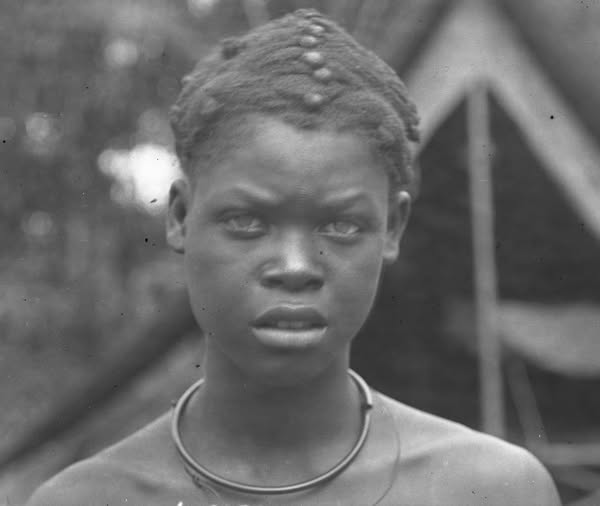
In June 1911, in the town of Nibo, a young Igbo girl named Nwauko stood before the camera of Northcote Whitridge Thomas, a British colonial anthropologist. This singular moment, captured in a monochrome photograph, provides an extraordinary, albeit filtered, window into the daily life and rich cultural expressions of Igbo communities in the Awka District of Southern Nigeria more than a century ago.
Her image is more than just a face from the past. It’s a named connection to an era when British colonial authority was rapidly expanding, and officials were keen to document the societies they sought to govern.
Nwauko of Nibo A Face From a Past Century
While the archive tells us little about Nwauko’s personal story, her preserved name keeps her from being an anonymous “type,” marking her as an individual witness to a pivotal period in Igbo history.
Today, Nwauko of Nibo represents a remarkable bridge to the past. She embodies the resilience and distinct cultural identity of the Igbo people at a time of immense change. Her portrait, taken in a town now located in the Awka South Local Government Area of Anambra State, captures a glimpse of a world both familiar and distant.
In 1911, Nibo was part of the British Protectorate of Southern Nigeria. The idea of a unified Nigeria was still years away from formal amalgamation in 1914. This colonial backdrop shaped the very act of Nwauko’s photograph and how it came to be preserved for future generations.
Northcote Thomas: collecting the fragments of culture
Northcote Whitridge Thomas (1868–1936) arrived in Southern Nigeria in 1909 as the first government anthropologist appointed by the British Colonial Office. His role was deeply embedded in the colonial project. He sought to gather extensive knowledge about African political systems, customary law, language, and social institutions.
Thomas’s extensive fieldwork across the Awka District between November 1910 and December 1911 included towns like Nibo, Awka, Agulu, and Agukwu Nri. He wasn’t just taking pictures; he was assembling a comprehensive, if colonially biased, record. This included thousands of photographs, some 700 wax cylinder sound recordings, and around 3,000 artifacts.
The cultural tapestry: art, body adornment, and identity
The Nwauko of Nibo portrait is part of an archive that vividly depicts specific Igbo cultural practices that have either evolved or, in some cases, faded over time. Among the most striking is *uli*, a traditional art form predominantly practiced by women. Uli designs adorned both the body with dyes and sacred walls with intricate paintings.
These wall paintings, often found on shrines and ceremonial spaces, were inherently temporary, designed to be renewed as surfaces weathered or for approaching festivals. Yet, Thomas’s camera captured these elaborate, ephemeral designs, like those documented at the “Ngene house” in Nibo, now identified as the shrine of Ngene Ngendo.
These images offer an irreplaceable visual record of a vibrant artistic tradition, much like the enduring craft of Nigerian handwoven fabrics continues to tell stories today.
Beyond uli, the archive reveals much about personal and social identity through body adornment. Thomas’s photographs meticulously documented diverse hairstyles and scarification patterns. One Nibo portrait, for example, features a man named Mboye with an elaborate hairstyle echoing uli motifs. Other images display facial scarification, signifying social standing or lineage within the community.
These visual details allow historians and cultural scholars to explore the intricate relationships between art, the human body, architecture, religion, and social life in early twentieth-century Igbo societies. It’s a rich, visual language that speaks volumes about daily existence and communal values, offering parallels to the societal transformations that led to the development of infrastructure like Nigeria’s pre-independence railways.
Colonial lenses and enduring records
Understanding Thomas’s archive demands acknowledging the unequal power dynamics of its creation. He was an agent of a colonial administration, whose anthropological pursuits aimed to facilitate governance. The individuals he photographed, including Nwauko, lived under an expanding imperial system attempting to categorize and control their societies.
Thomas often employed photographic conventions common in early anthropology, such as “physical type” portraits. These involved subjects posed against plain backgrounds, sometimes in profile, intended for comparative documentation of human populations based on then-prevalent European theories. Contemporary perspectives challenge these classifications as products of colonial thought rather than neutral descriptions.
Yet, the colonial context doesn’t negate the archive’s immense historical value. When viewed with a critical eye and integrated with local knowledge, these photographs preserve names, faces, buildings, artworks, and languages. They offer a unique lens to study aspects of African history, fulfilling purposes vastly different from those originally envisioned by colonial administrators.
This dual nature means the collection serves as both a legacy of colonial power and a vital source for reclaiming Nigerian histories.
Reconnecting with the past: the archive as living memory
The meaning and purpose of Thomas’s archive have shifted profoundly over the decades. What were once materials housed in European institutions are now actively being re-examined in collaboration with communities in Nigeria and Sierra Leone. Projects like “Entanglements” have retraced Thomas’s journeys, bringing copies of photographs and sound recordings back to their places of origin.
This collaborative work has been particularly significant in Nibo. Researchers, engaging with contemporary residents, have used Thomas’s 1911 images to identify the Ngene shrine with greater precision. Oral testimonies from Nibo residents have also provided crucial cultural context, explaining nuances that Thomas’s original documentation either missed or inadequately described.
A photograph captures a moment, but it often remains silent on the deeper cultural meanings understood by those pictured. Community knowledge is essential for restoring this missing dimension, allowing a richer understanding of traditions like the innovative Igbo-inspired Ikenga GT design. The archive transforms from a static collection into a dynamic resource for cultural reclamation.
Nwauko’s name: a refusal of anonymity
The story of Nwauko of Nibo resonates because her name itself is an act of historical preservation. Without it, her portrait might be just another anonymous face from early 20th-century Igboland. With her name, however, the image transcends mere ethnographic record to become a tangible link to a specific person who stood before Thomas’s camera.
We know little about Nwauko’s personal journey beyond that moment. We don’t have details of her family, her age, or what became of her. But the survival of her name is profoundly important. It prevents her from being reduced to an undifferentiated “colonial type,” allowing her to be remembered as an individual.
This simple act of naming offers a powerful counter-narrative against the often-impersonal nature of colonial documentation.
Her photograph, alongside the broader Thomas collection, serves as a crucial historical document. It preserves intricate details of clothing, hairstyles, body decoration, architecture, and social spaces that written colonial reports frequently overlooked.
More than a century later, names recorded in these registers can, in some cases, reconnect these images with direct descendants, offering a pathway to reclaim and reinterpret a shared past, anchoring it in human experience.
