




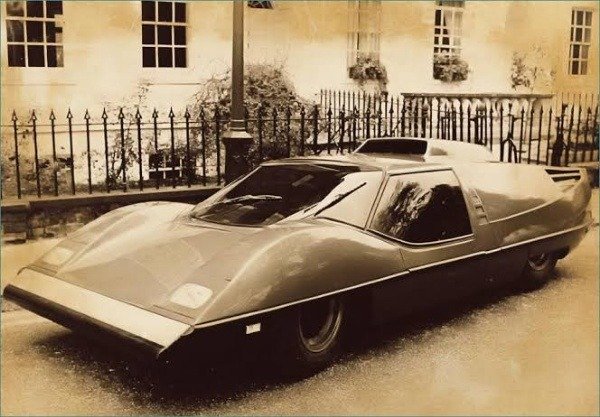
In the bustling London automotive scene of the late 1960s, David Gittens’ visionary project took shape, uniting experimental engineering with a profound cultural statement through the groundbreaking Ikenga GT design.
More than just an exotic sports car, the Ikenga GT was a mobile research platform. It integrated advanced ideas like closed-circuit television for rear vision and a movable steering wheel. Crucially, its very name, Ikenga, drew directly from Igbo tradition in southeastern Nigeria, symbolising personal achievement and individual accomplishment, a concept deeply rooted in Gittens’ own ancestral heritage.
The roots of the Ikenga GT design vision
David Gittens, born in Brooklyn, New York, in 1939, carved out a multifaceted career spanning art, photography, and design. Before his venture into automotive experimentation, he was a staff photographer for Car and Driver magazine from 1958 to 1964, capturing the essence of sports-car racing.
His deep fascination with automobiles persisted even after he relocated to London in 1964. There, Gittens established a photography studio, immersing himself in the fashion and advertising industries. Yet, cars remained a constant preoccupation, with sketches of future designs perpetually adorning his studio walls.
Gittens harboured a strong desire to establish an experimental design operation in Britain. He envisioned a system inspired by the collaborative spirit between independent designers, coachbuilders, and manufacturers prevalent in the Italian automotive industry, hoping to bridge worlds of design.
The pivotal figure in translating these concepts from paper to metal was Charles Williams, a highly skilled coachbuilder associated with Williams & Pritchard in North London. Williams’ craftsmanship proved indispensable in bringing Gittens’ radical designs to life.
Evolution of a unique design system: Mark I to Mark III
The Ikenga GT project began with a significant acquisition: a McLaren-Elva Group 7 chassis from engineer Ken Sheppard. This high-performance racing foundation, originally housing a Traco-Oldsmobile engine, was repurposed by Gittens for his road-oriented experimental venture. For the MkI, Gittens’ project records confirm a 3.5-liter Rover V8 engine, originally a General Motors Buick design.
The first incarnation, the MkI, debuted in 1967. It presented a strikingly low and dramatic profile, deliberately unconventional in its aesthetic. Charles Williams was instrumental in meticulously forming Gittens’ ideas and models into the car’s distinctive aluminium bodywork, making visual identity paramount.
By 1968, Gittens had substantially refined the car, unveiling the MkII. This iteration featured a more elaborate interior, complete with luxurious leather trim and specially fitted luggage, enhancing its grand touring capabilities. The bodywork itself underwent further evolution, reflecting Gittens’ continuous experimentation with its form and appearance.
The final transformation arrived in 1969 with the MkIII. This version adopted a cleaner, sharper wedge profile, a characteristic stylistic shift seen in high-performance designs of the late 1960s and early 1970s. These three successive forms showcased the continuous development of a single, underlying experimental automobile, a testament to its iterative design system.
Igbo cultural identity in automotive form
The name Ikenga GT was far from an arbitrary choice; it formed the very core of the car’s identity. Ikenga holds immense significance within the Igbo spiritual and artistic tradition of Nigeria. Historically, these shrine figures symbolise personal achievement, determination, and the accomplishments of an individual, often represented by the right hand and sometimes incorporating ram’s horns for strength.
David Gittens consciously connected the car’s name to his ancestral Igbo heritage. He sought to embed this powerful cultural concept of individual success directly into the project. This fusion of automotive innovation and cultural symbolism allowed Gittens to give voice to his Nigerian cultural narrative.
But the cultural influence extended beyond the name. Gittens deliberately incorporated African visual inspiration into the car’s physical form. He described the MkI, when viewed from above, as resembling an African mask facing upwards, with the canopy suggesting the eyes, a raised intake forming the nose, and the rear section completing the stylised facial impression.
This deep integration of African identity gave the Ikenga a truly distinctive position in European experimental automotive design history. It was a project where a Brooklyn-born American designer, working with British craftsmen and a racing chassis, confidently placed an Igbo cultural concept at its very heart.
Pioneering technology and future concepts
The Ikenga GT captured attention not only for its striking aesthetics but also for its array of forward-thinking technological features. Accessing the cockpit involved a pneumatically operated canopy, with a mechanical override system ensuring functionality. This innovative entry method underscored its experimental nature.
Rear visibility, often compromised by radical body designs, was ingeniously addressed. Gittens integrated a closed-circuit television system, featuring a camera that provided a clear rearward view. This was an exceptionally rare feature for a road-going car in the late 1960s, anticipating technology that would become common decades later.
The car also boasted a swing-away steering wheel, significantly easing entry and exit for the driver. Furthermore, Gittens engineered considerable luggage capacity behind the rear axle assembly, an unusual yet practical consideration for such an avant-garde design.
The MkIII model specifically measured a wheelbase of 92 inches (2,337 mm), a length of 163 inches (4,140 mm), a width of 70 inches (1,778 mm), and a remarkably low height of just 38 inches (965 mm) dry. Its curb weight was a nimble 1,800 lbs (816 kg).
As the project progressed, Gittens continued to explore additional technological frontiers. His ideas included a luminescent roof lining, fluorescent interior lighting, electronic warnings for road conditions, and collision-warning concepts. He even considered ultrasonic proximity sensing, pushing the boundaries of what was conceivable for a vehicle of its era.
This system had an estimated 325 hp (242 kW) and could hit 0-60 mph in 5 seconds, reaching a top speed of 160-162 mph (260 km/h).
The Ikenga was never merely a showpiece; it functioned as a dedicated research vehicle. It allowed David Gittens and his collaborators to test new approaches to styling, electronics, and overall road-car design, laying groundwork for future innovations in the automotive industry.
Public debut and international recognition
The MkII model of the Ikenga GT garnered significant public attention during the period of the 1968 British motor show. While experimental one-off cars often struggled to find official platforms within the British motor-show establishment, the Ikenga found an alternative spotlight.
Instead of the traditional Earls Court Motor Show, the Ikenga was prominently displayed at Harrods in London. This strategic exhibition brought the car before a vast public audience and generated considerable press coverage for David Gittens and his innovative design project.
American interest quickly followed. In April 1969, the MkII received extensive coverage in Car and Driver magazine, which memorably hailed it as the “World’s Wildest Street Racer.” Ebony magazine also dedicated a substantial feature to Gittens and the Ikenga in its September 1969 issue, highlighting his broader creative and technological interests within his London studio.
Setback and completion of the Mark III
The Ikenga project faced a major challenge in 1969 with the sudden death of Charles Williams. Williams had been the indispensable coachbuilder, translating Gittens’ creative concepts and models into tangible aluminium forms. His passing threatened to derail the ambitious design enterprise.
Determined to complete the latest version, Gittens moved the unfinished MkIII to Harold Radford’s coachworks in Chiswick. There, Gary Williams, unrelated to Charles Williams, along with sports-car builder Roger Nathan, helped ensure the vehicle’s completion. Radford handled the intricate interior and finishing work on the aluminium body, which was formed over a tubular steel frame.
Despite the significant disruption, the MkIII was finished in time for a major television appearance. In October 1969, it featured on the BBC programme Tomorrow’s World, a show dedicated to showcasing new technology and ideas about the future. Though a momentary starting issue required the car to be pushed onto the set at the BBC studios, its impact was undeniable.
A global journey and lasting influence
After its BBC debut, Gittens took the Ikenga MkIII on an international tour. It traveled to Paris for filming before making its way to Italy. In November 1969, the car appeared at the prestigious Turin Motor Show, a fitting venue for the kind of independent automotive experimentation that had inspired Gittens’ vision.
This was a critical time for Nigerian industry, seeking global connections and innovation.
The Ikenga then journeyed to Sweden, where it was featured at the Swedish International Motor Show in Stockholm in 1970. By this stage, the car transcended the ambition of merely creating a production sports car; it functioned as a moving exhibition, demonstrating Gittens’ innovative ideas about styling, technology, and the vast possibilities available to independent designers.
While plans for limited production of approximately 100-150 units, each estimated to cost around £9,000, never materialised into a sustained manufacturing operation, the sole Ikenga prototype survived. Its later history saw it displayed at the Manx Motor Museum, and it was sold at auction in 1998 and again in 2008 to a buyer in the Middle East, its precise current location now largely unknown.
David Gittens continued his design pursuits. Decades after the automotive project, he revisited the Ikenga name for an innovative gyroplane, the Ikenga 530Z, which later became part of the Smithsonian National Air and Space Museum’s collection.
This aircraft echoed the same creative spirit as the car: unconventional engineering, industrial design, and a dedication to combining technology with a distinctive personal vision, a hallmark of the Ikenga GT design.
The enduring impact of a cultural artifact
The Ikenga GT holds a truly singular place in automotive history. It cannot be neatly categorised as solely a British sports car, an American design project, or an African cultural statement, but rather a powerful synthesis of all three. Its creation narrative is a compelling system of collaboration and inspiration.
A Brooklyn-born designer, working in London with British specialists, acquired a McLaren racing chassis and named his creation after a vital Igbo concept. This confluence of global influences resulted in a vehicle that was technically advanced for its era, pushing boundaries with features like closed-circuit rear vision and a movable steering wheel.
Though never mass-produced, and despite the tragic loss of Charles Williams, the Ikenga journeyed across Europe and gained international recognition, appearing on television and in prominent magazines. Its true significance lies not in sales figures, but in its symbolic power as an experimental system.
It represented a unique moment where racing engineering, specialist British craftsmanship, American creative ambition, and Igbo cultural identity converged to produce one of the most distinctive automotive projects of the 1960s, offering a glimpse into how culture can profoundly shape technological innovation.
